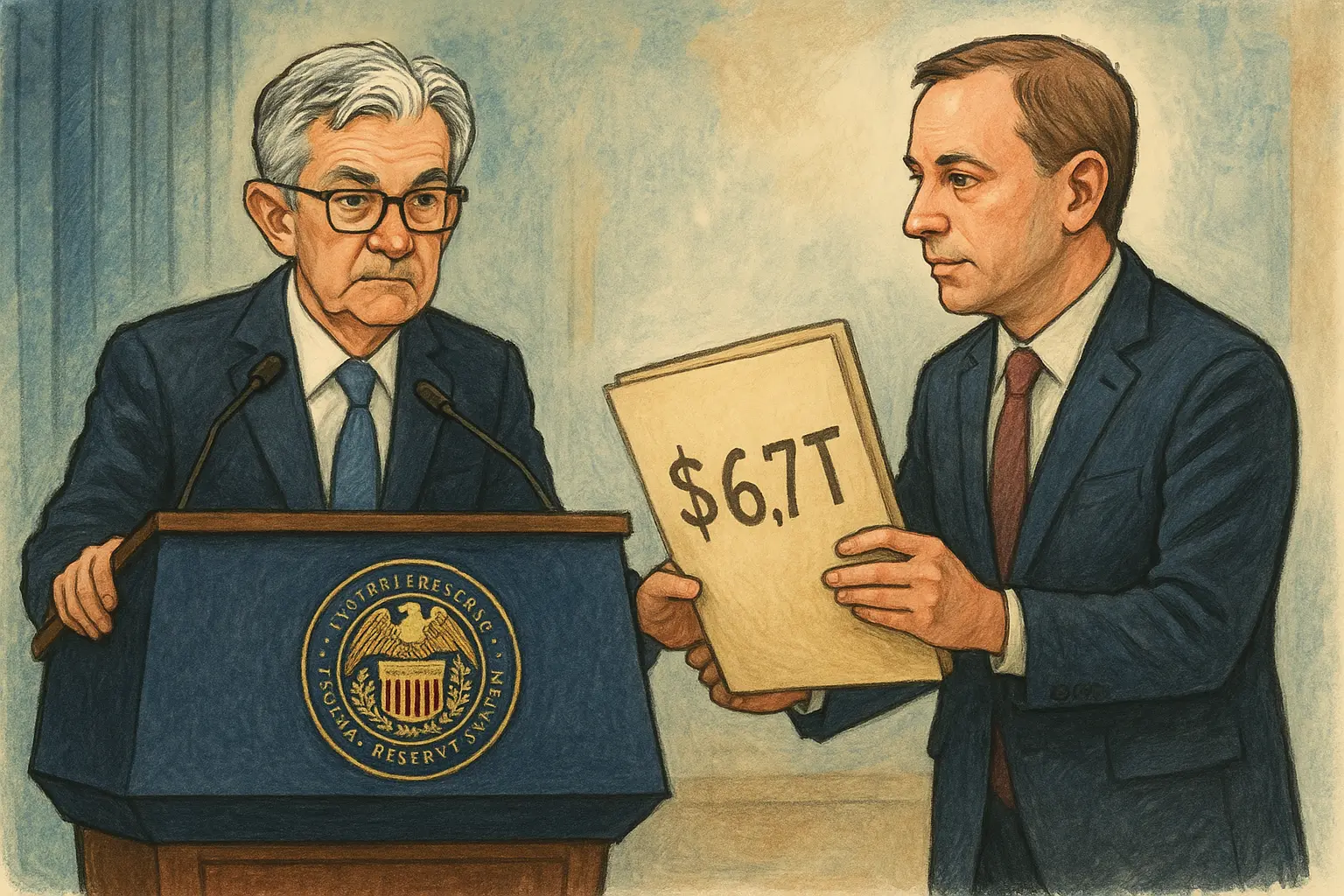
Federal Reserve (Fed) Chair Jerome Powell will preside over his final Federal Open Market Committee (FOMC) press conference of his tenure on April 29 (Wednesday), bringing an end to his eight-year chairmanship. After being succeeded by Kevin Warsh, the nominee from Trump, he will face a policy environment marked by a 6.7 trillion U.S. dollar Federal Reserve balance sheet and a resurgence in inflation.
Powell’s Major Policy Highlights
According to the Fed’s publicly available records, when Powell took over as chair in February 2018, he inherited an environment in which interest rates were about 1.5%, overall inflation was close to the 2% target, and the balance sheet had already been縮减 as planned.
COVID-19 response in 2020: According to Fed announcements, within less than three weeks the Fed cut rates to zero, restarted its asset purchase program, and launched nine emergency lending facilities. Wall Street Journal reporter Nick Timiraos said: “Powell held up against some moderate hawkish resistance during the sweeping emergency rate cut on March 15, 2020.” During this period, the Fed’s balance sheet expanded to 9 trillion U.S. dollars, and according to market data, Bitcoin rose over the same span from about $5,000 to more than $69,000 in November 2021.
Tightening cycle: Powell subsequently carried out the most aggressive rate-hike cycle since Paul Volcker, taking the policy rate from zero to 5.5% without triggering a severe economic recession or a collapse in the labor market.
2024 remarks on digital assets: At the DealBook summit, Powell said: “It’s like gold, only it’s virtual… It’s not a rival to the dollar; it’s a rival to gold.” According to market data, those remarks pushed Bitcoin above $103,000 that day.
Policy missteps: delayed rate hikes and the collapse of three regional banks
According to public records, in 2021 Powell adopted “transitional inflation” language, only officially launching rate hikes in March 2022, when CPI had already exceeded 7%. When Kevin Warsh testified before the U.S. Senate Banking Committee on April 21, 2026, he said: “Once inflation takes root in the economy, the cost and difficulty of suppressing it are higher, which is why the fatal policy mistake from four or five years ago is still a legacy problem we are dealing with today… We need to fundamentally change how policy is made.”
After that, the Fed raised rates 11 times over 16 months. According to public reports, Silicon Valley Bank (SVB), Signature Bank, and First Republic Bank all failed in March 2023 in succession due to long-term U.S. Treasury losses.
Public policy stance after Warsh took office
Based on Warsh’s public statements at the confirmation hearing, his key policy priorities include:
· Pushing a new inflation framework, suggesting a possible end to the FOMC press conference tradition after meetings, and pledging not to act as a “puppet” of any political force
· Accelerating quantitative tightening (QT), reducing the 6.7 trillion U.S. dollar Fed balance sheet
· Calling Bitcoin a “sustainable store-of-value mechanism,” ruling out the possibility of launching a retail central bank digital currency (CBDC)
· Disclosing holdings of more than $100 million in assets, covering Layer 1 networks, decentralized finance (DeFi) protocols, and Bitcoin payment infrastructure
Based on the Fed’s dot plot in March and data from the CME FedWatch tool, policymakers expect to cut rates only once each in 2026 and 2027, and the 2026 core personal consumption expenditures (PCE) growth forecast has been raised from 2.4% to 2.7%.
Frequently Asked Questions
When is Powell’s final FOMC press conference scheduled, and what is the current interest rate level?
According to the Fed’s published schedule, Powell is set to host his final FOMC press conference on April 29, 2026 (Wednesday). As of this meeting, the target range for the federal funds rate has been kept at 3.50% to 3.75% for the third straight time, and March CPI is 3.3%.
How does Kevin Warsh assess Powell’s monetary policy legacy?
According to Warsh’s public testimony submitted to the U.S. Senate Banking Committee on April 21, 2026, he called the delayed rate hikes in 2021 a “fatal policy misstep,” emphasized that once inflation takes root it becomes harder to restrain, and said there is a need to “fundamentally change how policy is made.”
What public positions does Warsh take on digital assets, and what does his personal holdings disclosure show?
Based on public records from the confirmation hearing, Warsh said Bitcoin is a “sustainable store-of-value mechanism,” and ruled out the possibility of launching a retail CBDC. Warsh also disclosed holding more than $100 million in assets, covering Layer 1 networks, DeFi protocols, and Bitcoin payment infrastructure.
Disclaimer: The information on this page may come from third parties and does not represent the views or opinions of Gate. The content displayed on this page is for reference only and does not constitute any financial, investment, or legal advice. Gate does not guarantee the accuracy or completeness of the information and shall not be liable for any losses arising from the use of this information. Virtual asset investments carry high risks and are subject to significant price volatility. You may lose all of your invested principal. Please fully understand the relevant risks and make prudent decisions based on your own financial situation and risk tolerance. For details, please refer to
Disclaimer.
Related Articles
Five Central Banks to Hold Policy Meetings This Week; Monetary Decisions Expected to Drive Markets
Gate News message, April 27 — Five major central banks—the Bank of Japan, Bank of Canada, U.S. Federal Reserve, Bank of England, and European Central Bank—will hold policy meetings this week, with monetary policy decisions expected to be the primary market driver, according to Asger Wilhelm
GateNews28m ago
Republican Sen. Tillis: The criminal investigation into Powell is over; it will no longer block Wash from serving as chair.
Republican Sen. Tom Tillis posted on the X platform on Sunday, announcing that after the U.S. Department of Justice (DOJ) concluded its criminal investigation into Federal Reserve Chair Jerome Powell’s involvement in the Federal Reserve headquarters renovation project, he will no longer block the procedure for confirming Kevin Warsh’s nomination as Federal Reserve chair, and said he is “looking forward” to supporting Warsh’s appointment.
MarketWhisper47m ago
U.S. Treasury Yields Rise Amid Middle East Tensions; Fed Rate Decision Looms This Week
Gate News message, April 27 — U.S. Treasury yields climbed during Asian trading hours on April 27, with the 2-year yield rising 2.3 basis points to 3.798% and the 10-year yield gaining 1.4 basis points to 4.323%, according to Tradeweb data. Persistent Middle East tensions kept oil prices elevated, w
GateNews1h ago
U.S.-Iran talks collapse triggers a sharp drop in gold prices, while Bitcoin quickly surges past $79k
Bitcoin rose above $79,000 during the Asian trading session on April 27. At the same time, the spot gold price fell to a low of $4,672.11 per ounce, with an intraday decline of more than $38. The backdrop is that U.S. President Trump canceled the itinerary of his special envoy to Islamabad, Pakistan, and the U.S.-Iran peace negotiations have hit a stalemate. Federal Reserve Chair Powell is scheduled to preside over his final news conference of his tenure at the Federal Open Market Committee (FOMC) on April 29.
MarketWhisper5h ago
DOJ Drops Probe into Powell, Clearing Path for Crypto-Friendly Kevin Warsh to Lead Fed
Gate News message, April 26 — The U.S. Department of Justice has dropped its criminal investigation into Federal Reserve Chair Jerome Powell, clearing the way for the Senate to confirm Kevin Warsh as the next Fed chair. U.S. Attorney for the District of Columbia Jeanine Pirro announced the
GateNews8h ago
Fed Holds Rates Steady in April With 100% Probability; June Rate Cut Odds at Just 4.7%
Gate News message, April 26 — According to CME FedWatch, the probability of the Federal Reserve holding rates steady in April stands at 100%. Looking ahead to June, the odds of a cumulative 25-basis-point rate cut are just 4.7%, while the probability of maintaining rates unchanged is 95.3%.
The dat
GateNews11h ago


