*Data last updated: 2026-04-07 23:02 (UTC+8)
As of 2026-04-07 23:02, International Paper Co (IP) is priced at $34,54, with a total market cap of $18,28B, a P/E ratio of -5,91, and a dividend yield of %5,35. Today, the stock price fluctuated between $34,19 and $34,71. The current price is %1,02 above the day's low and %0,48 below the day's high, with a trading volume of 4,67M. Over the past 52 weeks, IP has traded between $33,88 to $36,47, and the current price is -%5,29 away from the 52-week high.
IP Key Stats
About IP
Learn More about International Paper Co (IP)
Gate Learn Articles
IP (IP) — On-chain IP Creation and Management Infrastructure
Story Protocol has built a dedicated blockchain architecture centered on intellectual property (IP), using a modular layered design and a multi-core execution environment to solve the performance bottlenecks and functional deficiencies traditional blockchains face in complex IP management.
2025-02-11
Story Protocol: Making IP Programmable Through Blockchain
Story Protocol is an innovative blockchain project aiming to reshape intellectual property (IP) management. By placing IP rights on-chain and enabling programmability, the protocol provides new monetization pathways and value expansion opportunities for creators. Integrating blockchain, IP, and AI technologies, Story Protocol builds an infrastructure layer featuring an open IP repository and multifunctional modules. The project seeks to bridge the Web2 and Web3 worlds while fostering a new on-chain IP ecosystem. With the mainnet launch approaching, Story Protocol is set to create new growth opportunities for the crypto industry.
2024-10-17
Leading the new wave of crypto with programmable IP
This article introduces Story Protocol, which creates a new way to release creativity and liquidity by transforming IP (intellectual property) into a network that can span across media and platforms. Today, as generative artificial intelligence promotes the unlimited expansion of creativity, the protection and development of IP are facing unprecedented challenges. Story Protocol has established a programmable IP layer that allows creators to combine, reconstruct and monetize their works through on-chain rules. It truly transforms code into law and leads a wave of onchain art renaissance..
2024-03-04
Blogs
Audiera (BEAT) In-Depth Analysis: From 600 Million User IP to Web3 Transformation—On-Chain Data and Value Dynamics
Audiera (BEAT) is currently trading at $0.4104. Drawing on the latest on-chain data, this article reviews its evolution from a classic gaming IP to Web3, analyzes market sentiment and key points of controversy, and explores multiple scenarios for ecosystem development.
2026-03-13
How The PENGUIN NFT Market Mechanism Drives Token Value And Ecosystem Growth
Explore how PENGU drives token value through IP commercialization, retail revenue, tokenomics design, ecosystem partnerships, and price dynamics.
2026-02-27
How Is Polymarket Leading the Prediction Market? Unpacking the Growth Strategy Behind Sports IP and 90% of Trading Volume
A dynamic probability curve is quietly emerging from the cryptocurrency sector, steadily integrating into platforms like Google Finance and Bloomberg Terminal. It’s becoming a new benchmark for Wall Street giants as they bet on the future.
2026-01-29
International Paper Co (IP) FAQ
What's the stock price of International Paper Co (IP) today?
What are the 52-week high and low prices for International Paper Co (IP)?
What is the price-to-earnings (P/E) ratio of International Paper Co (IP)? What does it indicate?
What is the market cap of International Paper Co (IP)?
What is the most recent quarterly earnings per share (EPS) for International Paper Co (IP)?
Should you buy or sell International Paper Co (IP) now?
What factors can affect the stock price of International Paper Co (IP)?
How to buy International Paper Co (IP) stock?
Risk Warning
Disclaimer
International Paper Co (IP) Latest News
NFT market shakeup: scarcity loses its edge—IP-driven strategies and the shift to gaming determine who can make it to the end
Gate News update: The NFT market is undergoing a deep restructuring, and a small number of projects are beginning to shift from speculative assets to sustainable brand and intellectual property (IP) operating models. Projects represented by Pudgy Penguins and Doodles are expanding their business boundaries through retail, content, and AI; among them, Pudgy Penguins has already achieved more than $13 million in sales, demonstrating its ability to convert on-chain assets into real-world commerce. The industry is currently showing clear segmentation. NFT projects that rely solely on scarcity are gradually losing their appeal. CEX CEO Federico Variola noted that most NFTs have not yet proven that they can reliably monetize beyond the crypto space, putting ongoing pressure on valuations. Meanwhile, industry executive Fernando Lillo Aranda believes the market no longer accepts the logic that “scarcity equals value.” Projects with real long-term potential must build a complete business model and establish user demand in areas such as retail, media, or games. A similar shift is also taking place in the gaming sector. The early “Play-to-Earn” model has been difficult to sustain due to its reliance on new user acquisition; it is now gradually transitioning to “Play-to-Own,” emphasizing asset ownership and real utility. Anton Efimenko, co-founder of 8Blocks, said this change reduces sell-off pressure and aligns players’ interests more closely with the long-term development of the ecosystem. At the same time, NFT IP tokenization is becoming a new trend. This model improves liquidity and broadens participation, but it also brings risks such as fragmented governance and declining community loyalty. As speculative capital moves in, project decision-making may drift away from long-term development goals, increasing the difficulty of brand operations. Overall, the NFT industry is entering a selection phase. Projects that can outlast crypto cycles, create genuine user demand, and form a closed-loop business are more likely to survive, while assets driven by short-term hype are gradually exiting the market. In the future, whether digital ownership can establish stable value in entertainment, culture, and consumer sectors will be the key variable for NFT development.
2026-04-02 01:07ARIA (Aria) up 25.33% in the past 24 hours
Gate News message. On April 2, according to Gate market data, as of the time of writing, ARIA (Aria) is trading at $0.43. It is up 25.33% over the past 24 hours, reaching a high of $0.50 and dropping to a low of $0.33. The 24-hour trading volume is $1.6239 million. The current market cap is approximately $77.947 million. Aria.AI is a next-generation game development and publishing experiment. Its inspiration comes from a Disney-style immersive world and AI technology, and it is designed around game mechanics related to its own IP. It represents a major leap to bring Web2-quality game design and publishing standards (combined with AI execution) into the Web3 era. As an open-world mobile game, Aria invites players to explore the world of Fudonia, earn rewards through a Play to Earn mechanism, and mint an ARIA Wishfont Pass to accelerate advancement up the rankings. The project has received support from multiple well-known investment institutions, including Folious Ventures, The Spartan Group, and Merit Circle. This news is not investment advice. Investing involves risks, including market volatility.
2026-03-31 02:02Steakhouse Financial: The official website is temporarily offline, but the vault is running normally. The attack originated from social engineering that compromised an OVH account.
Gate News reports that on March 31, the DeFi project Steakhouse Financial provided the latest update regarding the recent security incident. The Steakhouse.financial website remains offline; DNS records point to a blank page, but the Steakhouse Vaults website is fully operational and can be accessed directly through a certain DeFi protocol. Deposits, withdrawals, and all vault functions are functioning normally; users will receive confirmation messages once the frontend is restored. Steakhouse disclosed that the attack originated from a telephone social engineering attack targeting OVH Cloud. The attacker gained domain management permissions for steakhouse.financial, redirected the DNS A records of the main website and the app subdomain to a malicious IP, and attempted to initiate a domain transfer with a 5-day lock period. The official statement confirms that all related changes have been rolled back; currently, the domain records have been temporarily reset to blank. The vaults, smart contracts, and all deposited funds remain unaffected, ensuring user assets are secure.
2026-03-25 08:05The Safest Middleman in the Chip Industry Takes the Most Dangerous Path
Between 4 billion dollars and 15 billion dollars, what lies between is not a growth curve but a self-revolution in business models. On March 24, Arm announced its first self-developed data center CPU in its 35-year history. Named AGI CPU, this chip features 136 Neoverse V3 cores, TSMC’s 3nm process, 300W TDP, with Meta as the first customer, planning large-scale deployment within the year. Also announced were collaborations with OpenAI, Cerebras, Cloudflare, SAP, and SK Telecom. Arm CEO Rene Haas provided a set of target figures at the launch, stating that the chip business aims to reach $15 billion in annual revenue by 2031, with the entire company’s total revenue at $25 billion and earnings per share of $9. What does this mean? Arm’s total revenue for FY2025 (ending March 2025) is $4.007 billion, according to Arm’s annual report, with licensing income of $1.839 billion and royalty income of $2.168 billion, and a gross margin of 97%. In other words, a company with $4 billion in annual revenue is expected to grow nearly to the scale of Intel’s entire data center division within five years based on a new business. According to Intel’s Q4 2024 financial report, Intel’s Data Center and AI (DCAI) division will generate $12.8 billion in revenue for 2024. 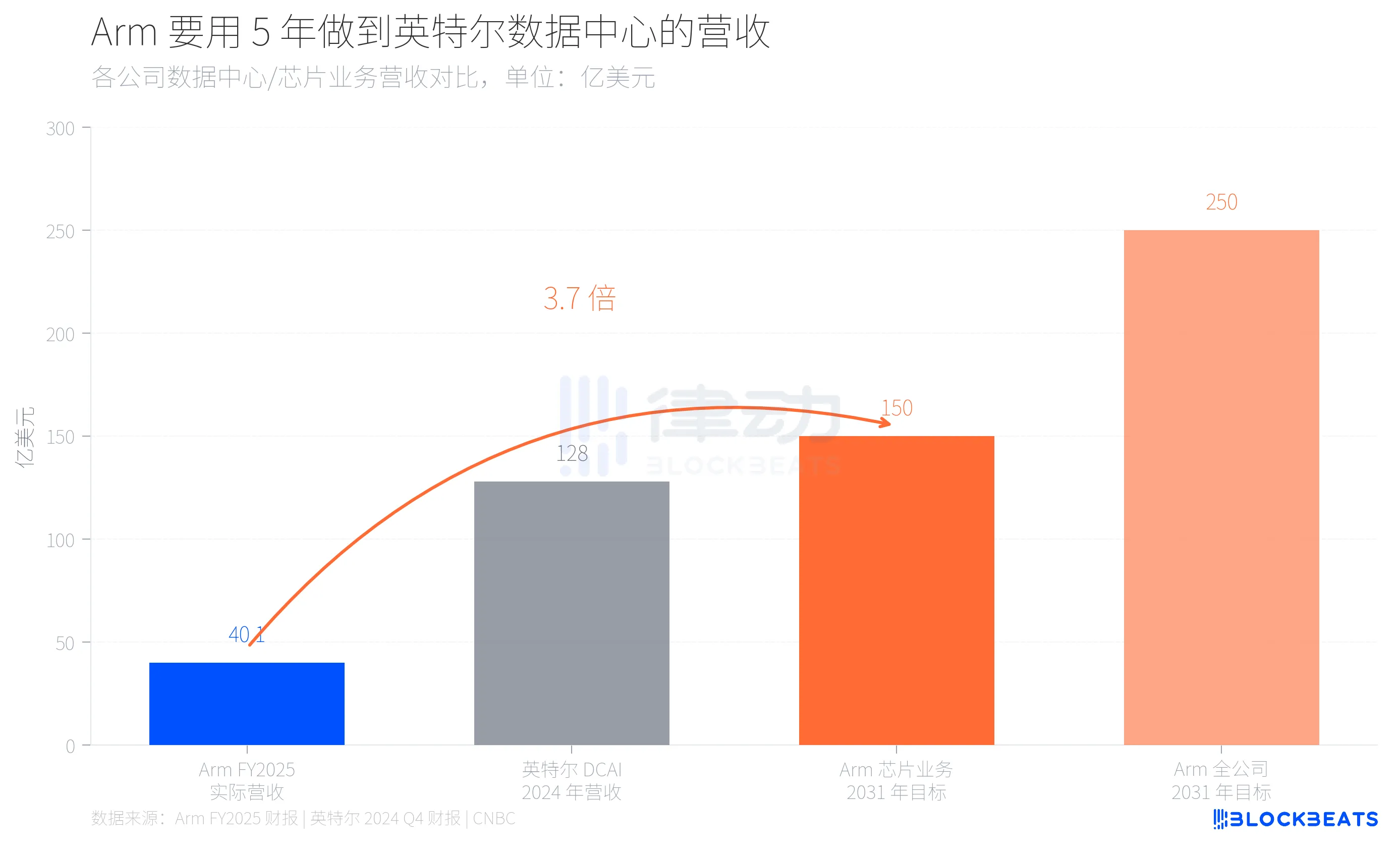 From $4 billion to $15 billion, a 3.7x leap, behind which is Arm’s attempt to transform from a pure IP licensing company into a hybrid that sells both design blueprints and finished products. This has no precedent in the chip industry. Why is Arm taking this risk? The answer lies in its customer list. Over the past three years, Arm’s largest data center clients have been doing the same thing. According to publicly available data from AWS, Amazon has migrated over 50% of its EC2 compute capacity to its self-developed Graviton chips, with the latest Graviton5 reaching 192 cores. Google Cloud disclosed that its Axion chips have migrated over 30,000 internal applications, improving efficiency by 80%. Microsoft’s Cobalt 200, based on Arm Neoverse architecture, uses TSMC’s 3nm process and has 132 cores. 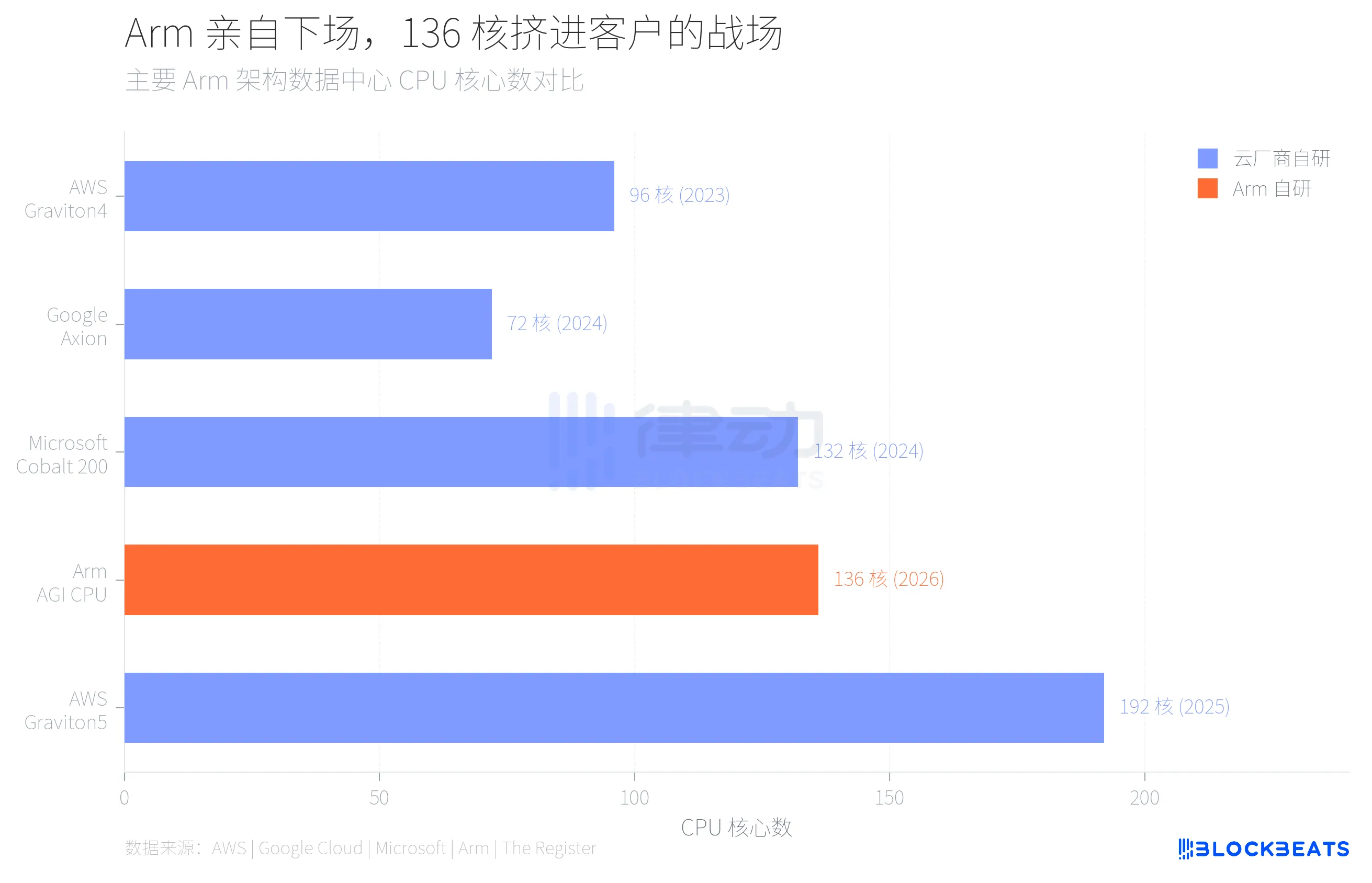 These cloud providers are using Arm architecture licenses, but the chips are designed, fabricated, and deployed by themselves. Arm earns licensing fees and royalties, not chip profits. As more computing power is absorbed by these self-developed chips, Arm’s revenue ceiling in data centers becomes increasingly clear. Looking at Arm’s revenue structure over the past four years, the outline of this ceiling becomes more concrete. According to Arm’s financial reports, from FY2022 to FY2025, the company’s total revenue grew from $2.7 billion to $4 billion, with an average annual growth of about 14%. Royalties increased from $1.562 billion to $2.168 billion, and licensing income from $1.141 billion to $1.839 billion. The growth rate of royalties has slowed to around 20%, largely driven by upgrades to the mobile Armv9 architecture, not data center developments. 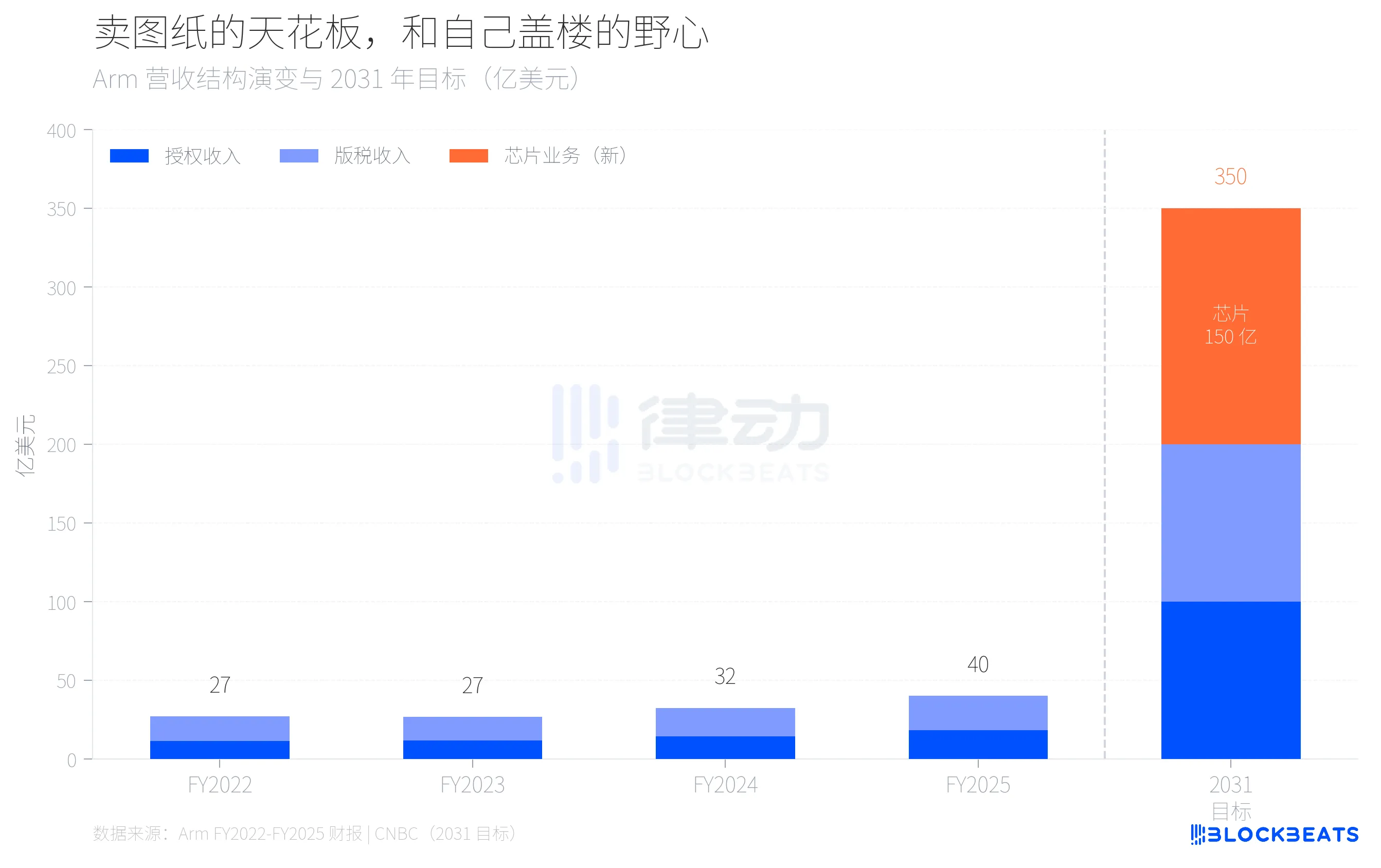 Extrapolating this growth rate, even if licensing and royalty income grow about 20% annually, the total would reach only around $10 billion by 2031. The remaining $15 billion must come from a new business that doesn’t yet exist today. This is the arithmetic behind Arm’s decision to build its own chips. Choosing to develop chips in-house essentially means competing with its own customers. A company that sells blueprints starts building its own buildings, while its blueprint buyers have been constructing for years. This is the real background of the 136-core AGI CPU. According to The Register, this chip has a base frequency of 3.2 GHz, up to 3.7 GHz, 12 DDR5 memory channels, 6 GB/s bandwidth per core, 96 PCIe 6.0 lanes, and supports CXL 3.0. Arm positions it as “the computing foundation for the agentic AI cloud era,” focusing on CPU-side task scheduling and data flow management in AI inference, not directly competing with GPUs. The pace of market share change also tells the story. According to Omdia, by 2025, Arm-based servers will account for about 21% of global shipments, with a 70% growth rate. But within hyperscale data centers, this share is already close to 50%. The 40-year monopoly of x86 isn’t collapsing but being replaced chip by chip. The risk of Arm’s self-developed chips isn’t technological but relational. Meta’s willingness to be the first customer is partly because Meta itself lacks a mature in-house chip project like Amazon or Google. But how will Amazon, Google, and Microsoft view this? If a supplier starts competing for your business, will you still entrust it with your most core architecture licensing? Arm’s gamble is that the overall growth of the data center market outpaces the deterioration of customer relationships. Rene Haas clearly believes that the incremental demand for CPUs in the AI era is large enough for self-developed chips and architecture licensing to coexist. The $15 billion target is a pricing of this judgment. Selling blueprints for 35 years, now building its own buildings for the first time. The blueprints are still being sold, and the buildings are being constructed—only whether they can fit on the same land remains to be seen. Click to learn more about Rhythm BlockBeats job openings. **Join the Rhythm BlockBeats official community:** Telegram Subscription Group: https://t.me/theblockbeats Telegram Group Chat: https://t.me/BlockBeats_App Twitter Official Account: https://twitter.com/BlockBeatsAsia
2026-03-25 02:37ARIA (Aria) increased by 26.60% over 24 hours
Gate News reports that as of March 25, according to Gate market data, ARIA (Aria) is currently priced at $0.31, up 26.60% in the past 24 hours, with a high of $0.32 and a low of $0.23. The 24-hour trading volume reached $1,135,200. Its current market capitalization is approximately $57.64 million. Aria.AI is a next-generation game development and publishing experiment inspired by Disney-style immersive worlds and AI technology, designed around its proprietary IP-based gameplay. It represents a significant leap in bringing Web2-quality game design and publishing standards—integrated with AI execution—into the Web3 era. Aria has launched an open-world mobile gaming experience where players can explore the world of Fudonia, with each character having a unique backstory. The platform supports players earning rewards and minting ARIA Wishfont Passes to accelerate progress. Currently, Aria has received angel funding from well-known investors such as Fish 8, PartyHatDao, and Hidden Street Cap. Its partners include Folios Ventures, The Spartan Group, Merit Circle, and other industry-leading organizations. This news does not constitute investment advice. Investors should be aware of market volatility risks.
Hot Posts About International Paper Co (IP)