Why Custody Is Key for Institutional Entry
In the crypto market, there is a classic saying: "Not your keys, not your coins." This means whoever controls the private key truly controls the assets—a significant difference from traditional finance. Traditional assets typically rely on accounts and legal frameworks to confirm ownership, while crypto assets depend more on cryptographic control. For institutions, custody is not just about fund security; it also affects internal compliance, audit requirements, risk control, and investor trust.
Especially for fund companies, public enterprises, banks, and asset management institutions, asset management is not only a technical issue but also involves legal responsibilities and fiduciary duties. As the crypto market becomes increasingly institutionalized, custody systems have become one of the most critical infrastructures. Without mature and trustworthy custody mechanisms, it is difficult for the crypto market to truly attract long-term institutional capital.
Hot Wallets, Cold Wallets, and Multi-Signature Mechanisms
In crypto asset management, a wallet is not simply an app for storing assets; its essence is a tool for managing private keys.
Depending on whether the private key is connected to the internet, wallets are generally divided into two types:
Hot Wallet
A hot wallet is constantly connected to the internet, allowing for fast transactions and real-time operations.
Advantages include:
However, due to being always online, hot wallets are more susceptible to:
-
Hacker attacks
-
Network vulnerabilities
-
Phishing risks
As a result, most institutions do not keep large amounts of core assets in hot wallets for long periods.
Cold Wallet
A cold wallet is usually kept offline, with the private key not directly exposed to online environments.
This approach is better suited for long-term asset storage due to its higher security.
However, cold wallets also have:
Therefore, institutions often use a "hot-cold separation" structure:
In addition to hot and cold wallets, multi-signature (multi-sig) mechanisms are also a key component of institutional custody.
Multi-sig means that a transaction requires signatures from multiple authorized parties before execution.
For example:
-
Out of 5 managers, at least 3 must approve
-
Or different departments conduct review and authorization separately
The core purpose of this design is to prevent:
For large institutions, multi-sig mechanisms essentially rebuild an "internal approval system" on-chain similar to traditional finance.
Qualified Custody and Risk Control Framework
As the scale of institutional funds grows, technical security alone is no longer sufficient. Institutions are increasingly concerned with whether the custody system meets regulatory and audit requirements. Thus, qualified custody has gradually become an important direction for the industry.
Unlike ordinary wallet services, qualified custodians usually must have:
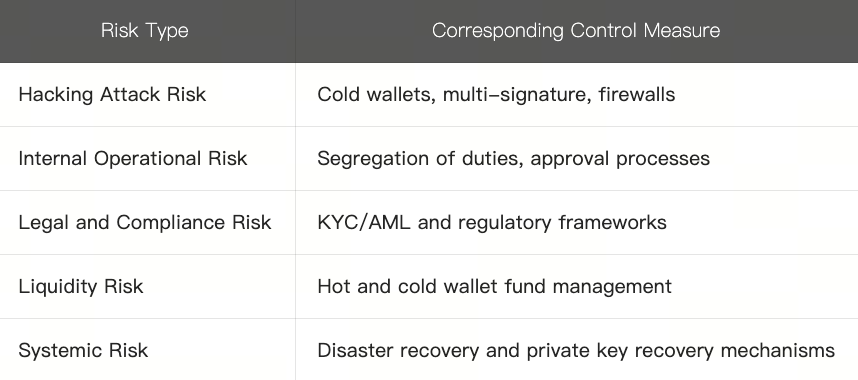
From a risk control perspective, institutional custody systems typically cover:
How to Build Market Trust for Institutional-Grade Infrastructure
For institutional funds, market trust is not built through market sentiment, but through the stability of the infrastructure.
In the early crypto market, due to:
-
Security issues on trading platforms
-
Asset loss incidents
-
Lack of regulatory systems
-
Insufficient market transparency
many traditional institutions remained on the sidelines for a long time.
However, as the industry matures, the market is starting to build more comprehensive institutional-grade infrastructure, including:
-
Compliant custodial platforms
-
Audit and reserve proof mechanisms
-
Institutional-grade trading systems
-
Risk management frameworks
-
Clearing and settlement systems
These capabilities collectively enhance institutions' trust in the market.
On a deeper level, what institutions truly need is not high returns, but:
This is why the current focus of the crypto industry is gradually shifting from traffic growth to infrastructure development.
Meanwhile, more and more custodial platforms are introducing:
-
Real-time monitoring systems
-
On-chain abnormal transaction identification
-
AI risk warnings
-
Insurance and asset compensation mechanisms
The emergence of these capabilities is gradually transforming crypto custody from a "technical service" into a complete financial infrastructure.
Overall, the importance of custodial systems in the crypto market goes far beyond a technical issue; it represents whether the digital asset market has the capability to accommodate global institutional capital. In the future, as more traditional financial institutions enter the crypto space, the importance of custody, security, and compliance systems will continue to grow. These infrastructures will also become vital bridges connecting traditional finance with on-chain finance.