Why Institutions Are Paying Attention to Crypto Assets
Institutional capital entering the crypto market is not the result of a single event, but rather a trend emerging as the industry matures. Early on, traditional financial institutions were generally cautious about crypto assets, mainly due to excessive market volatility, an incomplete regulatory framework, and immature custody and security systems.
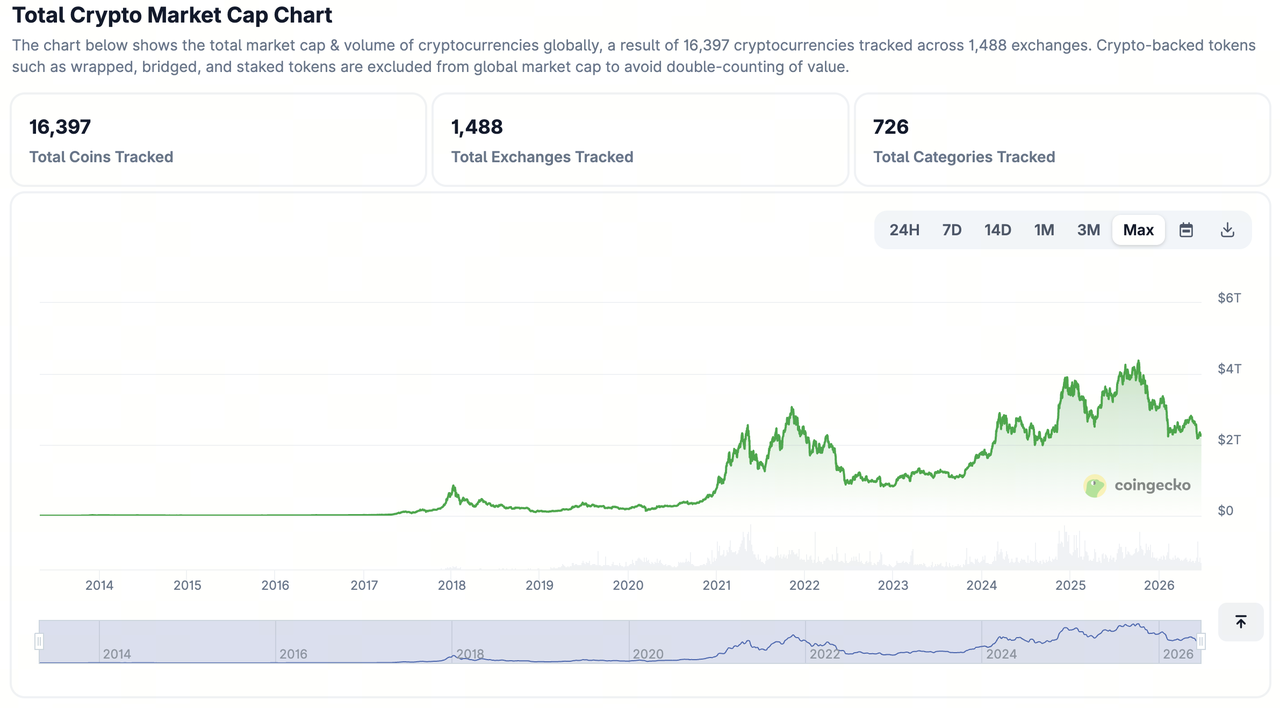 (Source: coingecko)
As the industry developed, these issues began to improve, and both market liquidity and infrastructure continued to advance. At the same time, institutions recognized that crypto assets offer global liquidity, 24/7 trading, scarcity structures, and low correlation with traditional markets.
During periods of global liquidity expansion, more institutions started seeking new growth assets, and digital assets like Bitcoin gradually entered mainstream financial circles. For some institutions, the significance of crypto assets extends beyond returns—it's also about positioning for the next generation of financial infrastructure.
Structural Shift from Retail to Institutional Markets
In its early stages, the crypto market was essentially dominated by retail participants. The main actors were individual investors, miners, and small trading teams, resulting in a market characterized by emotional trading, high volatility, and strong speculative tendencies. As institutional capital gradually entered, the market structure began to change.
Compared to retail investors, institutions typically have longer-term allocation strategies, stricter risk management frameworks, and more stable trading behaviors. This means the crypto market is shifting from an environment driven by short-term sentiment to one focused on macro cycles, asset allocation, and risk-reward dynamics.
Structurally, this shift can be divided into three stages:
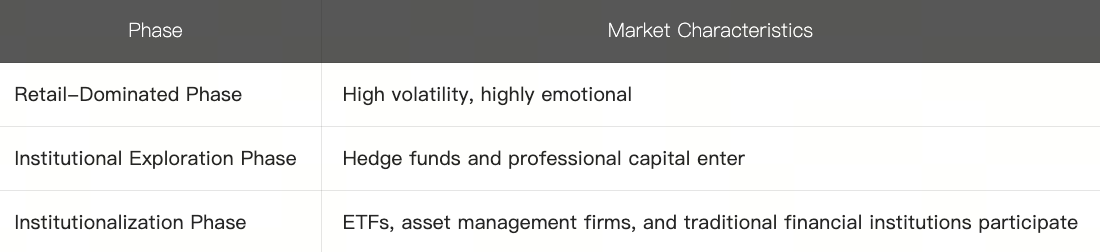
Institutional Capital and Market Infrastructure Evolution
This shift has also driven an upgrade across the entire industry infrastructure, including:
-
Compliance custody systems
-
Institutional-grade trading platforms
-
Risk control tools
-
Derivatives market development
In other words, institutional capital is not only changing the scale of the market but also reshaping the entire crypto financial ecosystem.
Macroeconomics, Interest Rate Cycles, and Digital Asset Allocation
Whether institutions enter the crypto market largely depends on the macroeconomic environment. As digital assets mature, the crypto market is increasingly incorporated into global asset allocation strategies.
For example, in a low interest rate environment, bond yields decrease and market risk appetite rises, so capital tends to seek high-growth assets, and crypto assets gain more attention. Conversely, when interest rates rise rapidly and market liquidity tightens, high-risk assets often face greater pressure, and the crypto market typically fluctuates in tandem.
As a result, more institutions are beginning to view digital assets as risk assets, inflation hedging tools, or components of alternative asset allocation. Especially as global monetary policy continues to shift, the correlation between the crypto market and macroeconomics is steadily increasing.
Impact of Bitcoin ETFs on the Market
The emergence of Bitcoin ETFs is seen by many as a major turning point for institutionalization in the crypto market. The significance of ETFs goes beyond being an investment product; they mark the official opening of the traditional financial system to crypto assets.
Previously, even institutions wanting to allocate Bitcoin faced:
With ETFs, institutions can directly gain Bitcoin exposure through traditional securities accounts without having to manage on-chain assets themselves.
From a market perspective, ETFs have brought several important changes:
-
Lower barriers for capital entry
Traditional institutions can participate in the market without dealing with complex wallets and on-chain operations.
-
Increased market liquidity
More long-term capital enters, helping to expand market size and trading depth.
-
Changed market perception
ETFs boost the legitimacy and recognition of crypto assets within traditional finance.
-
Changed volatility structure
As the institutional share grows, the market may gradually shift from extreme emotional swings to a more mature structure.
However, ETF development has sparked new debates. As more Bitcoin is held by traditional financial systems, key industry topics include whether the market will gradually diverge from its original emphasis on decentralization and whether institutional capital will create stronger linkages between crypto markets and traditional finance.
Overall, institutional capital entering the crypto market represents more than just an influx of funds. The deeper meaning is that crypto assets are transitioning from a fringe market to becoming part of the global capital allocation system. As this trend continues, custody services, ETFs, RWAs (real-world assets), and on-chain financial infrastructure are poised for further accelerated growth.