What Are Spot ETFs and Futures ETFs
An ETF (Exchange Traded Fund) is essentially a fund product that can be traded on securities markets, typically aiming to track the performance of a certain asset or index.
In the crypto market, the two most closely watched types are:
The main difference between the two is whether they directly hold the underlying asset.
Spot ETF
A spot ETF directly buys and holds the corresponding crypto asset, such as Bitcoin or Ethereum. Its price usually more directly reflects the real market price. This model is characterized by being closer to spot market performance, having direct demand for the actual asset, and generally having lower long-term tracking error. For these reasons, spot ETFs are often seen as having a more direct impact on the market.
Futures ETF
A futures ETF does not directly hold crypto assets; instead, it gains market exposure through futures contracts. This means the product's performance is affected by futures prices and may incur roll costs, resulting in possible discrepancies from spot prices. However, since futures markets are typically regulated earlier, futures ETFs are often approved before spot ETFs. In terms of development, many countries and regions launch futures ETFs first before gradually opening up to spot ETFs.
How ETFs Lower the Entry Barrier for Institutions
For traditional financial institutions, the value of ETFs is not just providing a channel to purchase Bitcoin. More importantly, they enable crypto assets to be incorporated into the existing financial system.
In the past, if institutions wanted to directly hold crypto assets, they often had to deal with private key management, on-chain security, compliance audits, and complex custody processes—all of which significantly raised the barriers to entry. The emergence of ETFs essentially "packages" complex on-chain assets into traditional financial products. Institutions can allocate them just like stocks or funds, using familiar brokers and securities accounts, without needing to interact directly with wallets, on-chain operations, or asset custody systems.
This shift brings several key impacts:
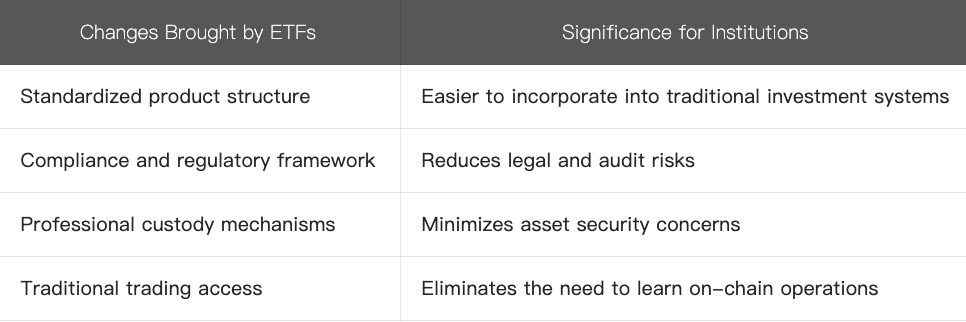
The true significance of ETFs is not about creating new assets, but enabling traditional capital to enter the crypto market with minimal friction.
Asset allocation logic in traditional financial markets
As institutions begin to access the crypto market through ETFs, crypto assets are gradually incorporated into the asset allocation framework of traditional finance. For institutions, the focus is often not just on whether prices will rise, but on what role these assets play in the overall portfolio, their correlation with other assets, and whether they can improve the overall risk-return profile.
Crypto assets are starting to be viewed as alternative assets, high-growth risk assets, or potential inflation hedges. When institutions discover that digital assets have a low correlation with traditional stocks and bonds, they may allocate some funds to enhance portfolio diversity and long-term return potential. At the same time, institutionalization is also transforming the crypto market itself. With the emergence of more ETFs, funds, and institutional products, the market is developing greater liquidity, more mature risk management systems, and a longer-term capital structure. However, this also means that the linkage between the crypto market and traditional finance is strengthening.
In the past, the crypto market was more like an independent market; in the future, it is likely to gradually become part of the global capital market system, and ETFs are an important bridge driving this change.