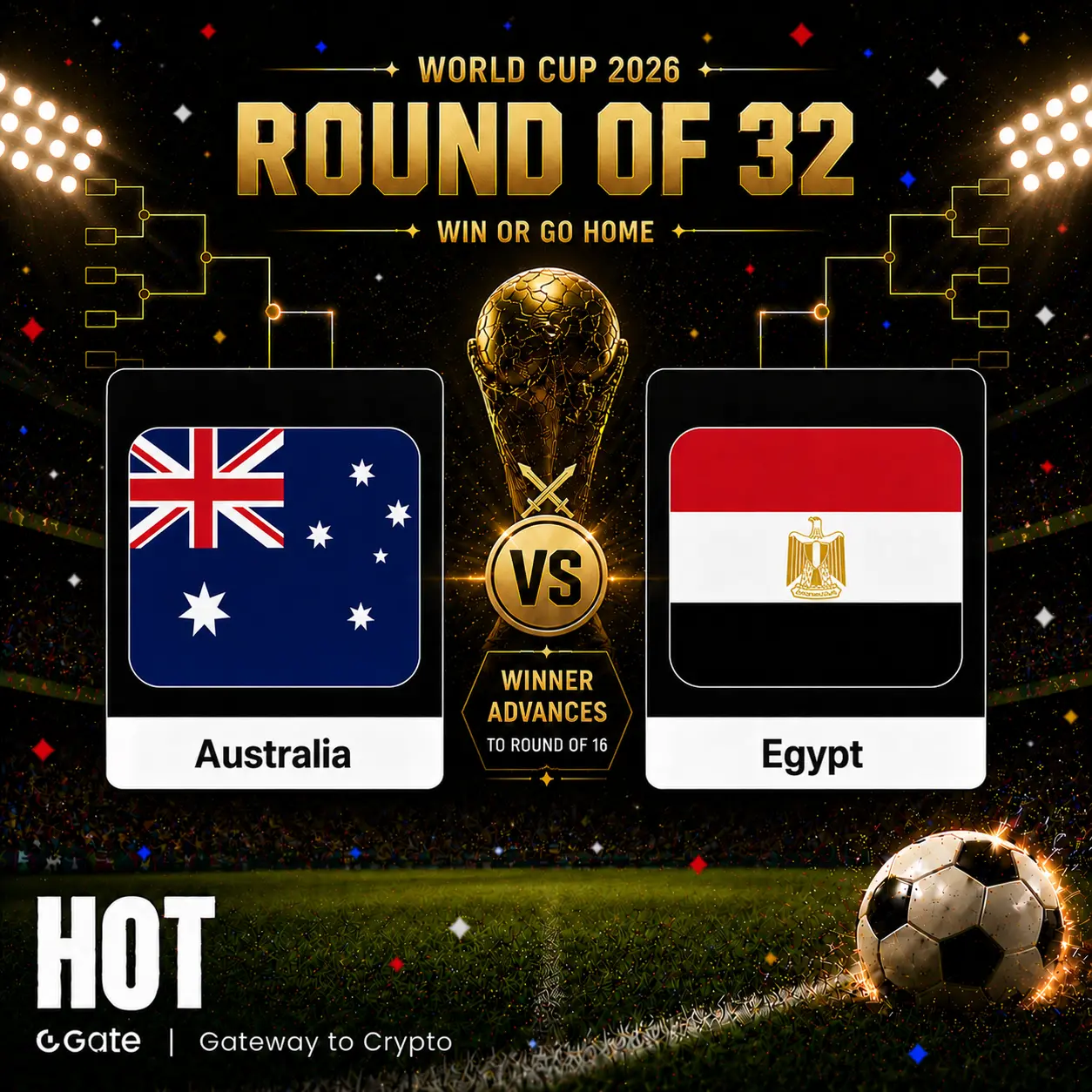
The round of 32 knockout stage of the 2026 World Cup is set to feature a highly anticipated intercontinental clash in the early hours of July 4 Beijing time, as Australia meets Egypt at AT&T Stadium in Dallas. Both teams advanced as group runners-up, separated by just two spots in the world rankings (Egypt 26th, Australia 28th). Despite the evenly matched contest, capital flows in prediction markets show a clear preference.
According to data from Gate Prediction Market, as of July 3, 2026, the market's expected distribution for this match is: Australia win probability 27%, draw probability 34%, Egypt win probability 41%. With over 40% probability, Egypt is seen as the more favored side in the market.
Behind this probability distribution lies the market's comprehensive pricing of several factors, including both teams' group stage performances, tactical adaptability, key player form, and knockout stage history.
How the Two Teams Reached This Knockout Match
Australia's path through Group D was not smooth. They opened with a 2-0 win against Turkey, then fell 0-2 to host nation USA, and ended with a 0-0 draw against Paraguay, advancing as group runners-up with four points. They scored only two goals in three matches, ranking among the lower tiers of the 32 teams in attacking efficiency. However, their defensive discipline deserves credit—against Paraguay, Australia showed a "controlled performance," maintaining maturity and calm under the pressure of needing a win to advance.
Egypt also emerged as group runners-up from Group G. They recorded a 1-1 draw with Belgium, a 3-1 win over New Zealand, and a 1-1 draw with Iran, remaining unbeaten in three matches. This marks the first time Egypt has advanced from the World Cup group stage since 1934, a milestone for the traditional African powerhouse.
The two sides have only met twice before, both in friendlies—a 0-0 draw in 1987 (Australia won on penalties) and a 3-0 win for Egypt in 2010. The limited head-to-head record offers little reference value, making the prediction market's pricing rely more on performance data from this tournament.
How to Interpret the Prediction Market's Probability Distribution
The 41% versus 27% probability gap from Gate Prediction Market (with a 34% draw probability) is not simply a judgment of "who is stronger," but rather the market's expected pricing of "who is more likely to resolve the match within 90 minutes."
The high draw probability of 34%, significantly above typical expectations for knockout matches, reflects market consensus on the match's "tight" nature. Both teams showed strong defensive resilience in the group stage—Australia conceded only two goals in three matches, while Egypt conceded in every match but never lost. Under the single-elimination format, both sides are likely to adopt relatively conservative strategies, further pushing up the market's draw pricing.
Egypt's 41% win probability is higher than Australia's primarily due to the difference in attacking ceiling. Egypt averaged six shots per game in the group stage, while Australia averaged only four. In a closely matched contest, the side with a higher attacking ceiling is typically assigned a higher win probability by the market.
How Salah's Injury Affects Market Pricing
The injury status of Egypt's star player Mohamed Salah is the biggest uncertainty factor in this match and a key pricing variable for the prediction market's probability distribution.
Salah was substituted in the group stage finale against Iran due to a hamstring strain. Egypt's FA later confirmed it was a hamstring injury requiring further assessment. As of July 3, Salah has resumed partial training, but Egypt coach Hassan stated that it remains uncertain whether he can start.
Salah has scored one goal and provided two assists in this World Cup, forming the core of Egypt's attack. If he cannot play or is limited, Egypt's offensive threat will drop significantly. Yet the prediction market still gives Egypt a 41% win probability, indicating that the market has already priced in this risk to some extent—or perhaps the market believes that even without Salah at his best, Egypt's advantages in other dimensions are sufficient to support this probability.
Australia coach Tony Popovic stated clearly before the match that the team has prepared for both scenarios of Salah playing or being absent. However, the market clearly considers Egypt's tactical system to be less dependent on Salah than Australia's defensive system is on specific tactical discipline.
What Structural Tactical Differences Exist Between the Two Teams?
The essence of this match is a clash between "defensive discipline" and "attacking talent."
Australia's tactical system is built on physical duels, defensive compactness, and set pieces. They focus on counter-attacks and long balls from wide areas, do not seek possession, and excel at limiting opponents' attacks by compressing space. In the group stage, Australia conceded very few goals—this defensive efficiency is a natural advantage in the knockout stage. However, the cost is a lack of creativity in attack—only two goals in three group matches, lacking the means to break down packed defenses.
Egypt, on the other hand, has a higher attacking ceiling. Besides Salah, Omar Marmoush and Mustafa Ziko both possess strong individual abilities. Egypt demonstrated sustained pressure in the group stage—against Iran, they had 61% possession and 15 shots. However, Egypt's defense has clear weaknesses: they conceded in every group match, with center-back Abdelmoneim and left-back Fattouh sidelined due to injuries, and midfielder Rassin suspended due to accumulated yellow cards.
The market's 41% versus 27% probability distribution essentially chooses between "Australia's defensive stability" and "Egypt's attacking explosiveness," favoring the latter. In a knockout scenario where a decisive moment is needed, the market tends to back the team capable of changing the rhythm of the game.
What Reference Does the Teams' World Cup History Provide?
This match holds historical significance for both sides—neither has ever won a World Cup knockout stage match.
Australia has reached the round of 16 twice before (2006 and 2022) but was eliminated each time. Egypt, since their debut in 1934, has never passed the first knockout round. This means that whoever wins will make history for their country's football.
From an intercontinental perspective, Australia has remained unbeaten against African teams in World Cup history—a draw with Ghana in 2010 and a win over Tunisia in 2022. Meanwhile, Egypt's 3-0 win over New Zealand in the group stage was the country's first World Cup victory against an Oceanian opponent. These samples are too small to form a reliable predictive basis, but they suggest that Australia may have a slight psychological advantage against African teams.
More noteworthy is the comparison of team values: Australia's total squad value is €77.45 million, while Egypt's is €116.48 million. The gap in value reflects, to some extent, differences in individual player ability—and the knockout stage is precisely the arena where individual talent can most easily alter the outcome.
What Information Efficiency Does the Prediction Market Data Reflect?
The core value of prediction markets lies in aggregating dispersed individual judgments into quantifiable collective expectations. When a large number of participants trade based on their own information and research, the market price itself begins to carry informational significance beyond mere "betting."
After Gate integrated with Polymarket, users can directly participate in event prediction trading on the platform. This one-stop experience lowers the barrier to entry and makes the price signals from prediction markets more representative. As of July 3, 2026, global prediction markets have seen monthly trading volume exceed $200 billion, with World Cup-related contracts accounting for a significant share.
The 41% versus 27% probability gap is a collective judgment made by thousands of participants based on public information, team form, injury reports, tactical analysis, and other multidimensional data. This data itself does not predict the match outcome, but it offers a window into market consensus—the market believes that Egypt's probability of resolving the match within 90 minutes is significantly higher than Australia's.
Of course, prediction market prices dynamically adjust as new information emerges. Salah's final playing status and lineup information from the last training session before the match could trigger further changes in the probability distribution.
What Key Variables Could Change Market Expectations?
Even though the market has provided a relatively clear probability distribution, the match's outcome is still influenced by several key variables.
Salah's playing time and physical condition are the first variable. Even if he starts, if he is limited or cannot play the full match, Egypt's attacking efficiency will be greatly reduced. Egypt's defensive injuries are the second variable. The absence of three defensive players may force Egypt to adjust its defensive lineup, and Australia's set-piece tactics are adept at exploiting defensive chaos.
Australia's attacking efficiency is the third variable. A production of two goals in the group stage is far from enough in the knockout stage—if they cannot capitalize on set pieces or counter-attacks, Australia may find themselves in a passive position, unable to score for long periods. The 20-year-old forward Irankunda is Australia's most threatening presence in the attacking third, having already scored in the group stage. His pace and dribbling are Australia's most reliable weapon to break down Egypt's defense.
Additionally, match conditions could be a variable. The high heat and humidity in Dallas in July will take a toll on both teams' stamina. Australia midfielder McCaffrey, when recalling the 0-2 loss to Egypt at the 2021 Tokyo Olympics, specifically highlighted the effect of "hot and humid weather." Memories from five years ago may provide Australia with extra mental preparation, but cannot change the objective reality of the climate.
FAQ
Q: How are the probability figures from Gate Prediction Market derived?
Prediction market prices are determined by the buying and selling actions of participants. When more funds buy a particular outcome, the price of that outcome rises, and the corresponding probability increases accordingly. After Gate integrated with Polymarket, users can directly participate in prediction trading on the platform, and the market price reflects the collective judgment of thousands of participants.
Q: Why does the prediction market favor Egypt over Australia?
The market believes that Egypt has a higher ceiling in attack—the attacking line consisting of Salah, Marmoush, and Ziko is capable of changing the rhythm of the game. Egypt averaged six shots per game in the group stage, higher than Australia's four shots. In closely contested knockout matches, the side with greater attacking explosiveness is typically assigned a higher win probability.
Q: How much does Salah's injury affect the prediction market probabilities?
Salah is the core of Egypt's attacking system, contributing one goal and two assists in this World Cup. The market has already priced in the risk of Salah's injury to some extent when assigning the 41% win probability to Egypt. If Salah is ultimately unable to play or is severely limited, the market probabilities could shift significantly.
Q: Why is the draw probability as high as 34%?
Both teams have shown strong defensive resilience in the group stage, and both sides are likely to adopt relatively conservative strategies in the knockout stage. Australia conceded only two goals in three group matches, while Egypt conceded in every match but never lost. In a single-elimination format, neither side wants to take unnecessary risks, making a draw a significant option in the market's eyes.
Q: Will the prediction market's probability distribution change?
Yes. Prediction market prices dynamically adjust as new information emerges. The lineup information from the final training session before the match, the final confirmation of Salah's availability, or any signals from pre-match press conferences could trigger a reallocation of funds and corresponding changes in probabilities.