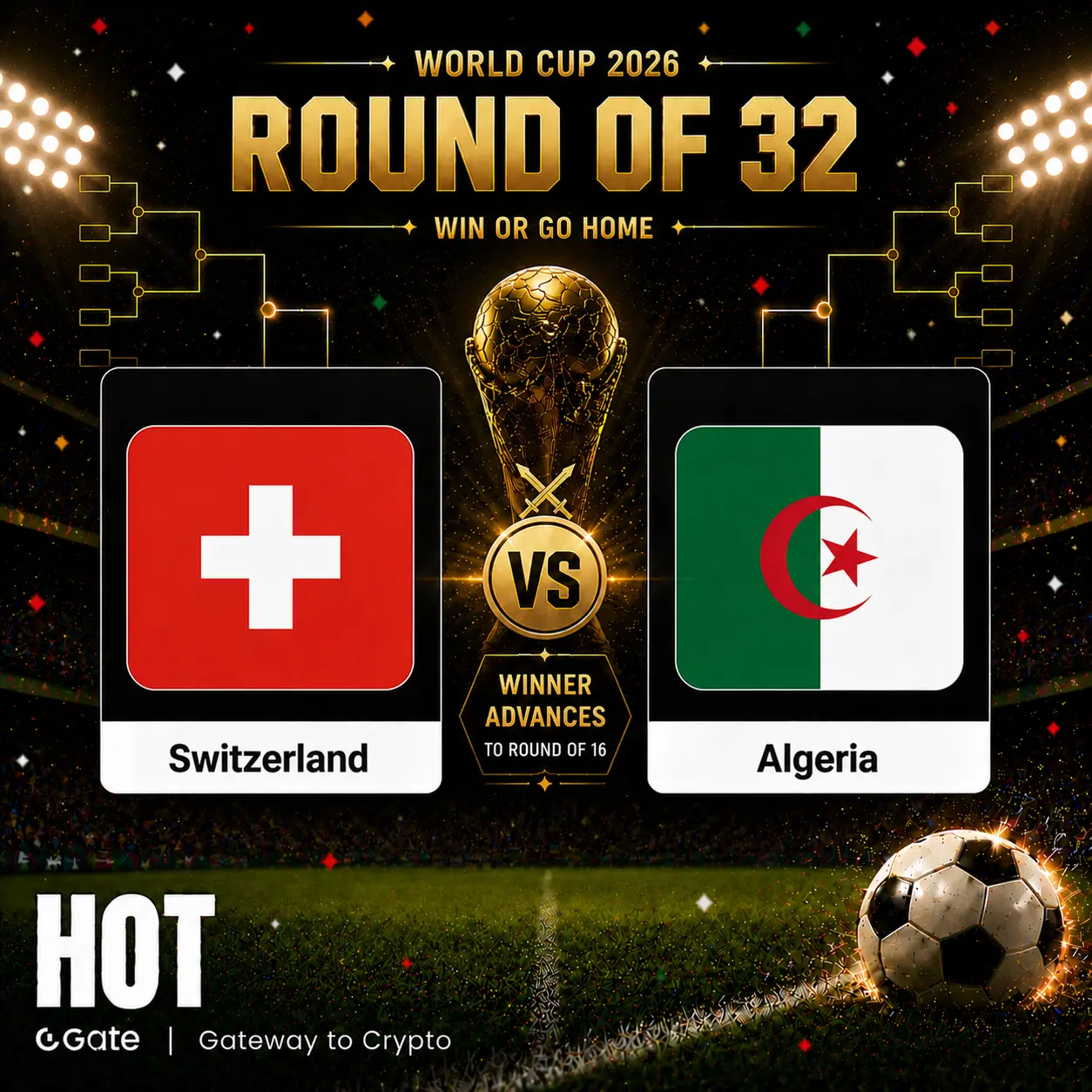
In the first round of the knockout stage of the 2026 World Cup, Switzerland and Algeria will face off in a life-or-death duel at Vancouver's BC Place Stadium. According to Gate prediction market data, current market funds indicate a 49% probability of Switzerland winning, 28% for a draw, and 21% for Algeria winning—meaning the market favors Switzerland nearly twice as much as Algeria. Does this probability distribution accurately reflect the true strength gap between the two sides? What logic lies behind the fund allocations?
How Big Is the Strength Gap Between Switzerland and Algeria?
In terms of FIFA rankings, Switzerland sits 19th while Algeria is 29th. In total squad value, Switzerland is around €326 million, while Algeria is about €265 million. The gap in ranking and value does exist, but it's not enough to explain the 49% to 21% disparity in the prediction market.
More noteworthy is the difference in performance during the group stage of this World Cup. Switzerland finished top of Group B with 2 wins and 1 draw (7 points), scoring 7 goals and conceding 3 in three matches. Compared to the 2022 Qatar World Cup group stage where they scored 4 and conceded 3, Switzerland's attacking firepower has notably improved this edition. Young striker Manzambi has contributed 3 goals and 1 assist in the group stage, becoming a key variable in their attack.
Algeria advanced narrowly as one of the best third-place teams with 1 win, 1 draw, and 1 loss (4 points). They scored 5 goals and conceded 7 in three matches, exposing clear defensive vulnerabilities. In the first group match against defending champions Argentina, they lost 0-3, and in the final match against Austria, they drew 3-3 in a high-scoring game—both matches revealed Algeria's defensive fragility when facing intense forward pressure.
Can Knockout Experience and Historical Record Give Switzerland an Edge?
Switzerland has significantly richer knockout-stage experience. Over the past three World Cups (2014, 2018, 2022), Switzerland advanced from the group stage every time but exited in the round of 16. Since the 1994 World Cup, Switzerland has qualified for the finals six times, exiting in the round of 16 five times. The "round-of-16 curse" is both pressure and proof that this team possesses knockout experience that most teams lack.
Algeria's World Cup knockout experience is extremely limited. This is only their second time advancing to the knockout stage—their only previous group-stage breakthrough was at the 2014 World Cup in Brazil, where they lost 1-2 to Germany in the round of 16.
In terms of historical head-to-head records, the two teams have only met in friendlies in 1983 and 1986, with Switzerland winning both matches. However, those matches are over 40 years old, making their reference value limited. At the official tournament level, this is their first encounter. The lack of direct meeting data means the prediction market's pricing relies more on the current form and fundamental analysis of both teams in this tournament.
Can Petković's Revenge Neutralize the Strength Gap?
The most unique variable in this match is on the sidelines. Algeria's head coach Petković previously managed the Swiss national team for seven years (2014 to 2021), leading them to the knockout stage in all three major tournaments, including reaching the quarterfinals. Key Swiss players like Xhaka and Embolo were groomed under him.
This means there are almost no tactical secrets between the two sides. Petković built Switzerland's 4-2-3-1 system and knows every core player's traits inside out. He understands how to limit Xhaka's distribution and cut off Switzerland's wing attacks. This "know thy enemy" advantage theoretically helps Algeria narrow the strength gap.
But familiarity does not guarantee containment. Switzerland's overall depth and hard power remain superior. Algeria's defensive coordination is lacking, as seen in the group stage when they conceded three times against Argentina. If Algeria tries to start aggressively and use Petković's informational advantage to create surprises, the space behind their defense could be exploited by Switzerland's counterattacks. How much Petković's "old friends" advantage translates into on-field effect is the biggest source of uncertainty in this match.
Is the Prediction Market's 49% Win Probability Overvalued or Undervalued?
To understand the prediction market's probability distribution, it needs cross-validation with traditional odds markets. The average international 1x2 odds are: Switzerland win 2.40, draw 3.35, Algeria win 3.38. Converting to implied probabilities: Switzerland win rate about 41%, Algeria win rate about 29%—the traditional market's pricing is more conservative than the prediction market's 49%.
This difference itself is noteworthy. The prediction market's 49% win probability means market funds believe Switzerland's chance of winning is nearly 50%, while the traditional odds market gives an implied probability of only about 40%. The gap may reflect structural differences in market participants—crypto prediction market participants tend to make judgments based on real-time information and capital flows, while traditional odds markets may incorporate more "psychological discount" factors.
From a fundamental perspective, Switzerland's balanced attack and defense, improved offensive firepower in the group stage, and accumulation of knockout experience all support them. Algeria's defensive vulnerabilities and physical reserve disadvantage (after a high-intensity 3-3 draw with Austria in the final group match) are unfavorable factors for the away team. However, Petković's deep understanding of Switzerland's system and Algeria's resilience in desperate situations should not be underestimated.
How Crypto Prediction Markets Are Changing Probability Pricing in Sports Events
The 2026 World Cup has become a milestone in the development of crypto prediction markets. In March 2026, global prediction market monthly trading activity climbed to approximately $25.7 billion, a year-over-year increase of over 12 times. Entering June, on-chain prediction markets saw weekly trading volume exceed $10.8 billion, setting a historical record. Since the World Cup began, prediction markets have quickly become one of the most discussed topics in the crypto industry.
The core value of prediction markets lies in aggregating dispersed individual judgments into observable, tradable market prices. For a match like Switzerland vs. Algeria, prediction markets provide not just the conclusion of "who is more favored," but also probability signals that market participants continuously update through real-time information and dynamic betting. Behind the numbers 49%, 28%, and 21% lies the collective pricing by countless market participants of multiple factors including team strength, form, tactics, injuries, and psychology.
Compared to traditional betting and sports odds, crypto prediction markets offer higher transparency and lower participation barriers. Anyone can trade based on their own judgment, making the price discovery process more efficient. Gate's selection of key World Cup matches for prediction challenges is a typical example of this trend.
What Do Capital Flows Reveal About Match Outcome Expectations?
Gate prediction market data shows Switzerland win probability 49%, draw 28%, Algeria win 21%. This distribution reveals at least three layers of market expectations.
- First, the market believes Switzerland will take the initiative but is far from a sure thing. A 49% win probability means there is still over a 50% chance Switzerland won't win in regular time—the uncertainty of knockout matches is fully priced in.
- Second, the draw probability of 28% is significantly higher than Algeria's win probability, indicating the market believes a draw within 90 minutes is more likely than Algeria pulling off a direct upset. This aligns with the basic strength comparison—Switzerland cannot easily break through Algeria's defense, but Algeria also faces difficulty beating Switzerland in regular time.
- Third, the 21% away win probability means the market has not completely ruled out an Algeria upset. Petković's "old friends" advantage, Algeria's counter-attacking speed, and Switzerland's historical psychological burden in knockout stages are all rational logics supporting this probability.
From a game flow perspective, if Switzerland scores early, the match will likely enter their controlled rhythm. If Switzerland struggles to score, pressure will gradually shift to the European side, and Algeria's counter-attack threat will rise accordingly. The prediction market's probability distribution is essentially a weighted average of these two scenarios.
Frequently Asked Questions (FAQ)
Q1: How is the win probability data from Gate's prediction market derived?
The prediction market's win probabilities are determined by real capital allocations from market participants. Every trade affects the probability of the corresponding outcome, and the final probability distribution is the result of collective market betting, reflecting all participants' latest assessment of the event's outcome.
Q2: Does a 49% win probability mean Switzerland will definitely win?
No. A 49% win probability means that in the prediction market's pricing, Switzerland's chance of winning is slightly below 50%. This precisely illustrates the high uncertainty of knockout matches—the market sees Switzerland as the more favored side, but far from a sure win.
Q3: How much impact does Petković's past coaching of Switzerland have on the match?
Petković's deep understanding of Switzerland's tactical system and core players is Algeria's biggest asymmetric advantage. He can tailor tactics to limit Switzerland's attack. But football matches ultimately depend on on-field execution; familiarity does not guarantee containment.
Q4: What is the difference between prediction markets and traditional sports odds?
Prediction markets are based on blockchain technology, offering higher transparency and lower participation barriers. Any user can trade based on their own judgment. Traditional odds are set by bookmakers, while prediction market prices are determined by supply and demand, theoretically reflecting collective judgment more accurately.
Q5: Where can I view the latest prediction data for this match?
Users can access Gate's prediction market feature to view real-time win probabilities, trading volumes, and capital flow data for Switzerland vs. Algeria and other World Cup matches.