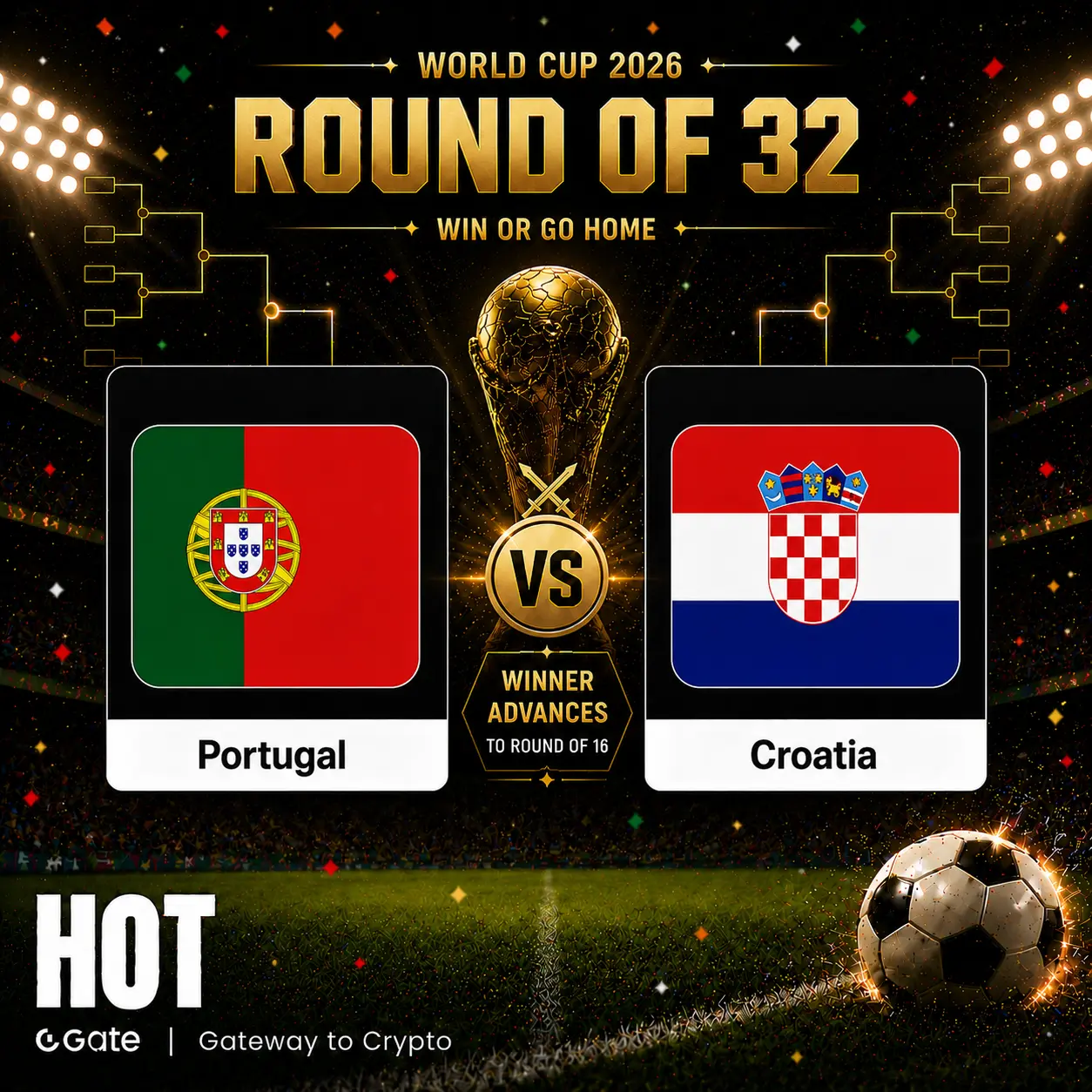
Where does the 57% win probability come from?
Gate prediction market's 57% Portugal win rate did not come out of nowhere; it is a collective judgment derived from market participants trading with real money. The core mechanism of prediction markets is: participants buy "Yes" or "No" shares for a specific future event outcome, and the market price reflects in real time the collective estimation of the probability of that event occurring.
Place this data in a broader prediction coordinate system: Opta's supercomputer predicts Portugal's probability of winning in 90 minutes at 54.5%, Croatia's win rate at 20.4%, and a draw at 25.1%; in the advancement prediction, Opta gives Portugal a 67.4% probability of advancing. Gate prediction market's 57% is very close to Opta's 54.5%, and the convergence between two independent pricing systems, to some extent, confirms the market's consensus judgment on Portugal's advantage.
From the historical head-to-head, the two teams have faced each other 10 times in history, with Portugal holding a dominant record of 7 wins, 2 draws, and 1 loss, the only defeat coming in a friendly. Cristiano Ronaldo remains unbeaten in 10 matches against Modrić, with a record of 8 wins and 2 draws. This historical data constitutes one of the important anchors for market pricing.
Why does the market give Croatia only an 18% win rate?
An 18% win probability is notably low in a knockout context. The formation of this data is directly related to the structural weaknesses Croatia has exposed in this tournament.
Croatia lost 2-4 to England in their opening group match, exposing fragility in defense. Although they subsequently defeated Panama and Ghana to advance, they conceded in all three group matches, and their defensive stability is no longer at the level of the 2018 runner-up and 2022 third-place finish. At the same time, Croatia's squad aging issue is prominent — 40-year-old Modrić and 37-year-old Perišić form the core backbone of the team. In the high-intensity, high-density second half of knockout matches, whether they can maintain physical fitness until the final whistle is a realistic challenge.
The deeper issue lies in tactical compatibility. Croatia excels at dragging matches into a slow-paced, low-scoring stalemate. However, Portugal's average possession rate is as high as 62.6%, compared to Croatia's 54.3%. Once Portugal pushes the tempo into the opponent's half, Croatia's midfield control will be continuously drained. The market's 18% win rate reflects the risk premium of this "tactical incompatibility."
Portugal's unbeaten record and hidden concerns
Portugal advanced from Group K with an unbeaten record of 1 win and 2 draws. During the group stage, the team set a record for the highest number of passes (1,690) and the highest average possession (62.5%). However, the other side of the data is also noteworthy: total shots were only 37, with 12 on target, relatively low figures in recent tournaments.
This means that although Portugal had possession, their efficiency in converting it into real threats was low. The 1-1 draw against DR Congo and the 0-0 stalemate against Colombia exposed the team's difficulties in breaking down compact defenses. Paris Saint-Germain midfielder Vitinha performed well in the group stage, completing 270 passes in three matches, setting a record for passes by a Portuguese player in a World Cup group stage. But whether the midfield's creativity can translate into lethal strikes in the penalty area during the knockout stage remains an uncertainty not fully priced into the market.
In terms of squad depth, Portugal holds a clear advantage. According to Transfermarkt valuation, Portugal's total squad value is €1.01 billion, Croatia's is €390 million. Portugal is ranked 5th in the world, Croatia 12th. In the last 5 matches, Portugal averages 2.2 points per game, higher than Croatia's 1.8. These quantitative indicators together support Gate prediction market's 57% win rate pricing for Portugal.
Can Cristiano Ronaldo break his knockout goal drought?
Cristiano Ronaldo scored a brace against Uzbekistan in the group stage, becoming the first player to score in six consecutive World Cups. But an unavoidable statistic is: Ronaldo has yet to score in the World Cup knockout stage — 8 knockout matches, 29 shots, zero goals. He is tied with Brazilian legendary left-back Roberto Carlos as the player with the most shots in knockout matches without a goal since statistical tracking began in 1966.
Whether this "knockout goal drought" has been fully priced into the prediction market is a question worth asking. The market's 57% Portugal win rate is more a judgment based on the team's overall strength than an optimistic expectation of Ronaldo's individual form. In fact, recent reports indicate that Ronaldo may be placed on the bench for the Round of 32 match, which to some extent reflects the coaching staff's weighing of his competitive form and tactical system fit.
From a tactical matchup perspective, Ronaldo will directly face Croatia's center-back Gvardiol. Gvardiol is regarded as a world-class center-back; his physicality and recovery pace will pose a substantial limitation on Ronaldo's activity in the box. Whether Portugal's average of 2.3 goals per game can be realized largely depends on the outcome of the Ronaldo-Gvardiol matchup.
Modrić's tempo control is the biggest variable
If Portugal's advantage lies in overall strength and squad depth, then Croatia's hope for a comeback rests almost entirely on Modrić alone.
40-year-old Modrić will make his 201st national team appearance in this tournament, and provided a key assist against Ghana in the final group match, becoming the oldest assist provider in World Cup history. Coach Dalić explicitly stated before the match, "The midfield battle is the key to winning or losing."
Modrić's core value lies in his ability to slow down the game. Portugal's average possession is 62.6%, but their average shots per goal is only 7.4. As long as Modrić and Kovačić can cut off the first receiving points of Bruno Fernandes and Vitinha in the center circle, Portugal's attack will be forced into inefficient wide crosses.
This tactical variable constitutes the core support for the 26% draw probability in Gate's prediction market. Croatia has extremely rich experience in extra time and penalty shootouts in major tournaments — the previous three times they reached the World Cup knockout stage (1998 third place, 2018 runner-up, 2022 third place), they all successfully passed the first round. Once the match is dragged into extra time or even penalties, Croatia's win rate will increase significantly. This is also the important reason why the market sets the draw probability at 26% — significantly higher than Croatia's win probability.
How does the prediction market price sports events?
The Portugal vs. Croatia match provides a typical case for understanding the pricing mechanism of prediction markets.
The pricing logic of prediction markets is fundamentally different from the "fixed odds" model of traditional gambling. In the traditional model, odds are set and adjusted by the bookmaker; in prediction markets, prices are completely driven by the trading behavior of market participants, with every buy and sell order constantly revising the market's collective judgment on the probability of an event occurring. This "voting with money" mechanism theoretically brings prediction market prices closer to true probability than any single analyst's judgment.
Gate, as the world's first centralized exchange to integrate Polymarket, lowers the entry barrier for prediction markets to the same level as spot trading — over 54 million registered users can use USDT directly to participate in prediction trading without needing to set up a Web3 wallet or pay gas fees. In March 2026, the New York Stock Exchange's parent company, Intercontinental Exchange, completed a $1.6 billion investment in Polymarket, marking prediction markets moving from the crypto-native track to the core battlefield of mainstream finance.
Against this backdrop, the 57%-26%-18% probability distribution for Portugal vs. Croatia is not only the market's judgment on a football match but also a real-world test of the prediction market as an "information pricing infrastructure."
Summary
Gate prediction market data shows Portugal with a 57% win probability, reflecting the market's comprehensive pricing of Portugal's overall strength, historical head-to-head advantage, and squad depth. Croatia's 18% win rate and 26% draw probability reflect the market's risk pricing of its declining defensive stability, squad aging, and insufficient tactical compatibility.
The core highlight of this match is not simply "who is stronger," but a clash of two football philosophies — Portugal's possession dominance vs. Croatia's tempo control. Whether Ronaldo's knockout goal drought can end and whether Modrić can drag the match into Croatia's preferred slow tempo will together determine whether the 57% probability eventually translates into victory.
For users following prediction markets, the significance of this match goes beyond sports itself — it provides an excellent window to observe "how collective wisdom prices real-world events."
FAQ
Q1: How is the 57% win probability in Gate prediction market derived?
Gate prediction market prices are driven by user trading activity. Users express their judgment on event outcomes by buying "Yes" or "No" shares, and the market price reflects in real time the market's collective estimate of the probability of that event occurring. 57% means that in the current market, for every $100 wagered on Portugal winning, $57 believes Portugal will win in 90 minutes.
Q2: Does a 57% probability mean Portugal will definitely win?
No. 57% indicates the market believes Portugal's winning probability is slightly above 50%, but there is still a 43% probability pointing to other outcomes (draw or Croatia win). Prediction markets price probabilities, not certainties.
Q3: What impact does Ronaldo's knockout goal drought have on prediction market pricing?
Ronaldo has zero goals from 8 knockout matches and 29 shots. This data has been priced into the market — the 57% Portugal win rate is more based on the team's overall strength than optimistic expectations of Ronaldo's individual form. Recent reports even suggest Ronaldo may be on standby as a substitute, indicating that the market's assessment of Portugal has partially stripped away reliance on Ronaldo's individual heroism.
Q4: How is Gate prediction market different from other prediction platforms?
Gate is the world's first centralized exchange to integrate Polymarket. Users can use USDT directly to participate in prediction trading without needing to set up a Web3 wallet or pay gas fees. The platform also supports a dual architecture of "Prediction Mode" and "Trading Mode," catering to both beginners and professional traders.
Q5: What significance does the result of this match have for the prediction market industry?
The 2026 World Cup is the largest sports event for global crypto prediction markets to date, with prediction market monthly trading volume surpassing $200 billion. Portugal vs. Croatia, as a typical knockout match where "the strong and weak are clear but there are upset variables," its market pricing process provides another test opportunity for the effectiveness of prediction markets as an "information pricing infrastructure."