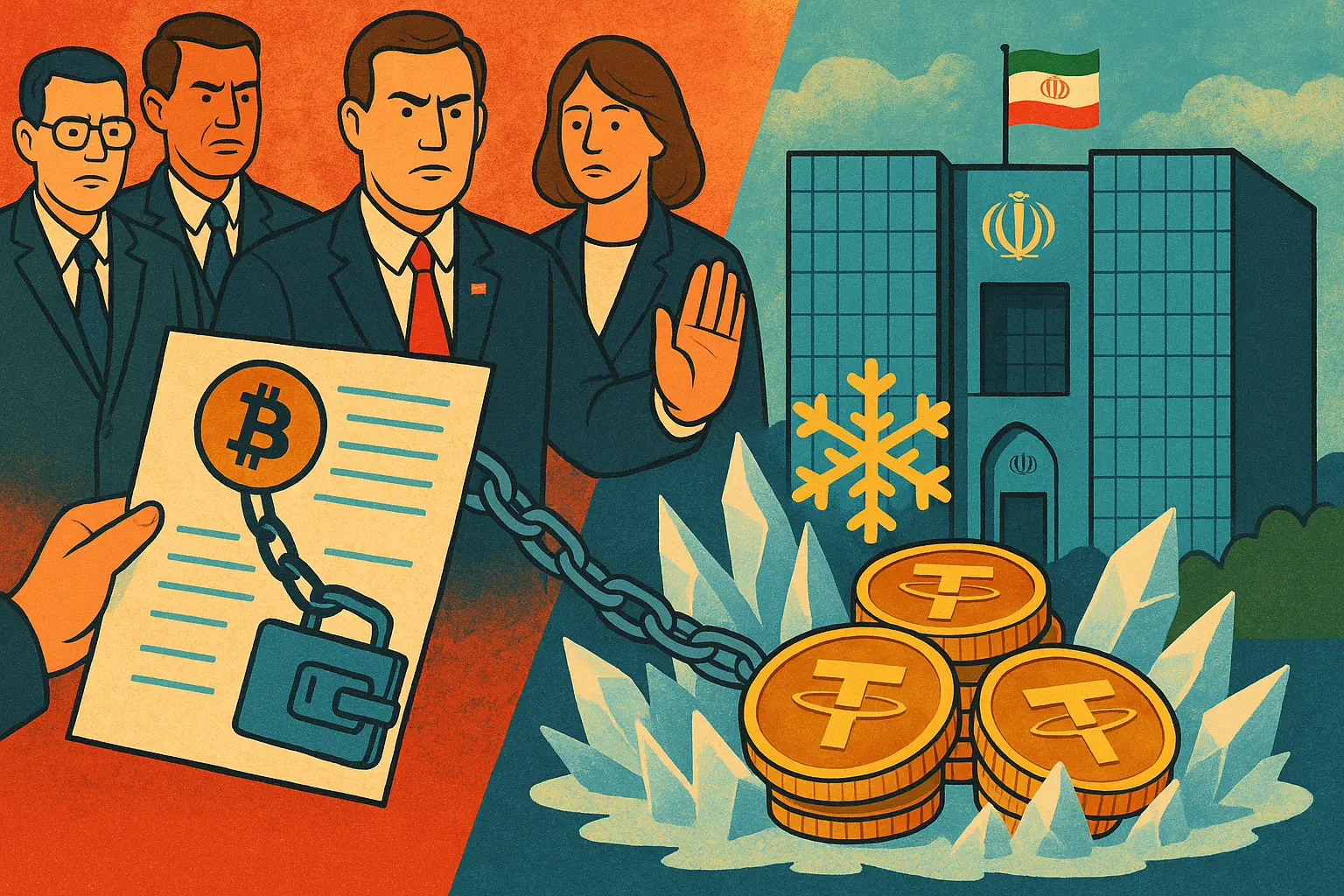
OFAC sanctions Iran’s central bank crypto addresses; Tether cooperates to freeze 3.44 billion USDT

OFAC制裁伊朗央行加密地址

According to a report by blockchain analytics firm Chainalysis on April 27, the U.S. Office of Foreign Assets Control (OFAC) has added two cryptocurrency addresses associated with the Iranian Central Bank (CBI) to its sanctions list; both wallets were frozen on April 23. Chainalysis confirmed that the frozen addresses’ cash balances match the $344 million USDT that Tether coordinated with U.S. authorities to seize.

Enforcement Action Timeline: Freezing, Sanctions, and Funds Confirmation

According to Chainalysis’ April 27 report, the two crypto addresses involved were frozen on April 23, and were then added to the sanctions list publicly updated by OFAC. Chainalysis explained that its analysis directly links the interaction activity of the above addresses to Iran exchanges, intermediary wallets, and the accounts associated with the Iranian Central Bank (CBI); the frozen balance matches the $344 million USDT seizure amount carried out by Tether together with U.S. authorities.

Chainalysis quoted in the report: “Iran’s digital asset network provides critical financial infrastructure for laundering billions of dollars generated by ‘shadow fleet’ vessels back to the Islamic Revolutionary Guard Corps (IRGC), as well as to organizations aligned with that region and Iran.”

Structure of Iran’s Crypto Funds Transfer Network

According to Chainalysis’ April 27 report, at the end of 2025, sanctioned individual Babak Morteza Zanjani released leaked documents, which included cryptocurrency addresses he claimed were associated with the Iranian Central Bank. Chainalysis said that the related data shows that a broker had helped the Iranian government purchase stablecoins using fiat currency.

Chainalysis further pointed out that the broker is linked to Alireza Derakhshan, who coordinated cryptocurrency purchases totaling more than $100 million between 2023 and 2025; the related transactions were connected to funds from Iranian oil sales.

According to the funding flow paths presented in the Chainalysis report:

· The broker purchases stablecoins on behalf of the parties using fiat currency

· Funds are transferred through intermediary wallets

· Multi-layer transfers are executed via cross-chain bridges and DeFi protocols

· Ultimately flows back to Iran’s crypto channels and IRGC-linked entities

Compliance Risks Related to the Strait of Hormuz

According to Chainalysis’ April 27 report, Iran claims it has the right to collect transit fees from merchant ships passing through the Strait of Hormuz, and fraudsters target shipping companies that try to comply with the relevant requirements. The report said that after some shipping companies paid the fraudsters, Iranian authorities did not receive the money, leading Iranian Revolutionary Guard Corps (IRGC) naval vessels to intercept them. Chainalysis said the payment method is still under investigation.

Chainalysis quoted in the report: “The Iranian Central Bank’s funds are transferred through multiple bridging agreements and DeFi agreements, and then flow back into Iran’s mainstream cryptocurrency ecosystem.”

Frequently Asked Questions

What is the specific timing of this USDT freezing action?

According to Chainalysis’ April 27 report, two cryptocurrency addresses involved were frozen on April 23 and were subsequently added to the OFAC publicly updated sanctions list, with Tether coordinating with U.S. authorities to complete the seizure of $344 million in USDT.

Which organizations are involved in this freezing action?

The organizations involved include: the U.S. Office of Foreign Assets Control (OFAC), stablecoin issuer Tether, and Chainalysis, which provides on-chain tracking and analysis. The sanctioned addresses are alleged to have direct transaction links to accounts associated with the Iranian Central Bank (CBI).

What data sources are cited in the Chainalysis report?

According to Chainalysis’ April 27 report, the analysis is based on: leaked documents published by sanctioned individual Babak Morteza Zanjani at the end of 2025, on-chain address transaction records, and the sanctions list publicly updated by OFAC.

Disclaimer: The information on this page may come from third parties and does not represent the views or opinions of Gate. The content displayed on this page is for reference only and does not constitute any financial, investment, or legal advice. Gate does not guarantee the accuracy or completeness of the information and shall not be liable for any losses arising from the use of this information. Virtual asset investments carry high risks and are subject to significant price volatility. You may lose all of your invested principal. Please fully understand the relevant risks and make prudent decisions based on your own financial situation and risk tolerance. For details, please refer to Disclaimer.

Related Articles

Tether Partners with Canaan to Develop Modular Bitcoin Mining Infrastructure

Gate News message, April 28 — Tether is developing a new class of modular bitcoin mining infrastructure in partnership with Canaan and ACME Swisstech, aiming to assert greater control over cost, energy efficiency, and performance at industrial scale. The new systems are built around application-spec

GateNews5h ago

Tether Launches Mining Development Kit (MDK), Open-Source Framework for Bitcoin Miners

Gate News message, April 27 — Tether announced the launch of Mining Development Kit (MDK), an open-source, full-stack development framework designed to provide unified control over the entire infrastructure stack for Bitcoin miners and developers. MDK features an open modular architecture with

GateNews04-27 12:15

Aave, Kelp, LayerZero Propose Releasing $71M in Frozen ETH for rsETH Recovery

Gate News message, April 27 — Aave Labs, Kelp DAO, LayerZero, EtherFi, and Compound filed a Constitutional AIP on the Arbitrum forum Saturday morning, requesting the release of approximately $71 million in frozen ETH to support DeFi United, a cross-protocol relief effort following last week's $292 m

GateNews04-27 00:16

US Sanctions Iran-Linked Crypto Wallets Holding $344M Frozen by Tether

U.S. Treasury Secretary Scott Bessent announced sanctions on multiple wallets linked to Iran as part of President Donald Trump's efforts to increase economic pressure on the country amid an ongoing ceasefire, according to CNN. The action followed Tether's freeze of $344 million in USDT on Tron,

CryptoFrontier04-26 22:01

U.S. Sanctions Iran-Linked Crypto Wallets, Tether Freezes $344 Million USDT

Gate News message, April 26 — The U.S. federal government sanctioned multiple wallets linked to Iran on April 25, with Treasury Secretary Scott Bessent announcing the action as part of efforts to increase economic pressure on the country amid an ongoing ceasefire. The sanctions came a day after

GateNews04-26 15:51

U.S. Sanctions Iran-Linked Crypto Wallets as Tether Freezes $344 Million USDT

Gate News message, April 26 — U.S. Treasury Secretary Scott Bessent announced on Friday that the federal government is sanctioning multiple wallets linked to Iran as part of efforts to increase economic pressure on the country amid an ongoing ceasefire. The move came a day after Tether froze $344 mi

GateNews04-26 09:34
Comment
0/400
No comments