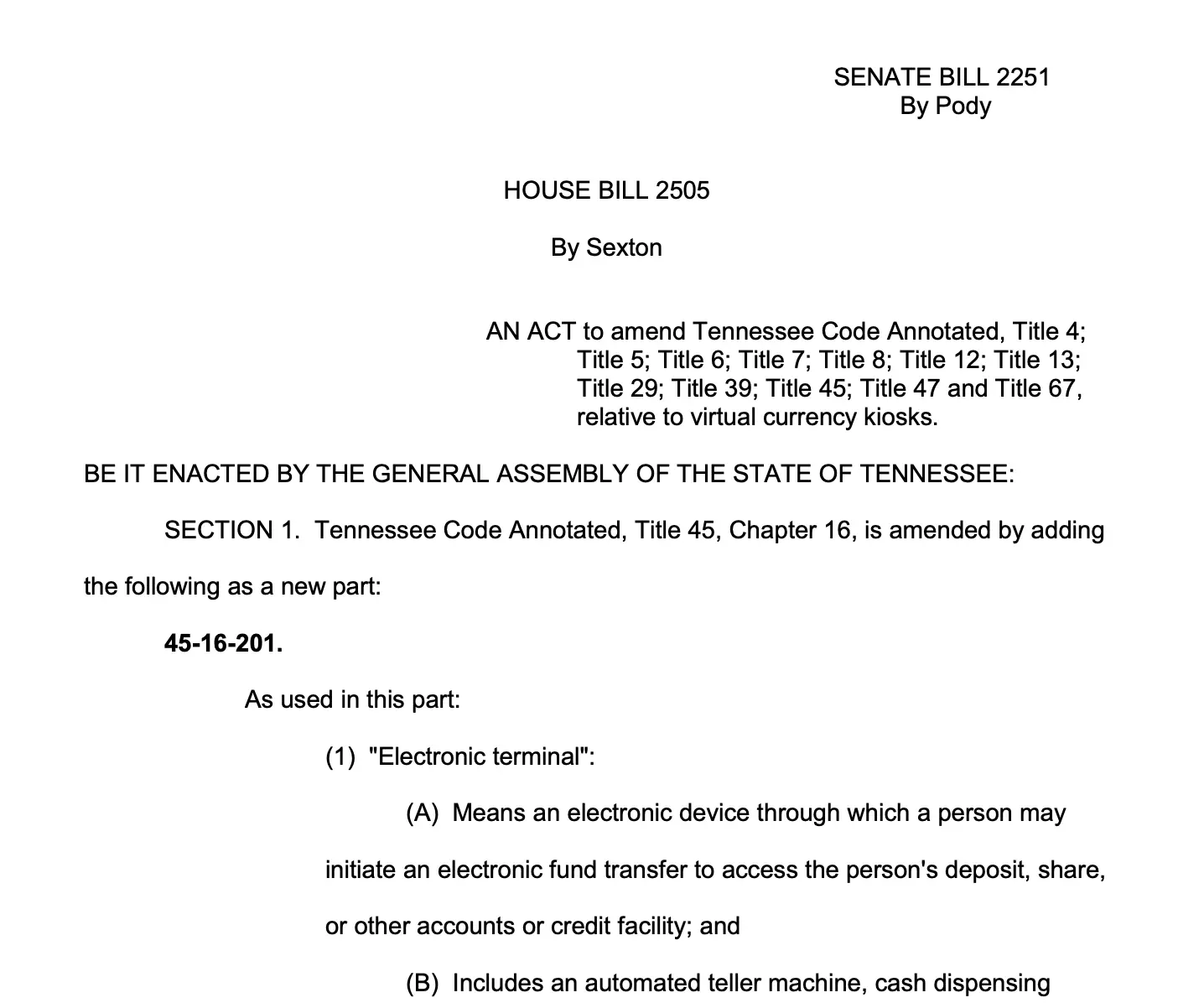
Tennessee Governor Bill Lee signed Tennessee House Bill 2505 (HB2505) on April 13, which provides that, starting July 1, installing or using cryptocurrency self-service kiosks and ATMs in the state will constitute a Class A misdemeanor. Under Tennessee law, offenders face up to 11 months and 29 days in jail and a $2,500 fine. Those affected include equipment operators and companies that provide machine hosting.
Legal Provisions of HB2505 and Criminal Liability

(Source: Tennessee General Assembly)
According to official documents from the Tennessee General Assembly, HB2505 was introduced by Tennessee House Speaker Cameron Sexton (Cameron Sexton). In a statement, Sexton said, “Virtual currency self-service terminals have become a way for scammers to exploit Tennessee residents, especially seniors. Once the money is taken, there is almost no chance of getting it back.” Starting July 1, 2026, the relevant equipment within Tennessee will be reclassified as illegal items. Operators and hosting companies must complete compliance by the deadline; otherwise, they will face criminal charges.
Market Participants Affected
According to CoinATMRadar data as of this Monday, Tennessee currently has more than 570 cryptocurrency self-service kiosks and ATMs. The main operators include Bitcoin Depot and CoinFlip. According to a report by Yahoo Finance, the stock of Bitcoin Depot, which is listed on the Nasdaq, fell by about 6.9% at Monday’s close. Cointelegraph contacted a spokesperson for Bitcoin Depot for comment; as of the time this report was published, it had not received a response.
FBI Data: The Scale of Cryptocurrency ATM Scams
According to the FBI’s annual cybercrime complaint report released in April 2026, in 2025 there were more than 13,000 complaints related to cryptocurrency ATMs and self-service kiosks, resulting in losses of more than $389 million. The FBI report classified cryptocurrency and AI-related scams as one of the “worst-loss scams” for Americans in 2025. Total losses from cryptocurrency scams in 2025 for the full year reached $11 billion.
Legislative Developments in the United States
According to a Cointelegraph report, earlier this month, a municipality in Massachusetts had completed a ban on cryptocurrency ATMs; the Minnesota State Senate also recently passed a bill that could ban cryptocurrency self-service kiosks statewide.
Frequently Asked Questions
What are the specific effective date, criminal liability, and applicable parties for Tennessee’s HB2505?
According to official documents from the Tennessee General Assembly, HB2505 takes effect on July 1, 2026. Installing or using cryptocurrency ATMs and self-service kiosks constitutes a Class A misdemeanor. The parties affected include equipment operators and companies providing machine hosting, and the maximum penalties are 11 months and 29 days in jail and a $2,500 fine.
How did Bitcoin Depot respond to the Tennessee ban?
According to a Yahoo Finance report, the stock of Bitcoin Depot, which is listed on the Nasdaq, fell by about 6.9% at Monday’s close. Cointelegraph has sought comment from Bitcoin Depot; as of the time this report was published, it had not received a response.
What does FBI data show about the scale of cryptocurrency ATM scams?
According to the FBI’s annual cybercrime complaint report released in April 2026, in 2025 there were more than 13,000 complaints related to cryptocurrency ATMs and self-service kiosks, resulting in losses of more than $389 million. Total losses from cryptocurrency scams for the full year of 2025 reached $11 billion.
Disclaimer: The information on this page may come from third parties and does not represent the views or opinions of Gate. The content displayed on this page is for reference only and does not constitute any financial, investment, or legal advice. Gate does not guarantee the accuracy or completeness of the information and shall not be liable for any losses arising from the use of this information. Virtual asset investments carry high risks and are subject to significant price volatility. You may lose all of your invested principal. Please fully understand the relevant risks and make prudent decisions based on your own financial situation and risk tolerance. For details, please refer to
Disclaimer.
Related Articles
Japan’s 4 prefectural government offices jointly request: Crypto-asset real estate transactions must strictly implement KYC and anti–money laundering measures
Japan’s Financial Services Agency and three other agencies issued a joint request in April, warning of money laundering risks in real estate transactions conducted using crypto assets. They urged real estate businesses to strictly comply with the Funds Settlement Act and the Act on Prevention of Transfer of Criminal Proceeds, and to implement KYC, suspicious transaction reporting, and police notifications. If crypto asset exchange businesses handle transactions that are large in amount and where the customer’s attributes do not match, they must strictly confirm and report the transaction at the time of dealing. Under the Foreign Exchange Act, crypto assets received from overseas exceeding 30,000,000 yen, and non-residents who acquire real estate in Japan, must be reported, and the requirements will apply comprehensively starting from 2026-04-01. This is administrative guidance, indicating that AML risk has become concrete.
ChainNewsAbmedia2h ago
Polymarket in Talks with CFTC to Bring Main Exchange Back to U.S.
Gate News message, April 28 — Polymarket is exploring a path to bring its main exchange back to the United States through discussions with the Commodity Futures Trading Commission (CFTC), according to Bloomberg.
The prediction market platform re-entered the U.S. market last year after acquiring QCE
GateNews3h ago
NYSE Arca proposal: Crypto ETF 85% qualifying asset threshold—BTC, ETH, SOL, XRP clear the bar
According to a report by News.Bitcoin.com on April 28, NYSE Arca, a subsidiary of the New York Stock Exchange, has submitted an amendment proposal to the U.S. Securities and Exchange Commission (SEC) regarding Rule 8.201-E (Generic). The SEC published a notice on April 27 to solicit public comments. The core of the proposal is to set a quantitative “qualified asset threshold” for crypto ETF trusts.
85% threshold: the specific definition of qualified assets
The core provision of the proposal is: at least 85% of the trust’s net assets (NAV) must hold “qualified assets” that are permitted under the rules as they currently exist, including:
commodities
commodity-based derivatives (commodity-based
ChainNewsAbmedia4h ago
CertiK Report: AML Enforcement Tightens, Smart Contract Audits Become Licensing Requirement
Gate News message, April 28 — Web3 security firm CertiK released its "2026 State of Digital Asset Regulation" report, providing a comprehensive analysis of global regulatory trends. As of April 2026, major jurisdictions including the United States, European Union, Hong Kong, and Singapore have
GateNews5h ago
White House Crypto Adviser Hints at Strategic Bitcoin Reserve Announcement
Patrick Witt, executive director of the President's Council of Advisors for Digital Assets, previewed a "big announcement" on Trump's strategic bitcoin reserve coming in the next few weeks during a Monday panel at the Bitcoin 2026 conference in Las Vegas. According to Witt, the White House and
CryptoFrontier5h ago