In July 2026, shipping through the Strait of Hormuz fell to the lowest level in two and a half months. On July 23, only one oil tanker left the strait, with no ships entering. This strategic waterway carries about one quarter of the world’s seaborne crude oil trade and about one fifth of global LNG transport, and it is now experiencing the worst shipping crisis since the Iran-Iraq War.

At the same time, the prediction market is seeing funds place bets on when the strait will reopen. According to Gate prediction market data, as of July 24, 2026, the probability priced by market funds that the Strait of Hormuz would return to normal by Aug. 31 is 11%, by Sept. 30 is 22%, and by Dec. 31 is 52%. Meanwhile, in June, the probability of returning to normal by Dec. 31 had peaked as high as 91%, and has since fallen by nearly 40 percentage points from that high.
These probability figures are not random swings in market sentiment. They represent “collective intelligence” paid for in real money by tens of thousands of participants—an integrated pricing of complex geopolitical developments, military games, and energy-supply-chain dynamics. Understanding the logic behind these numbers is a key entry point to pricing the risks in the current global energy market.
Why Strait of Hormuz transit shifted from “reopening seems in sight” to “zero transit”
In mid-June 2026, the U.S. and Iran reached a memorandum of understanding via third-party mediation, bringing a period of relative easing for the Strait of Hormuz. At that time, Gate prediction market data showed the probability of returning to normal by Dec. 31 had risen to 91%—the market broadly viewed a resolution of the strait shipping issue within the year as a high-probability event.
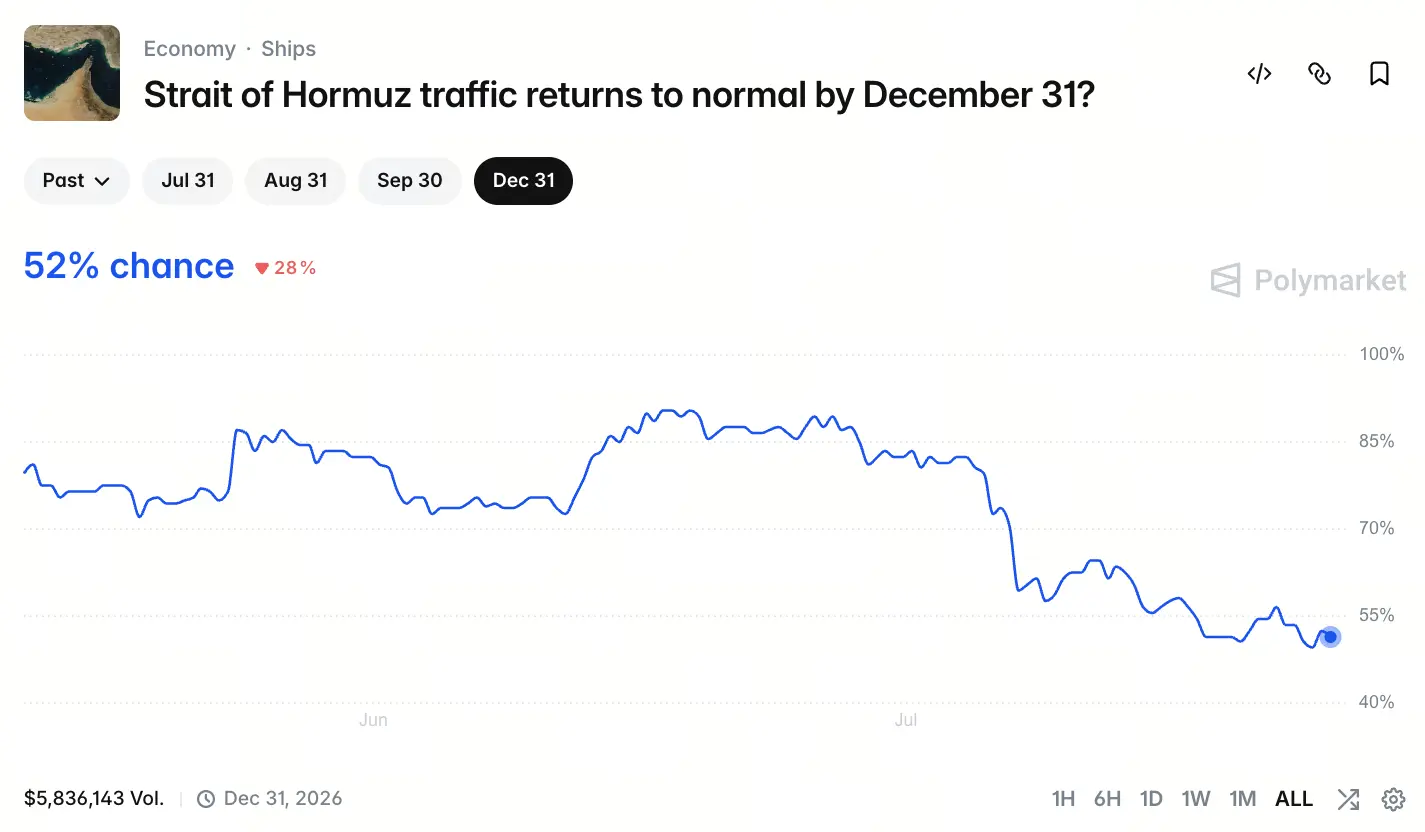
But this assessment was soon overturned by reality. The memorandum lasted for less than three weeks before it essentially became null and void. Since mid-July, the U.S. military has carried out multiple rounds of strikes on military targets inside Iran; by July 24, it had launched airstrikes for 13 consecutive nights. Iran, for its part, announced that the strait “will remain closed until the U.S. stops its aggression.” According to a report by Iran’s Fars News Agency citing sources, shipping through the Strait of Hormuz has fallen to zero, and Iran will not issue passage permits to any vessels.
From the transit data, the deterioration trend is clear. In early July, the strait’s weekly traffic was still 76 vessel trips; by the week of July 21, it had plunged to just 8. On July 23, it hit the lowest level since May 7—only one oil tanker departed and zero ships entered.
This reversal—from “reopening seems in sight” to “transit goes to zero”—took less than a month. The probability adjustments in the prediction market essentially reflect a lagging read on this real-world change: capital is repricing a risk that had previously been underpriced—that the strait standstill may be far more prolonged than the market expected.
From 91% to 52%: the narrative shift behind the probability curve
Gate prediction market probabilities trace a clear arc of narrative change.
The 91% probability in June corresponded to a framework of “conflict is controllable, negotiations are within reach.” Market participants generally believed that although the U.S. and Iran had friction, both sides had incentives to strike an agreement—the U.S. needs to curb oil prices and inflation, while Iran needs to lift sanctions and restore exports.
The 52% probability on July 24 corresponds to a completely different narrative: the conflict has evolved from a “political bargaining contest” into a “zero-sum struggle for control of the strait.” Iran’s Islamic Revolutionary Guards have elevated control over the strait from a military contingency operation to the level of the national legal framework. That means that even if negotiations resume in the future, Iran’s bottom line on strait sovereignty has been locked in by legislation, further shrinking the space for talks. The U.S. has also publicly declared it wants to become a “guardian of the Strait of Hormuz,” and plans to charge a 20% fee on transiting cargo.
Both sides are fighting for exclusive control over the strait, not seeking a coexistence solution. This zero-sum setup makes the political cost of either side conceding extremely high—exactly the core logic behind the prediction market lowering the probability of a return to normal by year-end from 91% to 52%.
How are the probability figures in prediction markets priced?
Gate prediction markets operate on a “price equals probability” principle—each contract trades between 0.01 and 0.99 USDT, directly reflecting the market-implied probability that the event will occur. Participants trade using USDT, and the winning side receives a payout after the event concludes.
The key advantage of this mechanism is information aggregation. Thousands of participants place bets based on their combined assessments of the trajectory of U.S.-Iran negotiations, the degree of military restraint, the effectiveness of external mediation, and reactions in the energy market. The resulting price signal is more reference-worthy than any single analyst’s view.
The stepped probabilities shown by Gate—11% by Aug. 31, 22% by Sept. 30, and 52% by Dec. 31—fundamentally reflect how the market prices “time.” In the near term (by August), reopening is considered almost impossible (only 11%). In the medium term (by December), the probability is over 50% but far from a certainty. Notably, these data also imply tail risk: the probability that the strait cannot return to normal during 2026 has risen to 48%, close to half.
This assessment cross-validates with data from other prediction platforms. On Polymarket, the contract for “Strait of Hormuz returns to normal by the end of the year” was priced at 51.5% on July 24, closely matching Gate’s 52%. Kalshi traders were even more pessimistic, estimating the probability of returning to normal during 2026 at only about 43%, with the earliest chance of rising to 53% on Jan. 1, 2027.
Multiple independent prediction markets are delivering similar probability ranges, indicating this is not a bias from a single platform, but a consensus view among market participants.
Why the geopolitical game is sliding from “negotiable” toward “zero-sum”
To understand why prediction market probabilities keep falling, it’s necessary to examine the structural changes in the U.S.-Iran standoff.
The earlier memorandum could be reached because both sides had a shared “space for compromise”—the U.S. would unlock some assets and lift some oil-export restrictions in exchange for Iran guaranteeing shipping through the strait. But that consensus has been completely broken.
From the U.S. side, the targets of U.S. military strikes have shifted from initially “punitive airstrikes” to “systematically depriving Iran of its military capability to control the strait.” The scope expanded from military targets to civilian infrastructure, and the intensity of operations has continued to ramp up. The White House has formally notified Congress that military operations against Iran are being restarted; in practice, the U.S. has no intention of fulfilling the corresponding responsibilities and obligations in the memorandum.
From Iran’s perspective, without a ceasefire and without gaining the economic benefits promised by the memorandum, Iran will inevitably not constrain its own actions according to the memorandum’s terms. Iran’s supreme leader has vowed retaliation against “all criminals from top to bottom” in the U.S. Iran’s armed forces have also warned that any cooperation with the U.S. will be treated as a “war” action against Iran’s sovereignty.
What’s even more challenging is the spillover effect of the conflict. On July 20, Yemen’s Houthis announced a maritime blockade of Saudi Arabia, and the Strait of Mandeb—another global energy chokepoint—also faces a risk of being blocked. With two major energy routes tightening at the same time, the compounded pressure of the “two-straits linkage” is further aggravating volatility in global energy supply chains.
When the game compresses from a “multi-issue negotiation” into a “zero-sum fight over a single issue,” the difficulty of compromise rises exponentially. This is the structural reason prediction markets keep cutting the probability of a return to normal—not because the market is just becoming more pessimistic, but because the fundamentals are worsening.
Historical reference: why a strait blockade is hard to lift quickly
The Strait of Hormuz is not the first time it has faced threats of blockade. During the Iran-Iraq War from 1980 to 1988, Iran repeatedly threatened to blockade the strait and, in 1987, laid mines and attacked tankers. At the time, some tanker crews reportedly referred to the strait as a “death corridor.” Iran’s threats drove oil prices up from over $30 per barrel to above $45.
But it’s worth noting that during the Iran-Iraq War, the strait was not fully and continuously locked down. A truly “comprehensive blockade” has historically been extremely rare—which underscores the special nature of the current situation: Iran not only announced the closure of the strait, but implemented it, driving traffic to zero.
Another historical reference is that even after a conflict ends, restoring shipping to normal typically takes a considerable amount of time. In its July report, the IMF noted that even if the Strait of Hormuz resumes operations, industry estimates still expect oil transport to return to normal in two to three months, with substantial uncertainty around the recovery of shipping, insurance, and operator confidence.
This means that even if the U.S. and Iran reach a new ceasefire agreement at some point, there is still a significant time gap between a “political agreement” and an “actual return to normal transit.” This factor may further extend the real time window for a “return to normal” as priced in prediction markets.
From probabilities to prices: how prediction market signals transmit to the broader market
Changes in prediction market probabilities are not isolated events. They are closely linked to price movements across the energy market, the shipping market, and the broader financial markets.
In the energy market, the Strait of Hormuz closing again has pushed international oil prices up rapidly by about 10%. Brent crude has returned to near-$100 levels, and refined-product prices have quickly broken above prior highs. The IMF warned that the world oil market’s previous “buffer mechanism” has nearly been exhausted—factors that previously absorbed shocks, such as falling Asian demand, increased production outside the Gulf, and inventory releases, are no longer available. By the end of May, estimated global oil inventories were about 1.2 billion barrels—only half of the pre-conflict level.
In the shipping market, war-risk insurance premiums have surged from 0.1%-0.2% of a vessel’s hull value prior to the conflict to 5%-10%. For example, for a $100 million ocean-going oil tanker, the insurance cost for a single crossing has risen from about $250k to as high as $10 million. This cost has moved from an “operational variable” to a “barrier to entry”—some shipowners have essentially stopped transiting the strait altogether.
At the level of hedge funds, during the week ending July 14, asset management firms increased their net long positions in Brent crude by 75,996 lots to 357,154 lots, the largest single-week increase since Dec. 2016. Institutional capital is betting on higher crude prices at nearly the fastest pace in a decade.
The 52% probability priced by the Gate prediction market is exactly what has been priced in against this macro backdrop. It’s not an isolated number, but a convergence point for countless price signals across the energy, shipping, and financial markets—collective pricing of “uncertainty.”
Three possible paths and what their corresponding probabilities imply
Based on Gate’s current probability structure, three main scenario paths can be inferred:
- Short-term breakout (return by Aug. 31, probability 11%). This scenario requires the U.S. and Iran to reach a new ceasefire agreement within weeks and immediately resume normal transit. But given that both sides have slid from “negotiable” to “zero-sum conflict,” and strike actions are still occurring daily, the likelihood of this scenario is extremely low. The 11% probability reflects the market’s cautious stance toward this path.
- Resolution within the year (return by Dec. 31, probability 52%). This is the current market baseline scenario—probability just over half means the market thinks the chance of resolving it within the year is slightly higher than not resolving it. This scenario assumes that after several quarters of military attrition, both sides ultimately return to the negotiating table. But as the IMF warned, even if an agreement is reached, it still takes two to three months for transit to return to normal—meaning if the deal is reached only in the fourth quarter, the actual return could extend into 2027.
- Long-term standoff (cannot return during 2026, probability 48%). This is the tail risk that the current market pricing cannot ignore. If the U.S. and Iran continue their current military confrontation, the probability that shipping through the strait cannot return to normal during 2026 is close to half. Under this scenario, about 25% of the world’s oil supply would remain obstructed, inflation pressure would rise further, and global economic growth would face even greater strain.
Among the three scenarios, scenario two (resolution within the year) is the market’s current baseline view, but it’s worth noting that—at 52%—the market’s confidence in this judgment is not strong. That itself is an important risk signal.
FAQ
Q: How are the probability data in the Gate prediction market derived?
Gate prediction markets operate on a “price equals probability” mechanism. Each contract trades between 0.01 and 0.99 USDT, directly reflecting the market-implied probability that the event will occur. Participants trade using USDT, and the winning side receives a payout after the event concludes.
Q: Why was the predicted probability as high as 91% in June, but now it has fallen to 52%?
In June, the U.S. and Iran reached a memorandum of understanding, and the market generally believed the conflict was controllable and negotiations were within reach. But the memorandum lasted for less than three weeks before becoming effectively void. The U.S. carried out multiple rounds of airstrikes, Iran announced the strait would remain closed, and the game shifted from “negotiable” to “zero-sum.”
Q: What does a 52% probability mean?
A 52% probability means the market thinks the chance of returning to normal by year-end is only slightly higher than the chance of not returning to normal, with a very narrow gap. In practice, this reflects a high degree of uncertainty in the market—nearly half the funds are betting that the strait will not return to normal during 2026.
Q: What is the real impact of the Strait of Hormuz blockade on the energy market?
The Strait of Hormuz handles about one quarter of the world’s seaborne crude oil trade and about one fifth of LNG transport. Currently, transit volume has fallen to zero, international oil prices are up by about 10%, and Brent crude has returned to near-$100 highs.
Q: If the strait resumes transit by year-end, can shipping return to normal immediately?
No. The IMF notes that even if the strait resumes operations, industry expects oil transport to return to normal still requires two to three months, and there is substantial uncertainty around the recovery of shipping, insurance, and operator confidence.


