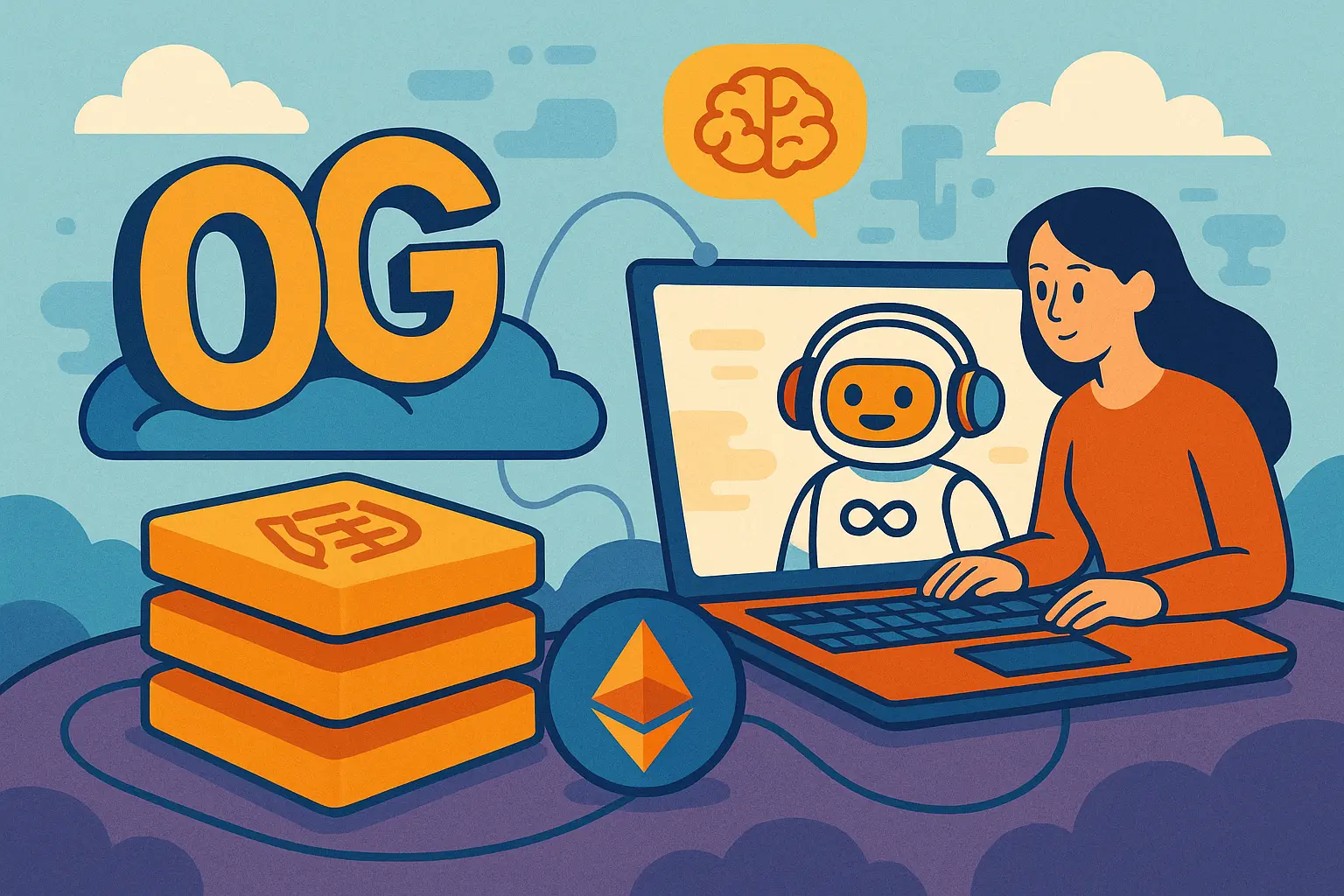
On April 21, the 0G Foundation announced an official partnership with Alibaba Cloud, bringing the Qianwen (Qwen) large language model into decentralized infrastructure so that AI agents can directly call commercial-grade LLMs from on-chain environments. Developers will use a token-gated access mechanism to access the Qianwen inference capabilities, effectively converting LLM calls into on-chain, measurable actions, making Qianwen one of the first major commercial LLMs to be embedded into decentralized agent frameworks.
Token-Gated Access: How LLM Calls Become On-Chain, Measurable Actions
Under the cooperation agreement, developers switched their payment for using Qianwen inference capabilities from traditional cloud-based billing to a token-based access mechanism, achieving on-chain measurability for LLM calls. When an AI agent calls Qianwen inference, its computation requests and fee settlement can be recorded as on-chain, auditable actions, rather than being silently completed in a centralized backend.
This architecture enables Web3 developers to embed the same LLM primitives into AI agents. These agents can be minted, traded, and composed like other crypto-native assets, making LLM calls programmable resources that coexist with tokens, DeFi, and on-chain governance.
0G’s Agent Economy Vision: An $88.88 Million Ecosystem Fund to Support It
For 0G, the integration of Qianwen is part of a broader strategy to build an on-chain “Agent Economy,” aiming to establish an autonomous AI agent that can have an identity, pay for compute costs, and interact with other protocols—without relying on the ecosystem of centralized AI platforms. Earlier this year, the 0G Foundation announced an $88.88 million ecosystem growth plan intended to fund decentralized AI agents and efficient decentralized applications (dApps).
Alibaba Cloud Qianwen’s Technical Foundation: 90,000 Deployment Instances Worldwide
Alibaba Cloud stated that the Qianwen series has already been deployed in more than 90,000 instances globally, covering Qwen2.5 models ranging from 7 billion to 72 billion parameters, as well as multimodal products such as Qianwen VL (vision), Qianwen Audio, and more, available in both open and closed versions. The goal of this cooperation is to extend this enterprise-grade technology stack to a permissionless environment.
Frequently Asked Questions
What is the 0G Foundation, and why does it introduce the Qianwen LLM?
The 0G Foundation is a Web3 infrastructure project positioned as an “AI Layer (AIL) and a decentralized AI operating system (dAIOS),” aiming to provide a complete on-chain execution environment for autonomous AI agents. Introducing the Qianwen LLM is a specific step in building an on-chain Agent Economy, allowing AI agents to directly call commercial-grade LLMs when executing inference tasks without relying on a centralized API gateway.
What are the fundamental differences between token-gated LLM access and traditional cloud APIs?
Traditional cloud APIs rely on fiat-based billing and centralized identity verification, and all operations are performed in a centralized backend, making them not externally auditable. Token-gated access maps LLM calls into on-chain, measurable actions, with fees paid in tokens. The entire process can be verified on-chain, allowing AI agents to independently pay for and call inference services in a programmatic way.
What is the practical significance of this integration for Web3 developers?
Developers can embed Qianwen’s inference capabilities directly into on-chain AI agents, enabling agents to call enterprise-grade LLM intelligence while executing tasks, all while maintaining the decentralized characteristics of the agents. If the experiment succeeds, it could become a concrete template for how ultra-large-scale cloud vendors can coordinate cloud-native AI with decentralization.
Disclaimer: The information on this page may come from third parties and does not represent the views or opinions of Gate. The content displayed on this page is for reference only and does not constitute any financial, investment, or legal advice. Gate does not guarantee the accuracy or completeness of the information and shall not be liable for any losses arising from the use of this information. Virtual asset investments carry high risks and are subject to significant price volatility. You may lose all of your invested principal. Please fully understand the relevant risks and make prudent decisions based on your own financial situation and risk tolerance. For details, please refer to
Disclaimer.
Related Articles
PicWe Launches AI Agent Wallet with On-Device Key Management
PicWe announces public beta of PicWe Wallet, an AI-agent-enabled, on-device key wallet with no recovery phrases. It supports multi-chain assets, swaps, AI-accessible automation, and aims to unify RWA infrastructure.
PicWe has launched the public beta of PicWe Wallet, an AI Agent-enabled wallet that stores keys on-device, eliminates recovery phrases, and keeps critical operations local. The beta supports multi-chain asset management, swaps, and stablecoin-based fees while enabling programmable AI interactions. Broader PicWe initiatives position the platform as unified infrastructure for real-world assets, enabling issuance, circulation, settlement, cross-border payments, tokenization, and supply-chain coordination for enterprise use cases.
GateNews21m ago
Vitalik: System Simplification Crucial for Ethereum Adoption Among Users and Developers
During a Foresight News event, Vitalik Buterin outlined two levels of simplification—interface-level tweaks and broader system-level changes—and argued that Ethereum’s growth depends on reducing system complexity to boost participation by users and developers.
Buterin distinguishes interface vs. system-level simplification; for Ethereum, reducing system complexity is crucial to boost user and developer participation and overall adoption.
GateNews29m ago
Ripple Sets 2028 Target for XRPL Quantum Shift Plan
Ripple outlines a four-phase plan to prepare XRPL for quantum threats, targeting full migration and network upgrade by 2028.
Early phases focus on testing quantum-resistant algorithms and hybrid cryptography with partners like Project Eleven.
XRPL’s key rotation and seed-based design
CryptoFrontNews40m ago
Chainlink Achieves SOC 2 Type 2 Certification from Deloitte, Strengthening Security Standards
Deloitte completed Chainlink CCIP SOC 2 Type 2 audit; Chainlink becomes the sole data and interoperability oracle meeting this security standard, and holds SOC 2 Type 1 plus ISO/IEC 27001:2022 certifications.
This article reports that Deloitte & Touche LLP completed a SOC 2 Type 2 audit of Chainlink's Cross-Chain Interoperability Protocol (CCIP) and data feeds, making Chainlink the only data and interoperability oracle platform to meet this standard. It also notes that Chainlink holds SOC 2 Type 1 and ISO/IEC 27001:2022 certifications, underscoring enterprise-grade security and compliance.
GateNews1h ago
Sunny Side Labs Launches Privacy Boost, Enterprise Privacy Solution for Optimism Mainnet
Sunny Side Labs launches Privacy Boost on Optimism Mainnet, an SDK-based privacy tool using ZK and TEEs with selective disclosure for regulators, targeting enterprises; no cryptography expertise required.
Abstract: Sunny Side Labs unveiled Privacy Boost, an enterprise-focused privacy SDK for the Optimism Mainnet. It combines zero-knowledge proofs and trusted execution environments with selective disclosure to protect transaction privacy while enabling regulators to access only necessary data. Aimed at enterprises and institutions, the plug‑and‑play SDK minimizes cryptography know‑how. The initiative follows ongoing collaboration with Optimism since late 2025, signaling broader privacy integration on the mainnet.
GateNews3h ago
VOOI Light to Halt Services on May 18 Following Infrastructure Provider's Decision to Discontinue Chain Abstraction Solution
Gate News message, April 22 — VOOI, a decentralized exchange supported by YZi Labs, announced that VOOI Light will cease operations on May 18 due to OneBalance, its chain abstraction (CA) infrastructure provider, discontinuing its chain abstraction solution.
Users are required to close all open
GateNews3h ago


