Renowned encryption investor Andrew Kang recently published a lengthy article, directly pointing out that Wall Street analyst Tom Lee's bullish argument on Ethereum “lacks basic financial knowledge.” Kang refuted Lee's five major points one by one, sparking heated discussions in the crypto community. Some netizens even brought up Kang's prediction from April this year that ETH would fall below 1,000 USD, questioning his judgment. This article delves into the market logic behind this showdown of experts.
Five Major Controversies: How Kang Breaks Down Tom Lee's Ethereum Bullish Argument
Andrew Kang posted on social media that Tom Lee's analysis of Ethereum is the “dumbest viewpoint from a well-known analyst” he has seen recently. He systematically criticized Lee's five bullish reasons:
1. Do stablecoins and real-world asset tokenization (RWA) drive demand? The data says no
 (Source: X)
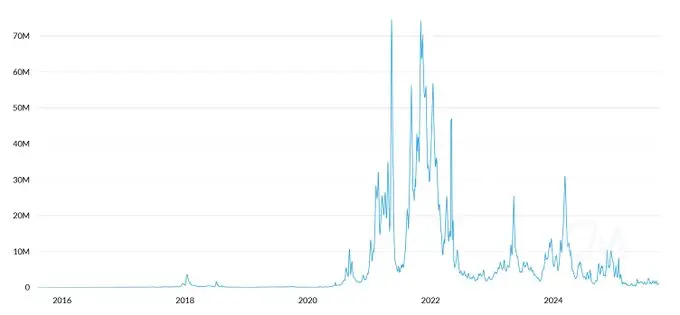
Kang pointed out that Lee's first argument states that the growth of stablecoins and tokenized assets will drive ETH trading volume and fee income, but this completely ignores the actual data: “Since 2020, the total value of tokenized assets and the transaction volume of stablecoins have grown 100 to 1000 times, but the daily fee level of ETH has remained basically the same as in 2020.”
Kang explains the reasons for this phenomenon include:
· The Ethereum network upgrade has improved transaction efficiency.
· Stablecoin and tokenized asset activities are shifting towards other competing public chains.
· Low liquidity assets have a low trading frequency after tokenization, resulting in negligible transaction fees.
“You can tokenize assets worth trillions of dollars, but if these assets are not actively traded, then perhaps it can only add a hundred thousand dollars in value to Ethereum.” Kang bluntly stated that in the race for blockchainizing traditional financial transactions, Solana, Arbitrum, and Tempo have already taken the lead.
2. The narrative of “digital oil” is actually bearish
Regarding Lee's view of comparing ETH to “digital oil,” Kang believes this is actually a bearish signal:
“Oil is a commodity, and the real oil prices adjusted for inflation have fluctuated within the same range for over a century, occasionally experiencing price spikes, but ultimately they will fall back. I agree that ETH can be considered a commodity, but this is not necessarily a positive outlook.”
3. The assumption of institutional staking of ETH lacks a realistic basis
Kang questioned Lee about the prediction that financial institutions would buy and stake large amounts of ETH: “Have large banks and other financial institutions included ETH on their balance sheets? No. Have any of them announced plans to do so? Neither.”
He rebutted with a vivid analogy: “Would banks stockpile large amounts of gasoline just because they continuously pay energy costs? No, because it doesn't matter; they only pay for it when needed. Would banks buy stocks of the asset custodians they use? No.”
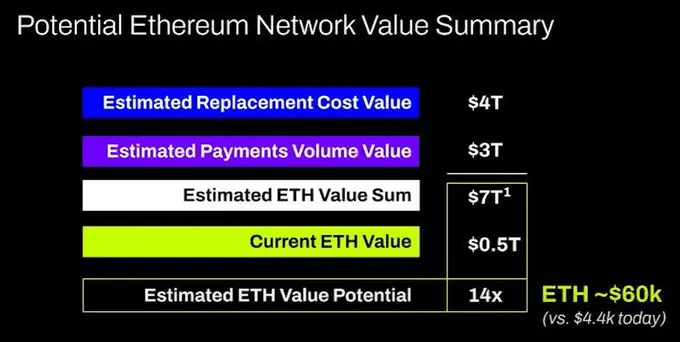
4. Is the value of ETH equivalent to the sum of all financial infrastructure companies? “Pure delusion”
(Source: X)
Regarding Lee's belief that the value of ETH should be equivalent to the total of all financial infrastructure companies, Kang responded directly with “pure delusion,” arguing that this is a “fundamental misunderstanding of the value accumulation mechanism.”
5. Technical analysis is misused to support biases
(Source: Bloomberg)
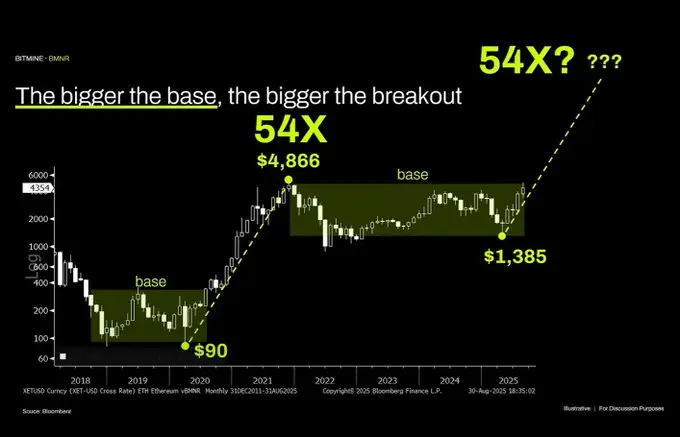
Kang stated that he is a supporter of technical analysis, but he believes that Lee “seems to use technical analysis to draw random lines to support his bias”: “The most objective conclusion is that Ethereum is in a multi-year consolidation range, which is quite similar to the trend of crude oil prices. Currently, Ethereum is not only in a consolidation range, but has also recently touched the upper end of the range without breaking through resistance. From a technical perspective, Ethereum's trend is actually bearish.”
Community Reaction: Is Kang's Criticism Justified?
Kang's lengthy post has sparked heated discussions on social media, with many netizens questioning his viewpoints. Some have dug up Kang's prediction from April this year that ETH would fall below 1000 USD, questioning his judgment.
Some netizens pointed out that Kang's understanding of the Ethereum ecosystem may be flawed, especially regarding the potential value that Layer 2 solutions and technical upgrades like EIP-4844 bring to Ethereum.
The Core Controversy of Ethereum Valuation: Cognitive Gap or Insufficient Fundamentals?
Kang presented a key point at the end of the article: “The valuation of Ethereum primarily stems from the market's insufficient financial understanding. Objectively speaking, this cognitive gap can indeed create considerable market value, just look at XRP. However, the valuation supported by cognitive deficiencies will eventually have an upper limit.”
He believes that the current loose macro liquidity environment temporarily maintains the price level of ETH, but unless a structural change occurs, Ethereum “is likely to fall into a prolonged slump.”
The core of this debate is: how should the value of Ethereum be assessed? Is it based on its potential as a global financial infrastructure, or merely its practicality as a medium of exchange? As institutional investors continue to enter the encryption market, the answer to this question will have far-reaching implications for the entire industry.
Disclaimer: The information on this page may come from third parties and does not represent the views or opinions of Gate. The content displayed on this page is for reference only and does not constitute any financial, investment, or legal advice. Gate does not guarantee the accuracy or completeness of the information and shall not be liable for any losses arising from the use of this information. Virtual asset investments carry high risks and are subject to significant price volatility. You may lose all of your invested principal. Please fully understand the relevant risks and make prudent decisions based on your own financial situation and risk tolerance. For details, please refer to
Disclaimer.
Related Articles
Robert Kiyosaki warns of a “fake coin” crash, insisting Bitcoin is the safest asset for 2026
Robert Kiyosaki, in a recent post, said that Bitcoin and Ethereum could become the safest investments of 2026, because the United States continues to print money, debt is rising, and inflation is worsening. He criticized the safety of U.S. Treasuries as “the biggest lie,” and noted that real assets and cryptocurrencies can preserve wealth during inflation. His investment recommendations include holding Bitcoin, gold, silver, and commodities. Although some of his predictions weren’t accurate, some of his long-term predictions have come true.
MarketWhisper1h ago
ETH 15-minute surge of 0.97%: Tightened on-chain net outflows and DeFi lockups both supporting the price rise
2026-04-05 15:15 to 2026-04-05 15:30 (UTC), during this period ETH’s return within 15 minutes was +0.97%, the price range was 2040.32 to 2063.89 USDT, and the amplitude reached 1.15%. During this period, market attention increased, volatility clearly intensified, and short-term capital remained active, driving ETH slightly higher.
The main drivers of this abnormal move are ETH’s net outflows from exchanges and the persistently high DeFi locked-in amount. According to on-chain data, the 24-hour net outflow amount reached -11,970.54 E
GateNews2h ago
ETH 15-minute drop of 0.62%: Large funds withdrawing in size and ETF net outflows converging to amplify volatility
From 2026-04-05 12:30 to 12:45 (UTC), the ETH price range is 2022.11 to 2037.82 USDT. The 15-minute K-line return is -0.62%, and the amplitude is 0.77%. Against the backdrop of elevated on-chain activity, market attention has increased, volatility has picked up, and this reflects stronger short-term risk-averse sentiment.
The main driver behind this unusual move is that large funds have continued flowing out of exchanges. Data shows that in the past 24 hours, ETH net outflows were as high as -11,970.54 coins, and in the $1M-$10M range, large net outflows were -5
GateNews5h ago
10x Research: Tether’s USDT issuance on Ethereum surpasses Tron—ETH could become the main beneficiary of stablecoin growth
10x Research noted that over the past five years, Ethereum (ETH) has performed lackluster, with its price trading around $2,000, mainly due to weak on-chain activity leading to insufficient demand. After falling 57% from its 2025 peak, ETH’s current valuation remains low, while capital accumulation is still ongoing; USDT’s issuance has surpassed Tron, sparking discussion that ETH could become a leading beneficiary of stablecoin growth. Analysts are now re-evaluating ETH’s potential turning point.
GateNews6h ago


