Ethereum founder Vitalik Buterin has signed the Distrust Manifesto, calling on blockchain builders to adhere to trustless design principles and resist the slide towards centralized platforms. The manifesto states that the Ethereum ecosystem is facing a crisis of decentralization erosion: custodial RPC becoming the default option, AWS and Cloudflare controlling the infrastructure, among others.
Warning of Decentralization Being Eroded by Comfort
(Source: Trustlessness.eth)
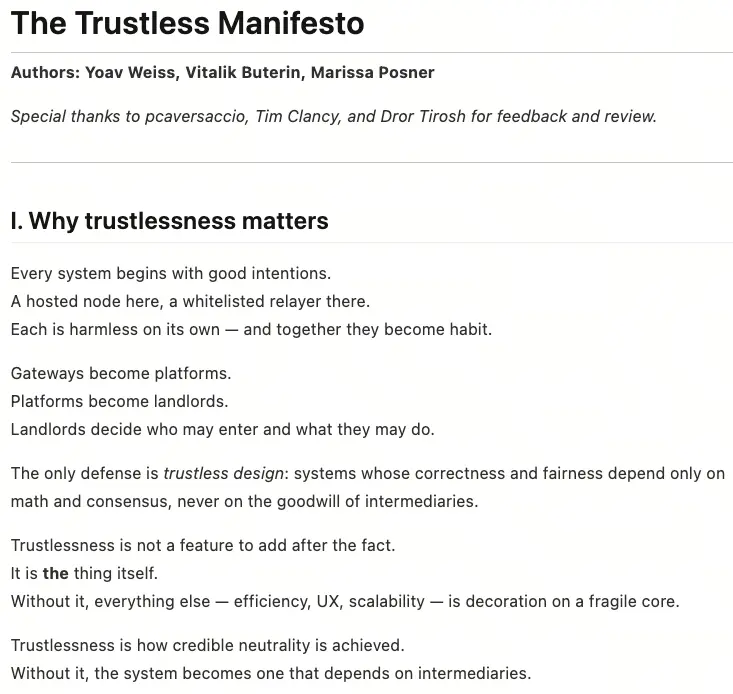
The opening of the declaration points out that every system begins with good intentions—there is a hosted node here, a whitelisted relay there. Individually, they are harmless, but together they form a habit. The entry becomes a platform, the platform becomes a landlord, and the landlord decides who can enter and what they can do. This gradual process of centralization is precisely the phenomenon that Vitalik is most concerned about.
The trust dependency currently faced by the Ethereum ecosystem is deepening, and this trend is not just theoretical; it has already arrived. Managed RPC (Remote Procedure Call) has become the default option, and if AWS, GCP, and Cloudflare stop their services, most applications will also be unable to function. This means that theoretically decentralized Ethereum applications are, in practice, highly reliant on the cloud services of a few tech giants. This dependency was exposed during the brief outage of Infura in 2022, when a large number of Ethereum wallets and dApps were unable to operate normally.
Many Rollup solutions have centralized mechanisms for ordering. Rollup is a Layer-2 scaling solution for Ethereum, which theoretically should inherit the decentralized characteristics of Ethereum. However, in pursuit of performance and user experience, many Rollups have adopted centralized sequencers to handle transaction ordering. Although users can still enforce transactions through the Ethereum mainnet, everyday use heavily relies on the normal operation and honest behavior of centralized sequencers.
The upgrade keys still exist, and the “training wheels” are used as an excuse to delay decentralization. Many DeFi protocols and dApps retain administrator keys or multi-signature wallets, which can upgrade smart contracts or modify parameters at any time. The development teams refer to these keys as “training wheels,” claiming they are for quickly fixing vulnerabilities and adjusting parameters in the early stages. However, this “temporary” centralized control often lasts for years, becoming a de facto permanent feature.
“Self-custody” has been entrusted to centralized exchanges (CEX). Although the crypto community has always emphasized the principle of “Not your keys, not your coins,” in reality, most users still store their assets on centralized exchanges like Coinbase and Binance. While this practice is convenient, it completely goes against the idea of self-sovereignty.
Cross-chain interoperability is beginning to reflect the centralization issues it was originally designed to overcome, with solvers and relayers acting as gatekeepers of execution, deciding which transactions succeed and which fail. Cross-chain bridges and interoperability protocols were supposed to enhance the connectivity of blockchains, but many solutions rely on centralized validators or relay nodes, which can censor transactions or selectively serve certain users.
The Centralization Threats Currently Facing Ethereum
Infrastructure Dependency: AWS, GCP, and Cloudflare control RPC nodes, with a high risk of single point of failure.
Rollup Centralization: Centralization of the sorter, long-term existence of the upgrade key, failure of decentralization commitment.
Custodial Dominance: Most users rely on CEX, while self-custody exists only in theory.
Cross-chain Gatekeeper: Solvers and relayers can audit transactions, undermining the permissionless feature.
Three Laws of Trustless Design
Vitalik stated in the declaration that the trustless design must adhere to three laws.
First Law: No critical secrets should be leaked. No step in the protocol should rely on any private information held by any single entity (excluding the user themselves). This means that the operation of the system cannot depend on secret data or keys held by a specific entity; otherwise, that entity becomes a single point of failure for the system.
Second Law: There is no need for indispensable intermediaries. Any forwarder, executor, or verifier must be replaceable by any other participant following the same rules. “Anyone can operate” is not enough; participation must be genuinely open, not limited to those who possess servers, capital, and operational skills. A system that relies on an intermediary that cannot actually be replaced by the majority of users is not trustless; it simply concentrates trust in the hands of a few operators.
Third Law: Unverifiable results must not occur. Any impact on the state must be reproducible and verifiable from public data. This ensures the transparency and auditability of the system, allowing anyone to independently verify whether the operation of the system complies with the rules.
These laws are harsh and limit what we can easily build, but they are the only guarantee that what we build belongs to everyone. Vitalik acknowledges that the cost of trustlessness is high; it requires redundancy, openness, and complexity, but it brings resilience, durability, neutrality, and freedom. Any shortcuts that rely on trust will ultimately lose freedom.
We choose to build our system based on Ethereum because we choose verification over blind trust. The founding of Ethereum is not intended to improve financial efficiency or facilitate applications, but to liberate people, empowering anyone, anywhere, to coordinate without permission and without trusting anyone who cannot be held accountable. As we scale, we must not betray this promise.
Disclaimer: The information on this page may come from third parties and does not represent the views or opinions of Gate. The content displayed on this page is for reference only and does not constitute any financial, investment, or legal advice. Gate does not guarantee the accuracy or completeness of the information and shall not be liable for any losses arising from the use of this information. Virtual asset investments carry high risks and are subject to significant price volatility. You may lose all of your invested principal. Please fully understand the relevant risks and make prudent decisions based on your own financial situation and risk tolerance. For details, please refer to
Disclaimer.
Related Articles
Three wallets withdrew 16,300 ETH from a certain CEX in the past 10 hours, worth $37.18 million
Gate News report: On March 17, according to Onchain Lens monitoring, three wallets withdrew a total of 16,350 ETH from a certain CEX in the past 10 hours, valued at approximately $37.18 million.
GateNews6m ago
Gate Daily Report (March 17): OpenSea Delays SEA Token Issuance; BitMine Increases Holdings by 60,999 Ethereum
Bitcoin has recently risen to approximately $75,850 due to eased market concerns about the Strait of Hormuz. OpenSea announced a delay in SEA token issuance with no new date set. BitMine increased holdings by 60,999 ETH, bringing total holdings to 4.596 million ETH, and plans to launch staking infrastructure. U.S. stocks rose on the back of declining oil prices. Market sentiment among short-term investors remains cautious, with views that a reversal has not yet arrived.
MarketWhisper17m ago
Bitcoin Surges to $75,500, Ethereum Approaches $2,400, Morgan Stanley: Soaring Oil Prices Don't Shake June and September Rate Cut Forecasts
Bitcoin has recently surged to $75,500, while Ethereum has broken through $2,380, with futures market liquidations reaching $570 million. Morgan Stanley economists predict the Federal Reserve will still cut rates in June and September despite rising oil prices. While market expectations for rate cuts have diminished, they still remain, and investors need to be vigilant about volatility risks in the crypto market.
動區BlockTempo30m ago
Whale "pension-usdt.eth" Faces Over $10M Floating Loss on BTC and ETH 3x Leveraged Short Positions
Gate News bot message, whale address "pension-usdt.eth" currently holds 3x leveraged short positions in BTC and ETH with floating losses exceeding $10 million as prices rise.
The positions include 1,000 BTC valued at $75.64 million with a loss of $6.7 million, and 10,000 ETH valued at $23.6 millio
GateNews33m ago
"Brother Maji" Increases ETH Long Position to 10175 Coins, and Adds New BTC and HYPE Long Positions
Gate News reports that on March 17, according to Hyperinsight monitoring, as the cryptocurrency market rose, "Maji Dage" increased their ETH long position to 10,175 ETH, approximately worth 23.92 million USD, with an unrealized profit of 1.37 million USD. Additionally, this address added 45 BTC and 64,000 HYPE long positions, with the total unrealized profit of the account reaching 1.41 million USD.
GateNews1h ago
A major trader closed a position of 40,000 ETH 2 hours ago, earning a profit of $14.8 million.
On March 17th, on-chain analyst Yu Jin detected a whale trader taking profit on 40,000 ETH after ETH rose 8%, earning $14.8 million. The trader previously opened a long position worth $290 million on Hyperliquid, which has already generated $47.92 million in profits. The trader currently still holds 80,000 ETH and 700 BTC long positions.
GateNews1h ago


