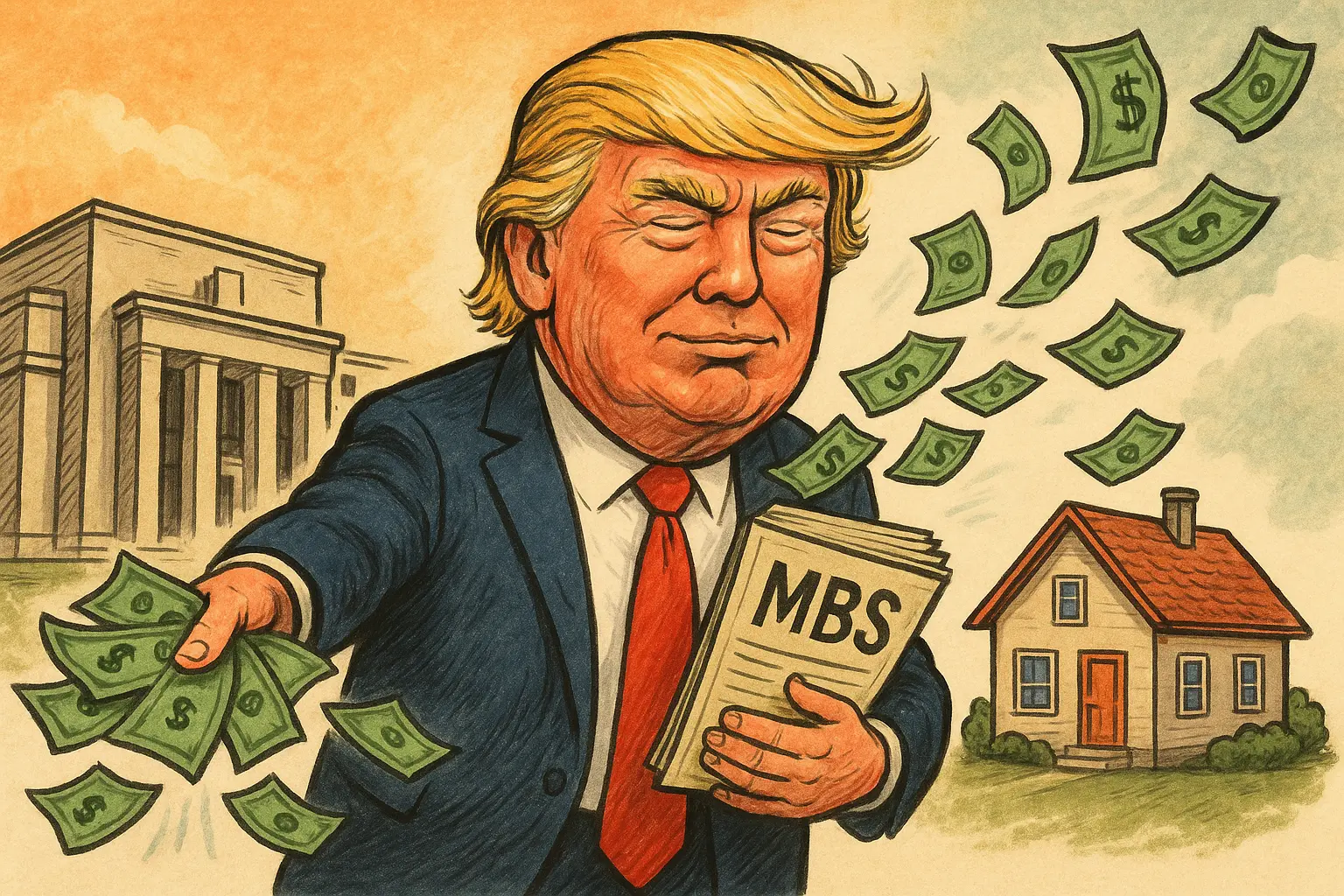
President Trump announces a $200 billion mortgage-backed securities purchase plan, with Fannie Mae and Freddie Mac each buying $100 billion, without Congressional approval. The goal is to reduce mortgage rates by 6.16%. Similar to 2008 QE but led by the President rather than the central bank. The housing crisis has severely damaged approval ratings, and although the Federal Reserve has cut interest rates by 75 basis points, mortgage rates remain high.
How Trump’s QE Works and Its Boundaries of Power
Trump posted on the “Truth Social” platform that he is “directing relevant agencies to purchase $200 billion worth of mortgage-backed securities.” “This move will drive down mortgage rates and monthly payments, thereby increasing Americans’ homebuying capacity,” Trump wrote. “This is one of the measures I am implementing to restore housing affordability, which the Biden administration has single-handedly destroyed.”
He added that during his first term, he decided not to sell Fannie Mae and Freddie Mac, allowing these two agencies to accumulate “$200 billion in cash,” and that his announcement was based on this reason. This statement reveals Trump’s forward-looking strategy, as holding these two agencies during 2017-2021 provided ammunition for current policy maneuvers.
Bill Pulte, Director of the U.S. Federal Housing Finance Agency, told the Financial Times that the bond purchases will be jointly executed by Fannie Mae and Freddie Mac. These government-sponsored enterprises primarily buy mortgages from lenders and repackage them into mortgage-backed securities. “We will leverage Fannie Mae’s strength to reverse the damage caused by President Biden over the past four years, including but not limited to strategic, large-scale purchases of mortgage-backed securities,” Pulte said. He added that this measure does not require Congressional approval.
Under existing agreements with the U.S. Treasury, each of these companies (Fannie Mae and Freddie Mac) is limited to holding $225 billion in mortgage investments. As of November 2025, each holds about $124 billion in these portfolios, meaning each can purchase an additional $100 billion in mortgage-backed securities. This figure matches the $200 billion plan announced by Trump, indicating it is the maximum feasible scale within current regulatory frameworks.
Three Major Differences Between Trump’s QE and the Federal Reserve’s QE
Decision-Making Authority: Trump directs the two agencies via executive order; the Fed’s QE is decided independently by the FOMC.
Funding Source: The agencies use their own cash; the Fed’s QE involves printing money to buy assets.
Target Assets: Only mortgage-backed securities are purchased; the Fed also buys Treasuries and corporate bonds.
Political Motivation: Directly responds to the housing crisis to boost approval ratings; the Fed emphasizes policy independence.
The Stubbornness of 6.16% Mortgage Rates and Policy Dilemmas
Despite multiple rate cuts by the Fed, the average 30-year fixed mortgage rate remains at 6.16%. Last year, the Fed lowered the federal funds rate target range by 75 basis points, bringing short-term rates down to 3.5-3.75%. This “short-term rates down, long-term rates stable” phenomenon reflects ongoing concerns about inflation and fiscal deficits.
Mortgage rates are typically linked to the 10-year Treasury yield, not directly to the federal funds rate. When markets anticipate persistent long-term inflation pressures or expanding government debt, the 10-year yield remains high, keeping mortgage rates elevated. This explains why, despite a 75 basis point rate cut, mortgage rates only fell from 7% to 6.16%, a much smaller decline than expected.
Trump previously pressured the Fed to cut rates sharply to stimulate the economy and lower borrowing costs for homebuyers. However, the Fed emphasizes its independence and refuses to succumb to political pressure. This deadlock prompted Trump to seek alternative measures—directly purchasing mortgage-backed securities through the two agencies to bypass the Fed and achieve lower mortgage rates.
His large-scale bond purchase plan echoes the policies after the 2008 financial crisis, when the Fed bought Fannie Mae and Freddie Mac bonds to stabilize the financial system and stimulate recovery. The key difference is that the 2008 QE was an emergency response to systemic collapse, whereas Trump’s 2026 QE is a proactive intervention aimed at lowering mortgage rates and boosting political support, under a stable financial system.
Housing Crisis and Trump’s Political Calculations
Since the pandemic, prices of essentials have surged, making it difficult for many Americans to maintain a decent standard of living. Trump has faced criticism for this. Notably, he previously claimed that the housing affordability crisis was a “scam.” But the reality is that high mortgage rates and housing costs have become one of the most urgent challenges for U.S. lawmakers.
This policy shift reflects Trump’s political pressure. With the 2026 midterm elections approaching, housing affordability directly influences middle-class voters’ choices. If mortgage rates can be lowered below 5% before the election, it could significantly boost Trump and Republican prospects. This political calculus makes the $200 billion QE seem more like an election strategy than an economic policy.
From a market perspective, purchasing $200 billion in mortgage-backed securities will push up bond prices, lower yields, and thus reduce mortgage rates. However, such artificial intervention may distort market signals. If inflation re-emerges, the Fed may need to raise interest rates again, offsetting Trump’s QE effects. This policy contradiction could surface in late 2026.
Overall, Trump’s personal QE signifies direct executive intervention in monetary policy. While the $200 billion scale is smaller than the Fed’s historical QE programs, it sets a precedent for presidents bypassing the central bank to implement similar QE measures. The long-term impact on the Fed’s independence and market confidence warrants close attention.
Disclaimer: The information on this page may come from third parties and does not represent the views or opinions of Gate. The content displayed on this page is for reference only and does not constitute any financial, investment, or legal advice. Gate does not guarantee the accuracy or completeness of the information and shall not be liable for any losses arising from the use of this information. Virtual asset investments carry high risks and are subject to significant price volatility. You may lose all of your invested principal. Please fully understand the relevant risks and make prudent decisions based on your own financial situation and risk tolerance. For details, please refer to
Disclaimer.
Related Articles
Trump announces lifting of oil sanctions, Bitcoin surges to $69,500, Ethereum breaks through $2,053, and liquidations reach $342 million
Bitcoin and Ethereum rebounded after Trump announced a temporary suspension of some oil sanctions, with Bitcoin soaring to a high of $69,537 and Ethereum reaching $2,053 at one point. Oil prices fell sharply, easing inflation pressures, and market liquidity expectations improved, leading to gains in risk assets. However, analysts warn that the US-Iran conflict could still impact shipping through the Strait of Hormuz, and the decline in global oil prices remains uncertain.
動區BlockTempo1h ago
Circle stock price increased by 9.7% in a single day, with a monthly cumulative increase of 86%
Circle (CRCL) stock price rose 9.7% on March 10, with a total increase of 86% over the past month. Analysis indicates that the situation in Iran has led to a rise in crude oil prices, boosting inflation expectations and potentially influencing the Federal Reserve's interest rate cuts. Meanwhile, high interest rates benefit stablecoin issuers, and changes in trader positions contributed to this significant surge.
GateNews2h ago
CICC: The risk of a 'stagflation-like' situation in the U.S. has further increased and been validated
CICC pointed out in its report that the U.S. economy faces a risk of "quasi-stagflation," with rising inflation stickiness, AI impacting employment, and increasing financial risks. The Federal Reserve's rate cuts may be delayed, economic growth is expected to slow down, risk premiums in the capital markets are rising, and capital allocation is tending toward risk aversion.
GateNews2h ago
Bitcoin funding rates hit a three-month low, are the bears "jumping the gun" before the non-farm payroll data?
This article analyzes the dynamics of the Bitcoin derivatives market, pointing out that before macroeconomic data releases, the market shows downward risks through funding rates, open interest, and liquidation data. Negative funding rates, high open interest, and the subsequent employment report collectively influence market direction, revealing how the derivatives market quickly reflects macro pressures and trader sentiment.
PANews3h ago
Analyst: If the US-Iran conflict persists for months, debt expansion could benefit Bitcoin
Macro strategist Mark Connors stated that if the conflict between the US and Iran continues, increased fiscal spending and debt expansion could benefit Bitcoin. He pointed out that war financing will increase the supply of US dollars, weaken the currency's value, and drive Bitcoin higher. Since the conflict began, Bitcoin has risen approximately 3.6%.
GateNews10h ago
Trump will review plans to curb oil prices, including measures such as restricting U.S. oil exports.
U.S. President Trump will review plans to curb oil prices on March 10, as oil prices have already exceeded $100 due to the Iran conflict. The White House is concerned that high oil prices could harm the economy, especially on the eve of the elections. Meanwhile, officials are discussing measures such as jointly releasing strategic reserve crude oil with the G7. Analysis indicates that ongoing conflict will limit the impact of policies on the global oil market.
GateNews10h ago


