Article by: 100y.eth
Compiled by: Saoirse, Foresight News
Under the “GENIUS Act,” stablecoin issuers are prohibited from paying interest to stablecoin holders.
However, currently, Coinbase is offering a 3.35% reward to users holding USDC on its platform. This is possible because the “GENIUS Act” only bans issuers from paying interest and does not restrict distributors.
Nevertheless, before the relevant Senate committee in the United States reviews the “Crypto Market Structure Bill” on January 15 (which aims to systematize cryptocurrency regulation), a debate has already fully erupted over “whether the interest ban on stablecoins should be extended to the distribution stage.”
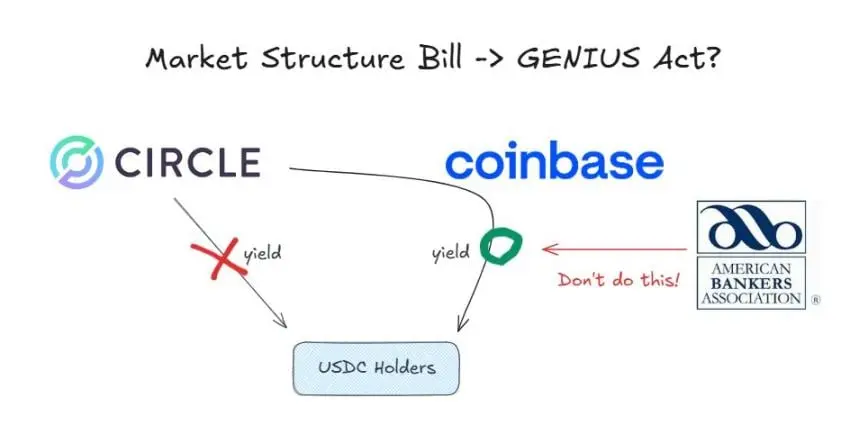
Strong Opposition from the Banking Industry
The American Bankers Association (ABA) is the main group calling for a complete ban on stablecoin interest payments. In a public letter released on January 5, the association advocates that the interest payment ban in the “GENIUS Act” should not only apply to issuers but should be broadly interpreted to include related parties. They are pushing to explicitly include this interpretation in the “Crypto Market Structure Bill.”
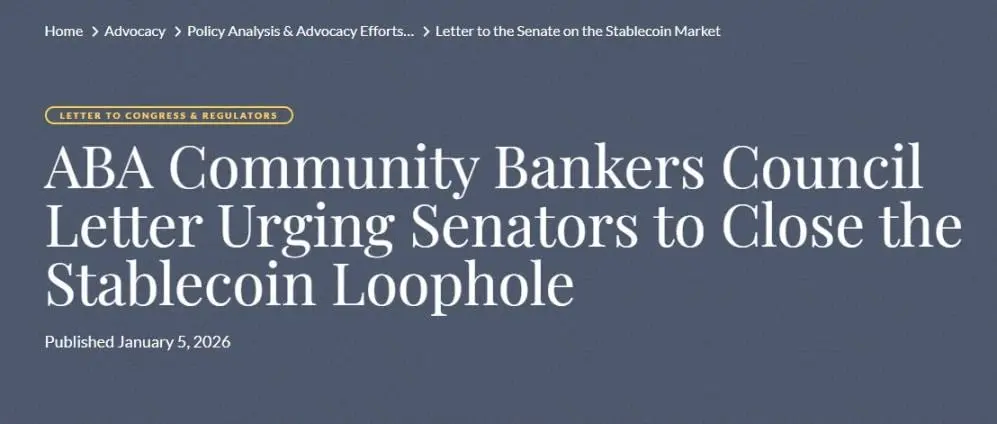
Reasons Behind the Banking Industry’s Firm Opposition
The banking sector’s desire to fully ban stablecoin interest payments is actually quite simple:
- Concern over outflow of bank deposits;
- Reduced deposits mean decreased lending capacity;
- Stablecoins are not insured by the Federal Deposit Insurance Corporation (FDIC).
Ultimately, stablecoins threaten the long-standing, stable, and highly profitable business model that the banking industry has relied on for decades.
Crypto Industry’s Counterattack
From the perspective of the crypto industry, the banking industry’s move is a major issue. If, due to lobbying pressure, the “Crypto Market Structure Bill” expands the restrictions of the “GENIUS Act,” it would effectively be a de facto rewriting and narrowing of the law. Unsurprisingly, this has triggered strong opposition from the crypto sector.
Coinbase’s Position
Coinbase Chief Policy Officer Faryar Shirzad countered by citing relevant research indicating that stablecoins have not caused substantial outflows of bank deposits. He also pointed to news about digital renminbi paying interest as new evidence in this debate.
Paradigm’s View
Alexander Grieve, Vice President of Government Affairs at crypto investment firm Paradigm, offered another perspective. He believes that even if stablecoins used solely for payment scenarios are allowed to pay interest, it is essentially a disguised form of “holding tax” on consumers.
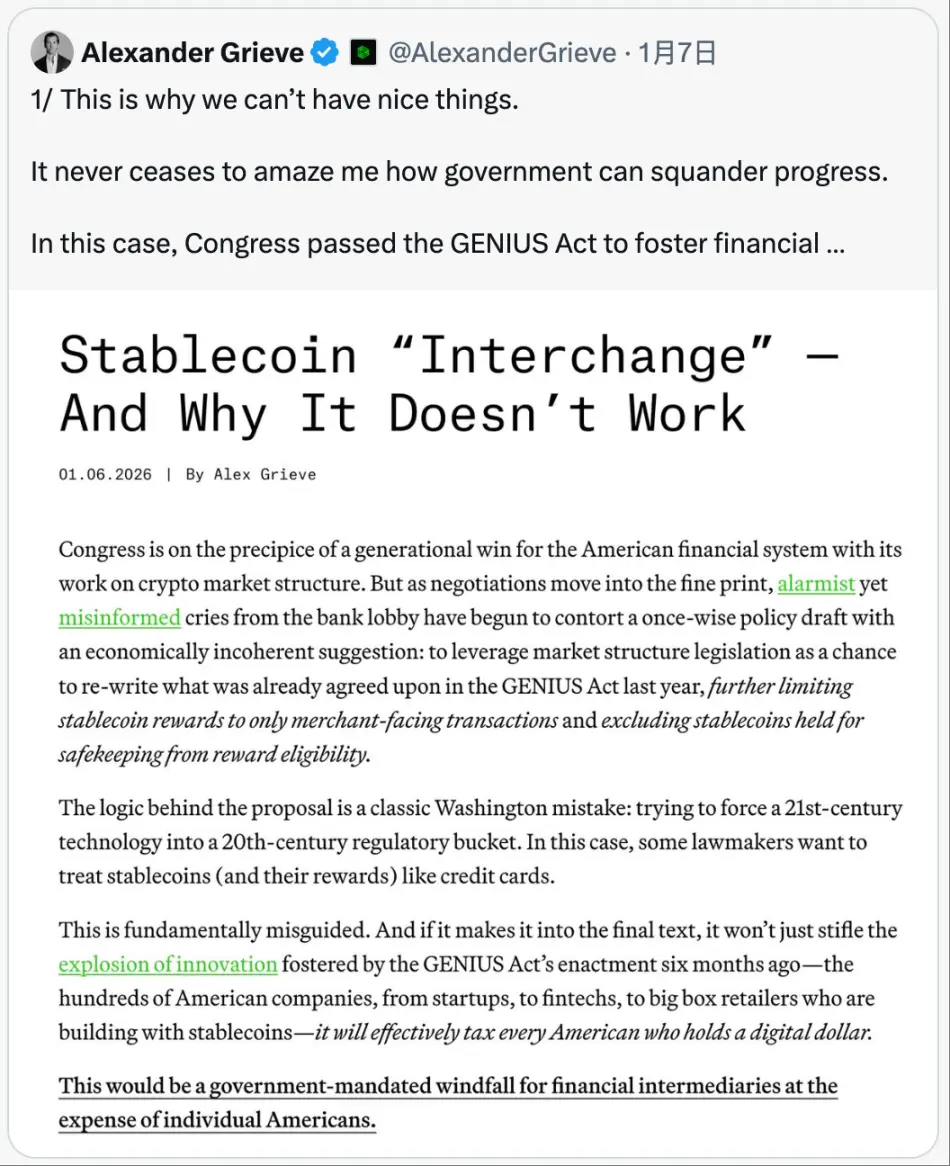
What About China and South Korea?
Although China and South Korea are not advancing their cryptocurrency policies as quickly as some other Asian countries, both have recently introduced a series of new measures related to central bank digital currencies (CBDCs) and stablecoin policies. The policy differences between the two countries on interest payments are particularly noteworthy:
China’s central bank has decided to pay interest on digital renminbi holdings, treating it the same as regular bank deposits to promote its adoption.
South Korea’s policy approach is closer to the US: it bans issuers from paying interest but does not explicitly prohibit distributors from doing so.
From a macro perspective, China’s aggressive stance is understandable. Digital renminbi is not a private stablecoin but a legal digital currency issued directly by the central bank. Promoting the digital renminbi can balance the dominance of private platforms like Alipay and WeChat Pay and strengthen a central bank-led financial system.
Conclusion
New technologies give rise to new industries, and the emergence of new industries often threatens traditional sectors.
Traditional financial institutions, represented by banks, are facing an irreversible trend toward the stablecoin era. At this juncture, resisting change is more harmful than beneficial; embracing transformation and exploring new opportunities is the smarter choice.
In fact, even for existing market participants, the stablecoin industry holds enormous opportunities. Many banks have already begun proactive layouts:
Bank of New York Mellon is developing custody services for stablecoin reserves;
Cross River Bank is acting as an intermediary for USDC fiat on-ramp via APIs;
JPMorgan is experimenting with tokenized deposits.
Major card organizations are also involved. As on-chain payment volumes continue to grow, traditional card organizations may face shrinking business. However, companies like Visa and Mastercard are not opposing this trend; instead, they actively support stablecoin payment settlements and seek new development opportunities.
Asset management firms are also entering the space. BlackRock and other funds are actively promoting the tokenization of various investment funds.
If the banking lobby succeeds in having the clauses banning stablecoin interest payments included in the “Crypto Market Structure Bill,” the crypto industry will suffer a heavy blow.
As a crypto industry practitioner, I can only hope that the “Crypto Market Structure Bill” will not include provisions that effectively nullify the “GENIUS Act.”
Disclaimer: The information on this page may come from third parties and does not represent the views or opinions of Gate. The content displayed on this page is for reference only and does not constitute any financial, investment, or legal advice. Gate does not guarantee the accuracy or completeness of the information and shall not be liable for any losses arising from the use of this information. Virtual asset investments carry high risks and are subject to significant price volatility. You may lose all of your invested principal. Please fully understand the relevant risks and make prudent decisions based on your own financial situation and risk tolerance. For details, please refer to
Disclaimer.
Related Articles
A certain whale has been longing EUR/USDC with 34x leverage over the past 4 days, with a position size of approximately 1.04 million USD.
On March 16, a whale starting with 0x133 opened a long position of approximately $1.04 million on EUR/USDC with 34x leverage, currently showing an unrealized loss of about 10%. The US job market is cooling with rising unemployment rates, and CPI year-over-year is approximately 2.4%. Market attention is focused on the Federal Reserve's interest rate decision on March 19.
GateNews3h ago
Whale "0x218" Deposits $2M USDC to HyperLiquid to Prevent ETH Short Position Liquidation
Gate News bot message, in the past 10 hours, whale "0x218" deposited $2M USDC into HyperLiquid to avoid liquidation on its ETH short position with 10x leverage. The position consists of 15,217 ETH valued at $34M, currently showing a floating loss of $3.288M. Despite the current loss on this position
GateNews4h ago
DeFiance Capital Founder: Going long on cryptocurrencies and shorting stocks trading strategies may be attractive, as USDC supply returns to a historical high
DeFiance Capital founder Arthur believes that the current stock market is priced too optimistically, and market shifts will accelerate adjustments. He thinks that Bitcoin and crypto assets present opportunities to perform amid uncertainty, and recommends a "long crypto, short stocks or high-yield bonds" strategy. Additionally, he mentioned that USDC supply has rebounded to historical highs, which may drive CRCL growth.
GateNews4h ago
Balaji Srinivasan Calls for Development of Refugee Crypto Tools, Stablecoins May Become Financial Solution for Global Displaced Persons
Former CEX Chief Technology Officer Balaji Srinivasan is calling on the crypto industry to develop blockchain-based financial tools for refugees and stateless persons to address service gaps caused by population migration. He points out that traditional financial systems often fail during conflicts, while blockchain possesses interference-resistant capabilities. However, despite the demand, related products targeting this demographic remain limited. Stablecoins are playing an increasingly significant role in fund flows, and the future requires more cryptocurrency financial tools oriented toward vulnerable populations.
GateNews6h ago
Whale Deposits 1.5 Million USDC to HyperLiquid Again, Opens 20x Leveraged Brent Crude Oil Short Position
Gate News: On March 16, according to Onchain Lens monitoring, whale address "0xF78" deposited another 1.5 million USDC to HyperLiquid, bringing the cumulative deposit amount to 7.1 million USD, and opened a 20x leveraged short position on BRENTOIL (Brent Crude Oil). Additionally, the whale currently holds a short position on CL (crude oil futures) worth 8.8 million USD, also using 20x leverage.
GateNews8h ago


