Bitcoin rebounded on Tuesday by 2.05% to around $79,000, with RSI dropping to 28 indicating extreme oversold conditions. MicroStrategy purchased 855 BTC, bringing its total holdings to 713,502 BTC. The White House convened a stablecoin summit, injecting policy expectations. Previously, uncertainty was triggered by Trump’s nomination of Kevin Waugh as Federal Reserve Chair, causing BTC to dip to $74,532.
MicroStrategy’s Contrarian Accumulation Provides Institutional Support
The reason for Bitcoin’s rebound today from an institutional perspective comes from Michael Saylor’s steadfast buying. Strategy used the price dip as an opportunity, purchasing an additional 855 BTC at $75,300,000, bringing its total holdings to 713,502 BTC. The average cost of this purchase is about $88,070 (75,300,000 ÷ 855), well above the current market price, but Strategy’s overall average cost remains at $76,052, with a total investment of $54.26 billion.
MicroStrategy’s continuous buying acts as a stabilizing sentiment during market panic. When the price fell to $74,532, it briefly broke below Strategy’s average cost line of $76,052 for the first time since late 2023. Market concerns include the possibility of MicroStrategy incurring unrealized losses, being forced to sell, or facing margin pressure. However, Saylor’s contrarian accumulation clearly signals: even with paper losses, MicroStrategy remains bullish on Bitcoin’s long-term prospects and views the current price as a good entry point.
Since these holdings are uncollateralized, despite short-term unrealized losses, the company currently faces no liquidity risk. This is crucial because it alleviates fears of forced liquidation. Unlike leveraged traders, MicroStrategy’s Bitcoin holdings are financed through equity, with no margin call risk. This financial structure allows MicroStrategy to hold its position at any price level.
Analysts see persistent accumulation during weak periods as a bullish signal, reducing available supply and indicating that major institutions view deep pullbacks as strategic buying opportunities. MicroStrategy’s buying also sets a reference for other institutional investors. When market leaders buy in panic, it often attracts followers, creating a concentrated dip-buying effect. This institutional-level bottom-fishing is a key driver behind Bitcoin’s rebound today.
White House Stablecoin Summit Injects Policy Expectations
The third reason for Bitcoin’s rebound today is that the White House convened a high-level meeting with crypto startups and major banks to discuss the controversial stablecoin yields. This meeting injects expectations of policy clarity, easing regulatory uncertainty.
Traditional banks and crypto firms are engaged in fierce debate over stablecoin yields. Banks advocate for limiting yields, fearing large amounts of savings account funds will flow out. Standard Chartered warns that if yields are not restricted, developed countries could lose $500 billion by 2028. Crypto firms argue these restrictions hinder competition, but opinions are divided.
Cody Carbone, CEO of the Digital Chamber of Commerce, said, “Today’s White House meeting is a step toward addressing one of the biggest obstacles to legislative progress in market structure.” White House crypto advisor Patrick Vetter described Monday’s meeting as “constructive, fact-based,” and “solution-oriented,” expressing confidence that representatives and officials will soon reach an agreement.
This meeting follows over two weeks of delay by the Senate Banking Committee in deliberating the CLARITY Act. Issues expected to be discussed before resumption include tokenized stocks, decentralized finance, ethics of elected officials investing in crypto, and stablecoin reward mechanisms. If the summit results in clearer, not more restrictive, rules, it will eliminate regulatory uncertainty premiums and support Bitcoin prices.
Market’s desire for regulatory clarity far exceeds concerns over specific rule details. Even if final rules impose limits on stablecoin yields, a clear and predictable framework is more conducive to market development than the current gray area. The White House’s proactive engagement indicates the Trump administration’s intent to accelerate crypto legislation, and this policy progress itself is a positive signal.
Extreme Oversold Conditions Trigger Technical Short Squeeze
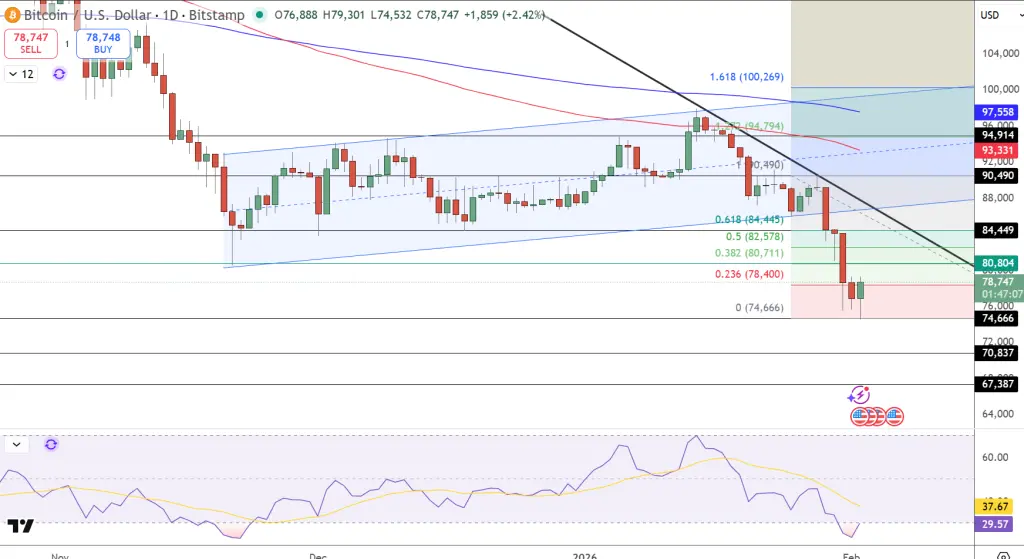
(Source: Trading View)
The primary technical reason for Bitcoin’s rebound today is the extremely oversold state. Bitcoin’s price fell to a low of $74,532 on February 2, confirming a decisive break below the psychological $80,000 level. This sharp decline caused the Relative Strength Index (RSI) to plunge to around 28, indicating an oversold condition, which often signals an impending “short squeeze” rebound.
An RSI below 30 is considered oversold, and a reading of 28 is extremely oversold. In such cases, selling pressure has been overextended, and even minor buying can trigger a strong rebound. A short squeeze occurs when, as the price begins to rise, traders with short positions are forced to cover (buy back) to cut losses, further driving up the price in a self-reinforcing upward cycle. The 2.05% rebound on Monday may be a manifestation of this mechanism.
From Fibonacci retracement perspective, Bitcoin is currently testing the 0.236 Fibonacci level at $78,400. The rebound today is closely related to holding this technical support. Failing to defend this level could lead to retesting the $74,666 support or the liquidity zone around $70,837. Conversely, a sustained move above $78,400 would confirm a higher low, an early sign of trend reversal.
On the resistance side, the levels at $80,706 and $84,449 (0.5 Fibonacci) have become strong dynamic resistance, limiting short-term recovery attempts. To confirm a genuine rebound, Bitcoin needs to break through $80,706, clearing out many trapped positions and stop-loss orders. Further突破 above $84,449 would open the way to higher prices.
Three Key Technical Factors Behind Bitcoin’s Rebound
RSI 28 Extreme Oversold: Excessive selling pressure, automatic technical buy-in
$78,400 Fibonacci Support: Key technical zone with concentrated buy orders
Short Squeeze Mechanism: Rebound triggers short covering, creating chain reaction of buying
If Bitcoin rebounds from $74,700, consider going long with a target of $80,700. Set stop-loss below $72,000 to hedge against liquidity issues from Fed policy adjustments. This trading strategy offers about a 1:3 risk-reward ratio, aligning with professional trading standards.


