
With about two and a half years until the 2028 U.S. presidential election, crypto prediction markets have opened early and are seeing staggering trading volumes. Although Vice President JD Vance’s net approval rating has fallen by 21 percentage points over the past 15 months—hitting a modern polling-era record low for the start of a vice president’s term—both Polymarket and Kalshi, the two major prediction platforms, still show him holding onto first place in the 2028 U.S. presidential election by a narrow margin.
Approval rating free-falls: Vance drops to a new modern low for a vice president
CNN data analyst Harry Enten recently noted that Vance’s net approval rating, as of early April 2026, has fallen to -18. As indicated by a late March CNN/SSRS poll, 37% approve and 62% disapprove; a Civiqs survey on April 8 also showed 37% favorability corresponding to 57% disfavor. Compared with the small positive reading when he took office in January 2025, the drop totals 21 percentage points.
Enten pointed out that this is the lowest net approval rating recorded in modern polling for the early period of any vice president’s term. Worth noting: during their terms, former vice presidents Dan Quayle and Dick Cheney both saw disapproval rates that came close to 60%, but that may not have been at the same point in their respective terms; this comparison is mainly used as a trend signal rather than a definitive historical judgment.
The decline in approval can be traced back to multiple macro pressures: after the U.S. military carried out airstrikes on Iranian targets, gasoline prices climbed to more than $4 per gallon; only 27% of the public approve of the government’s inflation management; tariff policies and intensifying supply-chain friction have heightened perceived cost-of-living burdens; and in 2024, measurable backsliding appeared among Latino voters, younger voters, and independent voters who had shifted to support the Trump–Vance ticket.
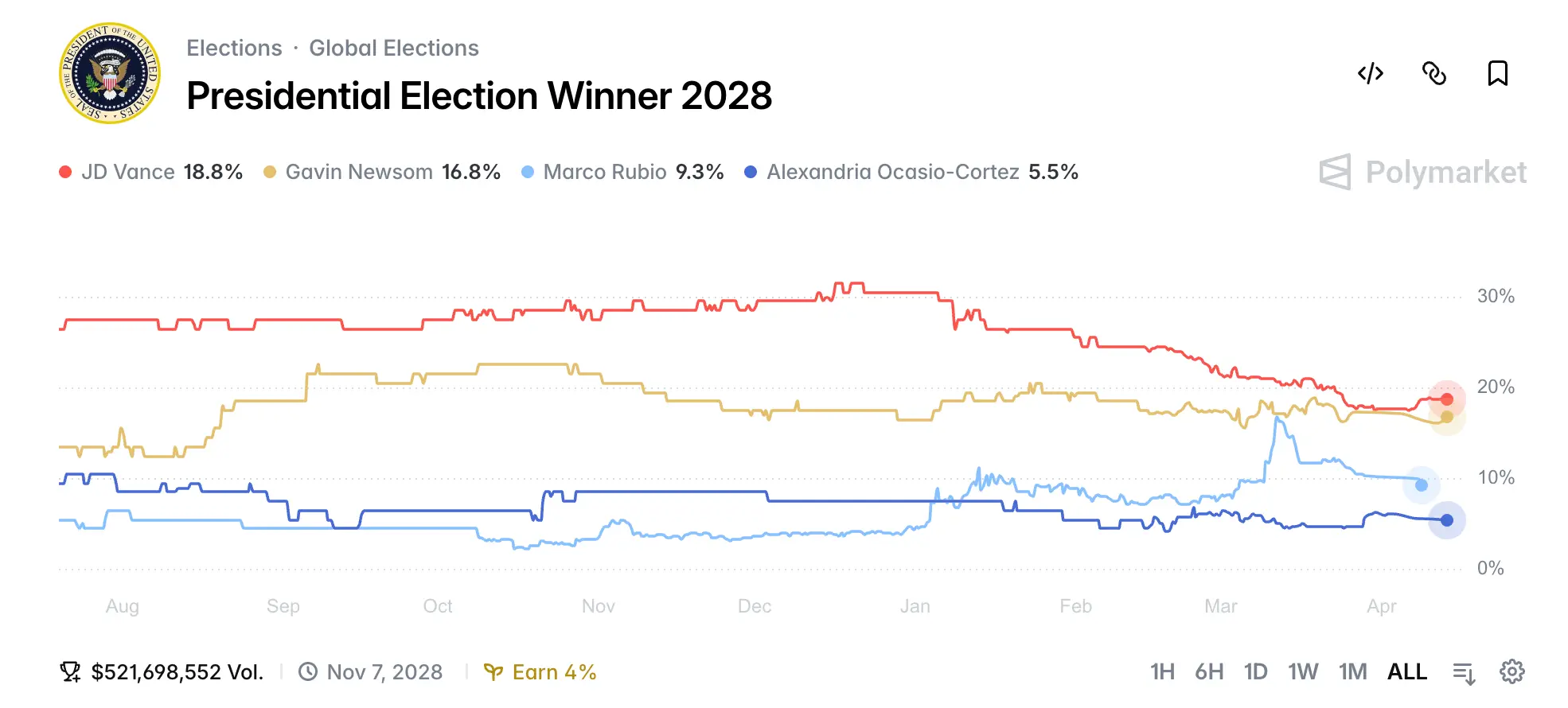
Prediction market data: $521.6 million bet on the 2028 U.S. election on Polymarket
 (Source: Polymarket)
Even with approval dropping to a historic low, Vance still holds the top spot in 2028 win odds on both major platforms, though his advantage has narrowed dramatically compared with 15 months ago. Polymarket’s 2028 U.S. election market has a total trading volume of $521.6 million, while Kalshi’s 2028 election market has a total trading volume of about $28.9 million.
Win odds for the main candidates on the two platforms (April 13, 2026)
JD Vance (Vice President): Polymarket 18.9% | Kalshi 21%
Gavin Newsom (Governor of California): Polymarket 16.9% | Kalshi 17%
Marco Rubio (Senator): Polymarket 9.5% | Kalshi 13%
AOC (Alexandria Ocasio-Cortez): Polymarket 5.5% | Kalshi 6.4%
Donald Trump (incumbent president): Kalshi 2.6%
Non-traditional candidates: LeBron James and Kim Kardashian each at 1%, accounting for trading volumes of $46.40 million and $32.80 million, respectively—reflecting the fact that some traders are making purely speculative setups
Outlook on the political landscape: the gap is narrowing, but the election is still far off
Vance’s approval rating trend lines up closely with Trump’s own—Trump, in recent polling across multiple outlets including CNN, Reuters/Ipsos, and the University of Massachusetts, has already slid into the low-to-mid 30% range, making it clear that public opinion for the governing party overall is under pressure.
Analysts caution that polling data itself comes with a margin of error, and public sentiment can change quickly. If an Iran ceasefire agreement remains solid, oil prices fall, or anxiety about inflation eases, it’s possible for approval trends to stabilize again. With about two and a half years left until the 2028 election and prediction markets already open, the competitive landscape remains open—Vance currently stays ahead on both platforms, but his advantage is shrinking day by day.
Frequently asked questions
Why is JD Vance’s approval rating described as a “historic low for a vice president”?
Based on an analysis by CNN data analyst Harry Enten, Vance’s net approval rating (-18) recorded at the start of his term is the lowest among vice presidents with modern records. Since he took office in January 2025, it has fallen by 21 percentage points, mainly due to the combined impact of rising gasoline prices, dissatisfaction with inflation, and tariff policy.
What does the 2028 U.S. election payout odds in prediction markets mean?
Prediction markets reflect traders’ probability judgments based on real money, not a direct conversion of poll results. Polymarket’s 2028 election market has accumulated a trading volume of $521.6 million, indicating some market depth, but with two and a half years still left until the election, uncertainty in early positioning is extremely high. Rapid changes in odds are the norm.
Does Gavin Newsom really have a chance to surpass Vance?
Right now, Newsom is closely trailing Vance, at 16.9% on Polymarket and 17% on Kalshi; the gap between the two platforms is also steadily shrinking. He has the highest odds among Democratic candidates, and as pressure on the governing party’s public opinion intensifies, the political environment may shift further toward challengers. However, prediction-market odds can be reshuffled at any time due to sudden political events.
Disclaimer: The information on this page may come from third parties and does not represent the views or opinions of Gate. The content displayed on this page is for reference only and does not constitute any financial, investment, or legal advice. Gate does not guarantee the accuracy or completeness of the information and shall not be liable for any losses arising from the use of this information. Virtual asset investments carry high risks and are subject to significant price volatility. You may lose all of your invested principal. Please fully understand the relevant risks and make prudent decisions based on your own financial situation and risk tolerance. For details, please refer to
Disclaimer.
Related Articles
Premier League Tottenham vs Brighton is a crucial matchup, with Polymarket forecasting a 50% chance that Tottenham will be relegated
Tottenham Hotspur this season has surged from Europa League champions all the way to the relegation zone, facing a relegation battle. In the 14 matches without a win, the team has been hit by a series of injuries and a change in head coach, and an ESPN report says that poor passing ability is a key factor. Sunday’s match against Brighton will be a do-or-die game for survival; if they lose, it will seriously affect morale and the standings. Successful survival requires three major conditions, and for a former “pyramid” club, relegation will inevitably cause a major loss.
ChainNewsAbmedia2h ago
Hong Kong SFC Investment Committee Warns Prediction Market Trading May Constitute Illegal Gambling
The Hong Kong SFC warns that prediction markets are speculative and not investment products, lacking regulatory protection. They involve gambling elements, potentially making them illegal. The committee urges the public to differentiate between investment and gambling.
GateNews4h ago
Prediction Markets Show Stark Wealth Concentration: 84% of Traders Lose Money
Prediction markets show stark wealth concentration, with 84.1% of Polymarket traders losing money, while just 0.04% hold over 70% of profits. Legislative efforts like the BETS OFF Act aim to regulate betting on sensitive events, as concerns rise over user protections amid the entry of major financial institutions.
GateNews12h ago
DAZN Partners with ADI Predictstreet to Launch Blockchain Prediction Market for 2026 World Cup
DAZN partners with ADI Predictstreet to introduce a blockchain prediction market for the 2026 FIFA World Cup. Users can engage in real-time predictions, utilizing advanced technology for privacy and scalability, despite regulatory challenges in Europe.
GateNews18h ago
Hong Kong Suspends Basketball Betting Project Amid Concerns Over Prediction Markets and Illegal Gambling
Hong Kong's government has suspended its basketball betting project due to concerns over the rapid growth of prediction markets linked to illegal gambling. With monthly trading volumes rising dramatically, authorities aim to enhance public education and collaborate on measures against gambling.
GateNews04-17 08:01
Hong Kong suspends the legalization of basketball betting and studies the impact and compliance issues of prediction markets
Hong Kong has suspended the legalization of basketball betting this week, while also planning to launch a study to assess the impact of prediction markets in Hong Kong and their level of adoption. Macie Mak, Commissioner for Home and Youth Affairs in Hong Kong, said that the monthly trading volume of prediction markets has grown from less than $100 million two years ago to more than $13 billion last year, with about 40% related to sports.
MarketWhisper04-17 06:02


