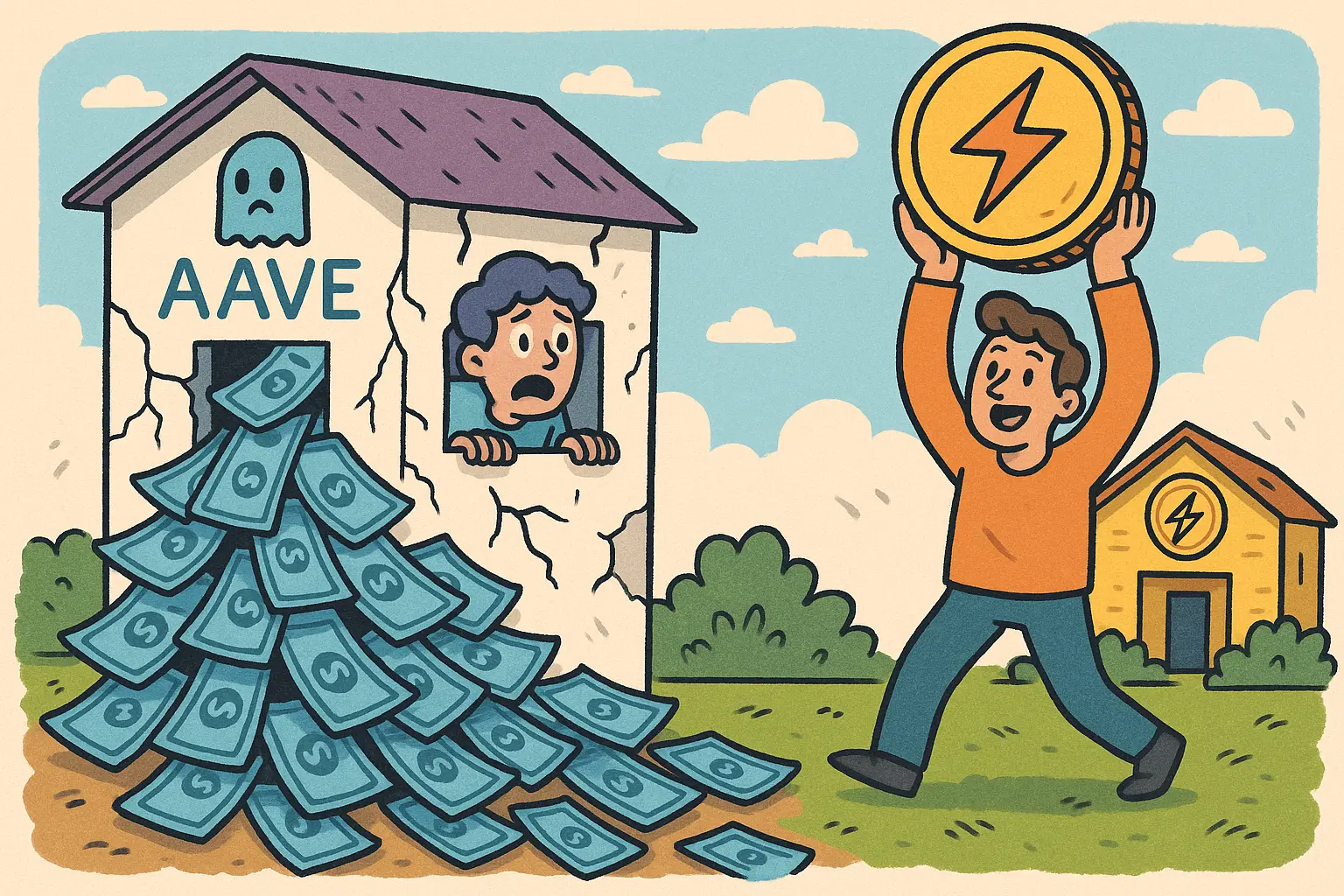
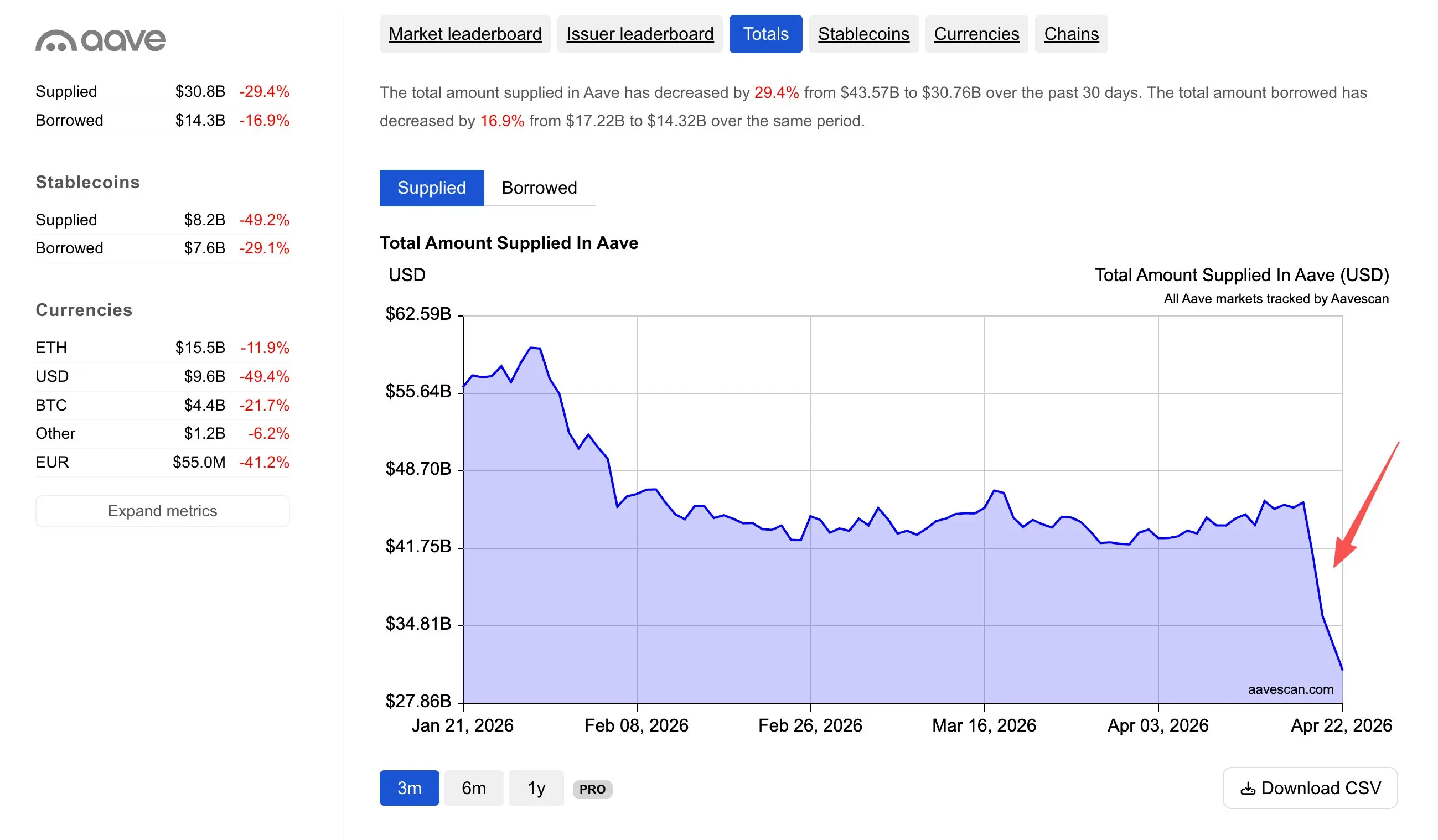
On April 22, on-chain analysts Yuyan showed that, affected by the rsETH/KelpDAO incident, Aave funds continued to flow out, with total deposits falling from $48.5 billion to $30.7 billion in just three and a half days. Morpho saw a modest outflow of $1.5 billion over the same period. The most notable contrast came from Spark: its SparkLend business TVL went against the trend, rising from $1.9 billion to $3.2 billion.
A split among three major platforms: Aave bleeds while Spark benefits in the opposite direction
(Source:Aave)
During this incident, three major mainstream DeFi lending platforms showed sharply different trends:
Aave: down from $48.5 billion to $30.7 billion, with net outflows of $15.1 billion in three and a half days (a drop of about 31%).
Morpho: down from $11.7 billion to $10.2 billion, net outflows of about $1.5 billion, with relatively limited impact.
Spark (SparkLend): up from $1.9 billion to $3.2 billion, net inflows of about $1.3 billion, making it the biggest beneficiary of the market turbulence this time.
Some institutional funds withdrawing from Aave redeployed into Spark, indicating that after the rsETH incident, some market participants chose a comparatively safer alternative platform.
Aave’s bad-debt outlook: Defillama’s founder presents two scenario analyses
Defillama founder @0xngmi provided two scenario analyses on how the recovery of $71 million worth of ETH on Arbitrum would affect Aave’s bad-debt size:
Scenario one (loss socialized): If Arbitrum prioritizes support for the Aave market and socializes the loss, then each rsETH holder’s position would be reduced evenly by 18.5%, Aave’s bad debt would be about $216 million, and the Treasury and Umbrella Fund would need to be used.
Scenario two (loss borne by L2 holders): If the loss is borne only by L2 rsETH holders, then Aave’s bad debt on Arbitrum would fall from about $88 million to about $17 million, cutting it by roughly 80%, but it could trigger dissatisfaction and potential lawsuits.
Market sentiment stabilizes: AAVE rebounds from the low, the DeFi industry calls for facing the recovery
After the Arbitrum Security Council froze about 307,776 ETH (about $71 million) in KelpDAO-related addresses, Santiment data showed that Aave market sentiment was no longer falling to new lows. The AAVE token rebounded from the $80 low on April 20 to around $93.59, and the TVL decline trend also began to level off.
Dragonfly managing partner Haseeb Qureshi said, “AAVE may take on some bad debt, but it has enough net worth to repay it.” Defillama’s founder emphasized, “DeFi will be hit, but it won’t disappear,” and believes that through protocol treasuries and adjustments, affected protocols such as Aave can “fully recover.”
Frequently asked questions
Why can Spark grow against the trend while Aave bleeds?
Spark benefited from this incident mainly because some market participants view it as a relatively safe alternative platform, especially amid the backdrop of Aave facing bad-debt risk. The transfer of institutional funds also further attracted other watch-and-wait funds to follow, creating a positive inflow effect.
How much could Aave’s bad debt ultimately reach?
Based on Defillama’s founder’s two scenario analyses, Aave’s bad debt is expected to range from $17 million to $341 million, depending on how Arbitrum disposes of the seized ETH and how the rsETH loss is allocated. Aave DAO currently holds $181 million in assets and about $54 million in the WETH Umbrella Fund as a buffer.
How does the DeFi industry assess the impact of this incident on the broader ecosystem?
Mainstream views tend to see the incident as a process of DeFi “learning from failure.” Executives from Dragonfly and Defillama both said the protocols have enough capital and mechanisms to absorb losses. Arbitrum’s coordinated freezing actions are viewed as a positive governance precedent, and overall optimism has begun to emerge in the community.
Disclaimer: The information on this page may come from third parties and does not represent the views or opinions of Gate. The content displayed on this page is for reference only and does not constitute any financial, investment, or legal advice. Gate does not guarantee the accuracy or completeness of the information and shall not be liable for any losses arising from the use of this information. Virtual asset investments carry high risks and are subject to significant price volatility. You may lose all of your invested principal. Please fully understand the relevant risks and make prudent decisions based on your own financial situation and risk tolerance. For details, please refer to
Disclaimer.
Related Articles
Michael Saylor: Bitcoin’s winter is over; institutional and sovereign adoption could fuel the next uptrend
Gate News message, April 25 — Michael Saylor, co-founder of MicroStrategy, said "winter's over" as Bitcoin climbed to approximately $78,000, signaling a shift in market sentiment.
According to analyst Mati Greenspan, recent market moves since the flash crash have been corrections within a broader bull market, with Bitcoin's bottom now in place. Greenspan believes the next leg of gains will be driven by "sovereign adoption," including central banks adding BTC alongside gold to their reserves.
Governments and institutions are increasingly incorporating Bitcoin into their holdings. The U.S. government currently holds approximately 300,000 BTC and has discussed establishing a strategic Bitcoin reserve. El Salvador continues making daily purchases, while the U.K. government and several U.S. state pension funds have added Bitcoin to their asset allocations.
GateNews9m ago
SHIB Reserves Hit 61.8T Amid Mixed Signals of Selling Pressure and Accumulation
Gate News message, April 25 — Shiba Inu's on-chain metrics reveal diverging market forces as a major CEX's SHIB reserves climbed to 61.8 trillion tokens, while simultaneously around 86 billion SHIB moved out of exchanges. Data from CryptoQuant shows the reserve increase began around mid-March and
GateNews43m ago
SHIB Nears Breakout Point After Revisiting Powerful Support Level
SHIB revisits a key support zone that previously triggered major price rallies.
Price compression and accumulation signals suggest a potential breakout ahead.
Analysts project strong upside, though market conditions may limit extreme gains.
Shiba Inu has returned to a price level that on
CryptoNewsLand4h ago
PEPE Price Outlook: The Case for a Surprise ‘Disbelief Rally’ Ahead
PEPE shows weak sentiment with falling price, volume, and Open Interest.
Heavy short bias may trigger a surprise rally through liquidation clusters.
Range-bound price suggests a possible trap before continuation of bearish trend.
PepeCoin — PEPE, has taken another hit, and sentiment
CryptoNewsLand5h ago
Crypto Fear and Greed Index Drops to 30, Signals Panic State
Gate News message, April 25 — The Crypto Fear and Greed Index currently stands at 30, down 8 points from yesterday, according to Coinglass data. The seven-day average is 33, while the 30-day average is 18, indicating a shift toward panic sentiment in the
GateNews6h ago
Not Too Late Yet: Altcoins Eye Rapid Move Ahead of Economic Uncertainty — 5 Picks Investors Are Watching
Market rotation is splitting attention between meme coins and infrastructure-driven blockchain projects.
TAO and FIL reflect stronger alignment with emerging tech and data infrastructure narratives.
DOGE and SHIB remain primarily driven by retail sentiment and short-term volatility
CryptoNewsLand9h ago


