
American trading influencer ImanTrading recently released an investigative video on YouTube, accusing the popular trading influencer TJR (Tyler Riches), who has millions of followers, of multiple suspicious activities related to trading performance and sources of wealth. The allegations include performance falsification, oversubscription of courses, and profit-taking after promoting cryptocurrencies. The video has sparked widespread discussion and brought attention to long-standing issues within Taiwan’s crypto community, such as fake trading accounts, exaggerated wealth narratives, and controversies over paid courses.
Core Revelations: Four Interconnected Allegations
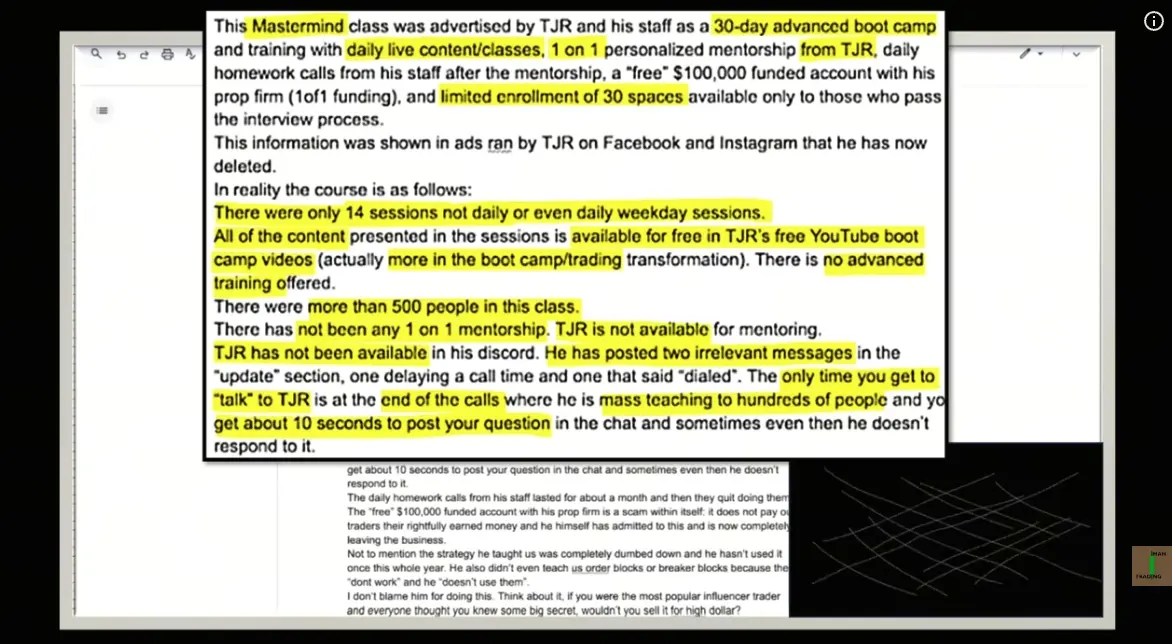 (Source: YouTube)
ImanTrading presents a series of specific accusations, focusing on:
Contradictory Performance Screenshots: TJR’s early rise to fame relied on a MetaTrader screenshot showing a $100,000 profit, recorded before he borrowed money from friends to trade. The whistleblower questions: if he already had $100,000 profit, why did he need to borrow funds?
Self-Entered Trading Logs: The performance shown during TJR’s live streams comes from a trading log app where data is manually entered, not from official broker accounts. The whistleblower believes this method could artificially inflate performance results.
Unrepaid Client Trading Losses: The video shows TJR solicited funds from university friends between 2021 and 2022, promising to trade on their behalf. The funds ultimately suffered losses, and some friends had to contact family members to recover their money. Investor Frank only received a refund in July 2022.
Oversubscribed Courses: The “Mastermind Course” claims to limit one-on-one guidance to 30 students, but some students report there are over 500 participants, making personalized guidance nearly impossible. At $4,000 per student, the estimated revenue from 500 students reaches $2 million.
Cryptocurrency Promotion Controversy: On-Chain Data Indicates Pump-and-Dump
The video also reviews several crypto projects promoted by TJR. The whistleblower points out that some tokens experienced rapid price increases following promotion, then declined by over 90%. On-chain data shows TJR-related wallets bought tokens before promotion and sold after, profiting from the price swings. The promotion costs are estimated to total around $45,000. The whistleblower also notes that many of TJR’s followers are teenagers, with some content teaching minors how to bypass age restrictions to open trading accounts, and using luxury cars and lifestyles to attract young, inexperienced buyers to purchase courses.
Parallel Phenomena in Taiwan’s Crypto Scene: Three Common Issues
The pattern exposed by the TJR incident closely mirrors long-standing problems in Taiwan’s crypto community. Market observers highlight three common phenomena:
Fake Trading Accounts Masking Real Positions: Some accounts display “profit screenshots” over extended periods, raising suspicion that these are fake or simulated accounts. Since simulated trading involves no real funds, exaggerated performance screenshots are easier to produce, creating a “paper millionaire” illusion.
Exaggerated Wealth Narratives: Success stories claiming “small capital doubles” or “turning tens of thousands into hundreds of thousands” frequently appear on social media, often accompanied by luxury cars and lavish lifestyles. These stories usually lack comprehensive trading records or long-term performance proof, and are often used as marketing tactics to attract traffic.
Paid Community Business Models: Selling signals, trade-copying services, or courses via Telegram, Discord, or private groups has become a common way to monetize followers. Whether these “teachers” truly possess consistent trading skills remains a long-term controversy.
Frequently Asked Questions
Q: What is the core controversy of the TJR incident?
A: The whistleblower ImanTrading accuses TJR of using a self-input trading log app instead of real broker accounts for performance records, overselling courses with a limit of 30 students but actually enrolling over 500, and engaging in pre-promotion accumulation and post-promotion liquidation of cryptocurrencies. TJR has yet to respond officially, and the case continues to develop.
Q: What is “simulated account exposure,” and why is it controversial?
A: Simulated accounts use virtual funds for practice, with no real financial risk, making performance records more idealized. If a trading influencer uses simulated screenshots to pretend they are real trades, it misleads followers and students about their actual ability, constituting consumer deception.
Q: How can investors verify if a trading influencer’s performance is genuine?
A: Key methods include requesting official account reports from regulated brokers instead of self-made screenshots; examining long-term performance rather than single high-profit screenshots; checking if course sales are their main income; and monitoring on-chain fund flows related to promoted tokens.
Disclaimer: The information on this page may come from third parties and does not represent the views or opinions of Gate. The content displayed on this page is for reference only and does not constitute any financial, investment, or legal advice. Gate does not guarantee the accuracy or completeness of the information and shall not be liable for any losses arising from the use of this information. Virtual asset investments carry high risks and are subject to significant price volatility. You may lose all of your invested principal. Please fully understand the relevant risks and make prudent decisions based on your own financial situation and risk tolerance. For details, please refer to
Disclaimer.
Related Articles
Polish lawmakers want to overturn the president’s veto of the cryptocurrency bill but failed again in their latest attempt to push it through.
Poland’s parliament failed to override the president’s veto of the cryptocurrency regulatory bill, stalling the process of digital-asset legislation and making it one of the few countries in the EU that has not yet implemented the MiCA framework. Differences between the president and the government over the bill’s content led to a political stalemate, affecting market confidence and legal transparency.
ChainNewsAbmedia1h ago
Polish Parliament Fails to Override President's Veto on Crypto Law; PM Alleges Russian Interference
Polish lawmakers failed to override President Nawrocki's veto on a cryptocurrency regulation bill aimed at aligning with EU standards. Tensions rise as accusations emerge of Russian influence in a major crypto exchange amid liquidity issues and lack of regulation.
GateNews3h ago
White House Mediates Clarity Act Stablecoin Dispute, Witt Reveals Legislative Timeline
Patrick Witt announced at the Solana Policy Institute summit that the White House mediated a stablecoin dispute to advance the Clarity Act. The compromise allows banks and crypto firms to together address regulatory concerns, with future focus on crypto taxation and blockchain integration strategies among financial institutions.
GateNews10h ago
Hong Kong SFC Investment Committee Warns Prediction Market Trading May Constitute Illegal Gambling
The Hong Kong SFC warns that prediction markets are speculative and not investment products, lacking regulatory protection. They involve gambling elements, potentially making them illegal. The committee urges the public to differentiate between investment and gambling.
GateNews12h ago
Economist Proposes National USD Stablecoin to Eliminate Currency Controls in Venezuela
Alejandro Grisanti, head of Ecoanalitica, proposed issuing a national USD stablecoin as part of a series of measures to lift currency controls in Venezuela. This system would complement the current auction system, allowing the excluded sector to receive dollars via blockchain rails.
Key
Coinpedia14h ago
Elizabeth Warren Accuses SEC Chair Paul Atkins of Misleading Congress Over Enforcement Decline
Senator Elizabeth Warren accused SEC Chair Paul Atkins of misleading Congress about enforcement actions' decline. With only 456 new cases in 2025, concerns arise regarding the SEC's effectiveness and the regulatory landscape for cryptocurrency and market oversight.
GateNews15h ago


