
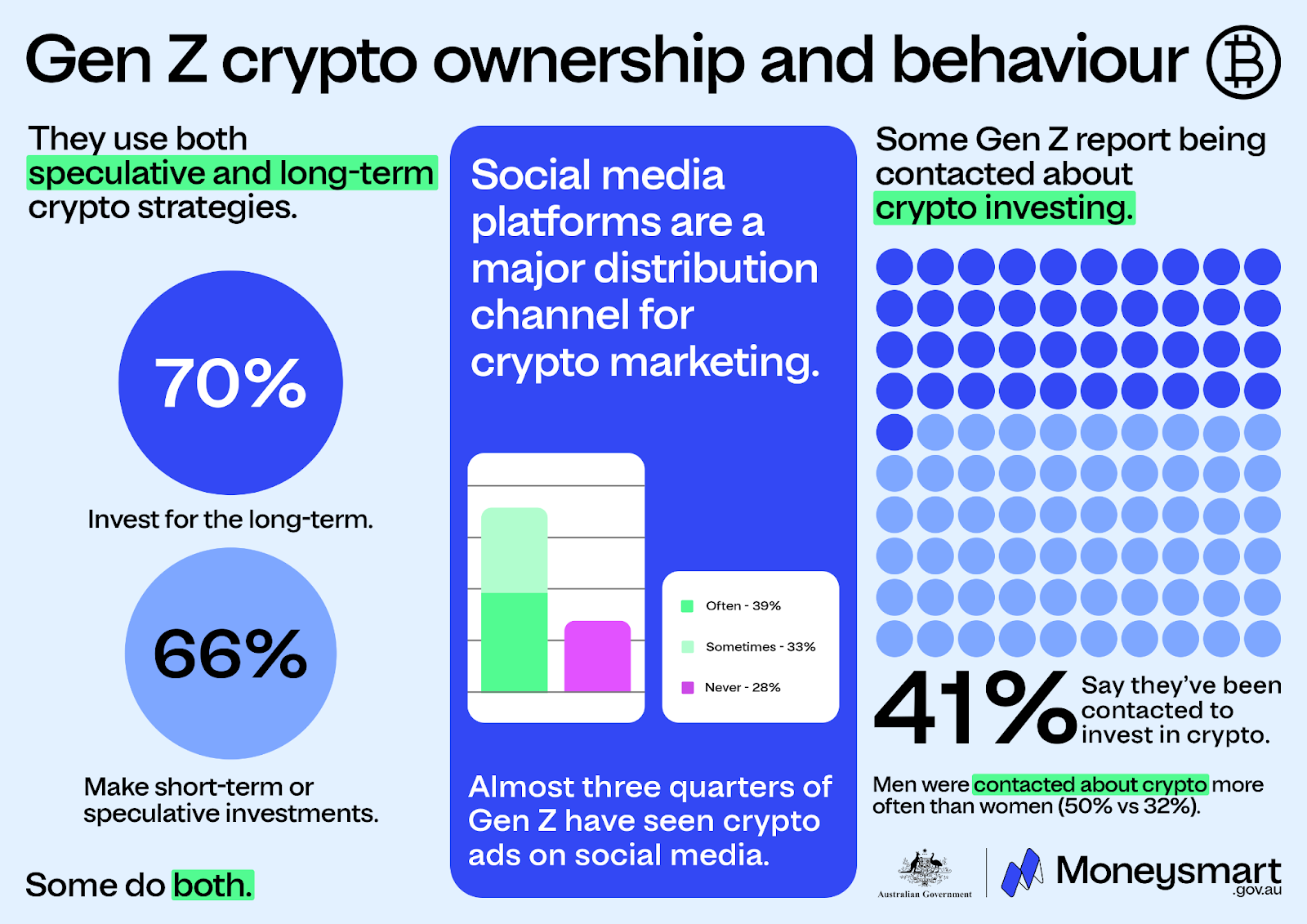
The Australian Securities and Investments Commission (ASIC) released a report in March on the financial behaviors of Generation Z, showing that AI platforms have a 64% trust rate among Gen Z for managing finances, the highest among all information channels, surpassing financial influencers (Finfluencers) at 52% and social media overall at 56%. The survey also indicates that 23% of Australian Gen Z hold cryptocurrencies.
Key Survey Data: Sources of Financial Information and Trust Structures for Gen Z
(Source: ASIC)
The survey was conducted from November 28 to December 10 last year, with 1,127 Australian youths aged 18 to 28. The main quantitative findings are as follows:
Social Media: 63% use social media to obtain financial information, with 30% specifically using YouTube.
AI Platforms: 18% use AI tools to assist with financial decisions, with a trust level of 64%, the highest among all channels.
Financial Influencers (Finfluencers): 52% say they “somewhat or fully trust” social media influencers focused on investment topics.
Overall Trust in Social Media: 56% trust financial information on social media.
ASIC notes that although Gen Z has a strong demand for reliable financial content, their search behaviors often lead them toward sources that prioritize user engagement over accuracy.
Cryptocurrency Holdings and Risks of Social Media-Driven Decisions
The survey shows that 23% of Australian Gen Z hold cryptocurrencies, and among those holding, 29% make trading decisions based on social media or influencer content.
ASIC officer Alan Kirkland told the Australian Financial Review (AFR) that regulators have observed some crypto marketing activities via social media that “actually encourage people to invest in scams.” He further pointed out that the volatility of crypto assets is often driven by external factors difficult for Australians to assess, and influencer content may lead investors to unrealistic expectations about returns, market risks, and the complexities of long-term allocation.
Kirkland specifically highlighted that Australia’s superannuation market, worth over AUD 4.5 trillion, is a major target for illegal marketing. He stated that some social media ads induce people to transfer their retirement savings into high-risk investments, which is especially dangerous since retirement funds are often individuals’ most important assets, and losses can be severe.
ASIC’s Three Regulatory Actions
Regulation of Financial Influencers: In June last year, ASIC issued warnings to 18 influencers, accusing them of “illegally promoting high-risk financial products and providing unlicensed financial advice,” marking the first formal enforcement actions by Australian regulators against the Finfluencer ecosystem.
AI Financial Tools Licensing Framework: Kirkland clarified that under Australian law, any entity providing specific financial advice tailored to individual circumstances must hold a license. Some crypto exchanges have integrated AI bots into their services to offer personalized trading guidance. ASIC is closely evaluating whether these tools comply with licensing requirements. In January this year, ASIC also warned that any crypto or AI companies exploiting the gray area of Australian payment licenses will be a primary regulatory focus in 2026.
Enhanced Cross-Agency Monitoring: ASIC stated it will continue to track the types of financial information generated by AI platforms and include related regulatory issues in its 2026 priority work list.
Frequently Asked Questions
Q: What are the main financial behavior risks identified in ASIC’s Gen Z survey?
A: The survey shows that Gen Z heavily relies on social media and AI platforms for financial information, with high trust levels but difficulty in verifying reliability. 23% hold cryptocurrencies, and 29% make trading decisions based on influencer content, raising concerns about unrealistic investment expectations and scam marketing.
Q: What are the legal regulations in Australia regarding AI financial advice tools?
A: Under Australian financial services laws, any entity providing specific advice about financial products tailored to individual circumstances constitutes “personal advice” and must hold an appropriate financial services license. ASIC explicitly states that this regulation applies regardless of whether the advice is delivered by AI.
Q: What is a Finfluencer, and why is it a concern for Australian regulators?
A: A Finfluencer is a creator on social media who focuses on finance or investment topics and has influence over followers. ASIC’s concern is that these creators often lack licensing but significantly impact Gen Z’s investment decisions, potentially leading to misconceptions about the returns, risks, and volatility of cryptocurrencies.
Disclaimer: The information on this page may come from third parties and does not represent the views or opinions of Gate. The content displayed on this page is for reference only and does not constitute any financial, investment, or legal advice. Gate does not guarantee the accuracy or completeness of the information and shall not be liable for any losses arising from the use of this information. Virtual asset investments carry high risks and are subject to significant price volatility. You may lose all of your invested principal. Please fully understand the relevant risks and make prudent decisions based on your own financial situation and risk tolerance. For details, please refer to
Disclaimer.
Related Articles
SEC Crypto Shift Clarifies Rules Without Blanket Approval
The SEC has adopted a more lenient stance on crypto regulation, allowing some interfaces to operate without broker-dealer registration, but has not given blanket approval for the industry. Recent guidance clarifies how crypto assets are categorized, emphasizing that federal securities laws apply mainly to digital securities. Enforcement activity has decreased as the agency focuses on fraud and market integrity.
CryptoFrontier7h ago
Polish lawmakers want to overturn the president’s veto of the cryptocurrency bill but failed again in their latest attempt to push it through.
Poland’s parliament failed to override the president’s veto of the cryptocurrency regulatory bill, stalling the process of digital-asset legislation and making it one of the few countries in the EU that has not yet implemented the MiCA framework. Differences between the president and the government over the bill’s content led to a political stalemate, affecting market confidence and legal transparency.
ChainNewsAbmedia8h ago
Polish Parliament Fails to Override President's Veto on Crypto Law; PM Alleges Russian Interference
Polish lawmakers failed to override President Nawrocki's veto on a cryptocurrency regulation bill aimed at aligning with EU standards. Tensions rise as accusations emerge of Russian influence in a major crypto exchange amid liquidity issues and lack of regulation.
GateNews10h ago
White House Mediates Clarity Act Stablecoin Dispute, Witt Reveals Legislative Timeline
Patrick Witt announced at the Solana Policy Institute summit that the White House mediated a stablecoin dispute to advance the Clarity Act. The compromise allows banks and crypto firms to together address regulatory concerns, with future focus on crypto taxation and blockchain integration strategies among financial institutions.
GateNews17h ago
Hong Kong SFC Investment Committee Warns Prediction Market Trading May Constitute Illegal Gambling
The Hong Kong SFC warns that prediction markets are speculative and not investment products, lacking regulatory protection. They involve gambling elements, potentially making them illegal. The committee urges the public to differentiate between investment and gambling.
GateNews19h ago
Economist Proposes National USD Stablecoin to Eliminate Currency Controls in Venezuela
Alejandro Grisanti, head of Ecoanalitica, proposed issuing a national USD stablecoin as part of a series of measures to lift currency controls in Venezuela. This system would complement the current auction system, allowing the excluded sector to receive dollars via blockchain rails.
Key
Coinpedia21h ago


