As the US-Israel coalition escalates military actions against Iran, Tehran’s years-long “shadow economy” has once again become an international focus. This parallel system, combining Bitcoin mining and stablecoin trading, has become Iran’s last shield in seeking survival outside the battered banking system and dollar dominance.
Using cheap electricity to mine Bitcoin
Iran legalized cryptocurrency mining as early as 2019, allowing licensed operators to use government-subsidized electricity for mining. The condition is that all mined Bitcoin must be sold to the Central Bank of Iran, becoming an important tool for paying for imports and settling foreign trade, thereby bypassing the dollar system and Western banking sanctions to some extent.
According to statistics, Iran’s Bitcoin mining hash rate accounts for about 2% to 5% of the global total, but many mining activities are not fully disclosed, so the actual scale may be higher.
Blockchain analytics firm Chainalysis found that Iran’s cryptocurrency ecosystem had grown to a $7.8 billion scale by 2025, nearly equivalent to the GDP of Maldives or Liechtenstein. Notably, crypto activity tends to surge during military conflicts or domestic unrest, including during the 12-day conflict between Iran and Israel last year.
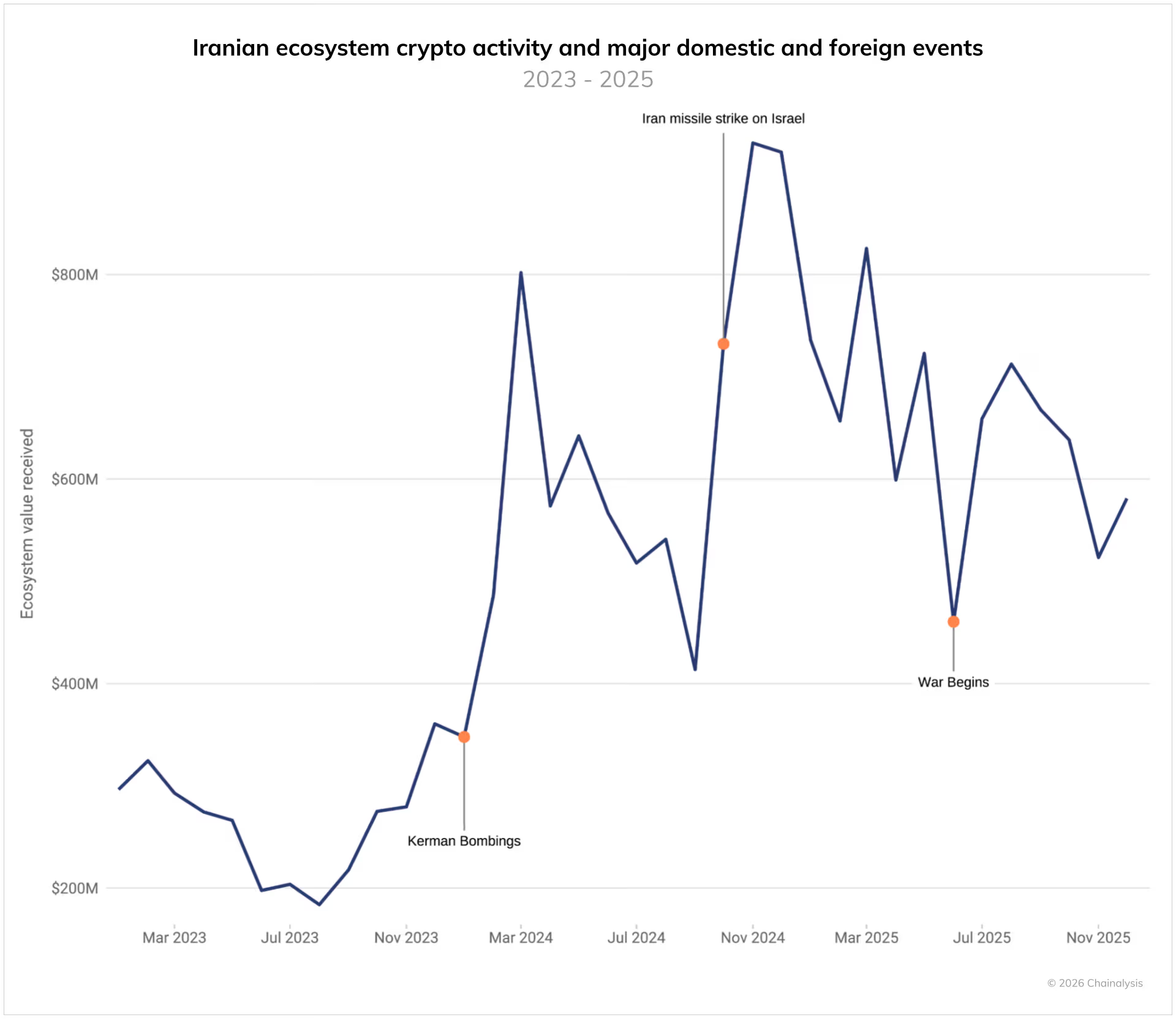
As Iran’s main military force, the Islamic Revolutionary Guard Corps (IRGC) has increasingly relied on cryptocurrencies in recent years. Chainalysis estimates that in Q4 2025, wallets related to IRGC accounted for over 50% of Iran’s total cryptocurrency inflows, receiving assets worth over $3 billion last year.
These figures only include publicly known wallet addresses directly linked to sanctions lists; the actual scale could be higher.
Rial plummets 96%, USDT becomes the new favorite for trade settlement
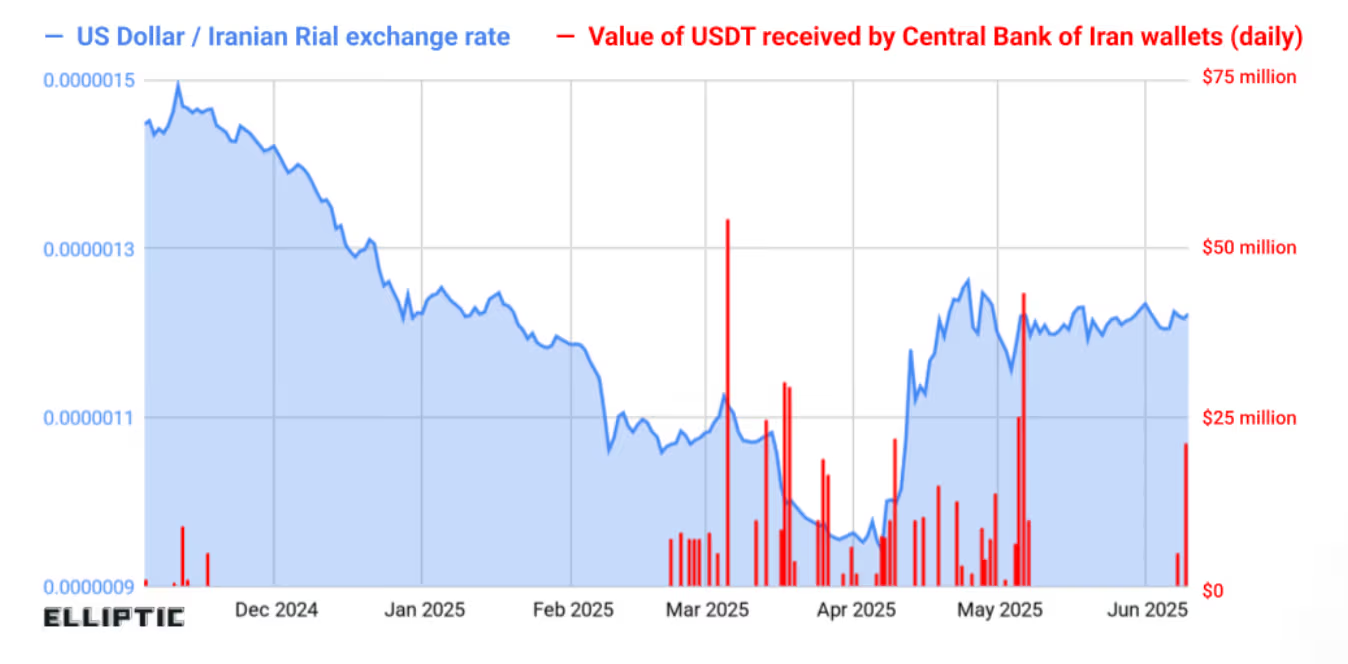
In addition to Bitcoin, stablecoins also play a key role. Blockchain analytics firm Elliptic indicated that by 2025, Iran’s central bank had accumulated at least $507 million in USDT, likely used to stabilize the Rial exchange rate and support foreign trade. However, this financial defense appears to have been largely ineffective. Data shows the Rial has depreciated over 96% against the US dollar.
Faced with deep-rooted hyperinflation and an economy on the brink of collapse, ordinary Iranians are also turning to Bitcoin. Data shows that during recent anti-government protests, the amount of Bitcoin withdrawn from centralized exchanges to personal wallets surged sharply, indicating that locals are trying to keep their assets in their own control.
Mining costs are only about $1,300 per Bitcoin
External estimates suggest that the cost of mining one Bitcoin in Iran is around $1,300. After miners mine Bitcoin, they sell it to the central bank, which then transfers funds to overseas trading partners to pay for equipment, fuel, or daily necessities.
Disclaimer: The information on this page may come from third parties and does not represent the views or opinions of Gate. The content displayed on this page is for reference only and does not constitute any financial, investment, or legal advice. Gate does not guarantee the accuracy or completeness of the information and shall not be liable for any losses arising from the use of this information. Virtual asset investments carry high risks and are subject to significant price volatility. You may lose all of your invested principal. Please fully understand the relevant risks and make prudent decisions based on your own financial situation and risk tolerance. For details, please refer to
Disclaimer.
Related Articles
Pakistan Opens Banking System to Licensed Crypto Firms, Reversing 2018 Ban
Pakistan's central bank has opened its banking system to licensed virtual asset service providers, reversing a previous ban. This change, following the Virtual Assets Act 2026, allows crypto businesses access to banking services under strict regulations.
GateNews3h ago
BTC edges up 0.46% in 15 minutes: institutional fund outflows and macro risk-off sentiment in sync drove the move
From 15:00 to 15:15 (UTC) on 2026-04-16, BTC logged a +0.46% return within 15 minutes. The price fluctuated in a range of 73,939.7 to 74,440.0 USDT, with an amplitude of 0.68%. During this time window, market attention increased, short-term volatility intensified, and fund-flow characteristics changed noticeably.
The main driver of this deviation is the continued outflow of large amounts of capital from exchanges. According to on-chain data, in the past 24 hours the net flow was -14,408.84 BTC, mainly concentrated in large transfer ranges of more than $1 million (especially>$10M net outflow -12,987.03 BTC). This shows that institutions and large holders actively reduced their BTC holdings on exchanges, and short-term selling pressure was significantly lowered. Against the backdrop of persistently weak liquidity, with order book depth remaining at a low level for a long time, the price has become more sensitive to medium-sized buy orders—amplifying the impact of even modest inflows on spot market price action.
In addition, macro conditions changed in parallel and produced a synchronized effect: easing geopolitical tensions in the Middle East boosted overall market sentiment. International gold prices rose, global equity markets hit new highs, and the market re-evaluated the probability of the Federal Reserve cutting rates within the year, further increasing investor attention to safe-haven assets (including BTC). At the same time, on-chain data indicates that the “whale” trading activity during this phase is at an annual low (>$1M transfers fell to 1,485 transactions). With heavy market wait-and-see sentiment and limited short-term supply, BTC’s responsiveness to sudden buy-side capital was further enhanced.
Investors should be reminded that current market liquidity is still fragile. Insufficient order book depth increases the market’s sensitivity to large capital movements, and short-term volatility may intensify. Going forward, focus on further shifts in on-chain large-fund flows, changes in price action as it breaks through support or resistance regions, and the risks and opportunities brought by related macro policies and geopolitical developments. Please continue to track key data and stay alert to any sudden shocks during the period of abnormal moves.
GateNews5h ago
U.S. Launches "Economic Fury" Campaign Against Iran, Treasury Department Imposes Maximum Pressure
U.S. Defense Secretary Lloyd Austin announced "Economic Fury," a Treasury Department initiative to apply maximum economic pressure on Iran, during a Pentagon briefing on April 16.
GateNews8h ago
Hong Kong Monetary Authority: Middle East Tensions Have Limited Impact on Banking Sector
Eddie Yue from the Hong Kong Monetary Authority states that Hong Kong's banking sector faces limited risk from Middle East tensions, though rising oil prices may impact energy-sensitive sectors. There's no increase in SME assistance requests, and the authority continues to monitor the situation. The anticipated 19.3% default rate for a special loan scheme is being managed through standard collection procedures.
GateNews9h ago
Russia's GDP Fell 1.8% in First Two Months of 2026, Putin Seeks Economic Recovery Plan
Russian President Putin reported a 1.8% GDP decline in early 2026 and called for economic stimulus proposals. In response to U.S. sanctions, Kremlin spokesperson Peskov stated that Russia has adapted to these challenges.
GateNews9h ago
Iran Restores Access to Some International Internet Services
Iran has lifted some restrictions on international internet services, signaling a change in its internet access policies, as announced by Iranian authorities on April 16.
GateNews9h ago


