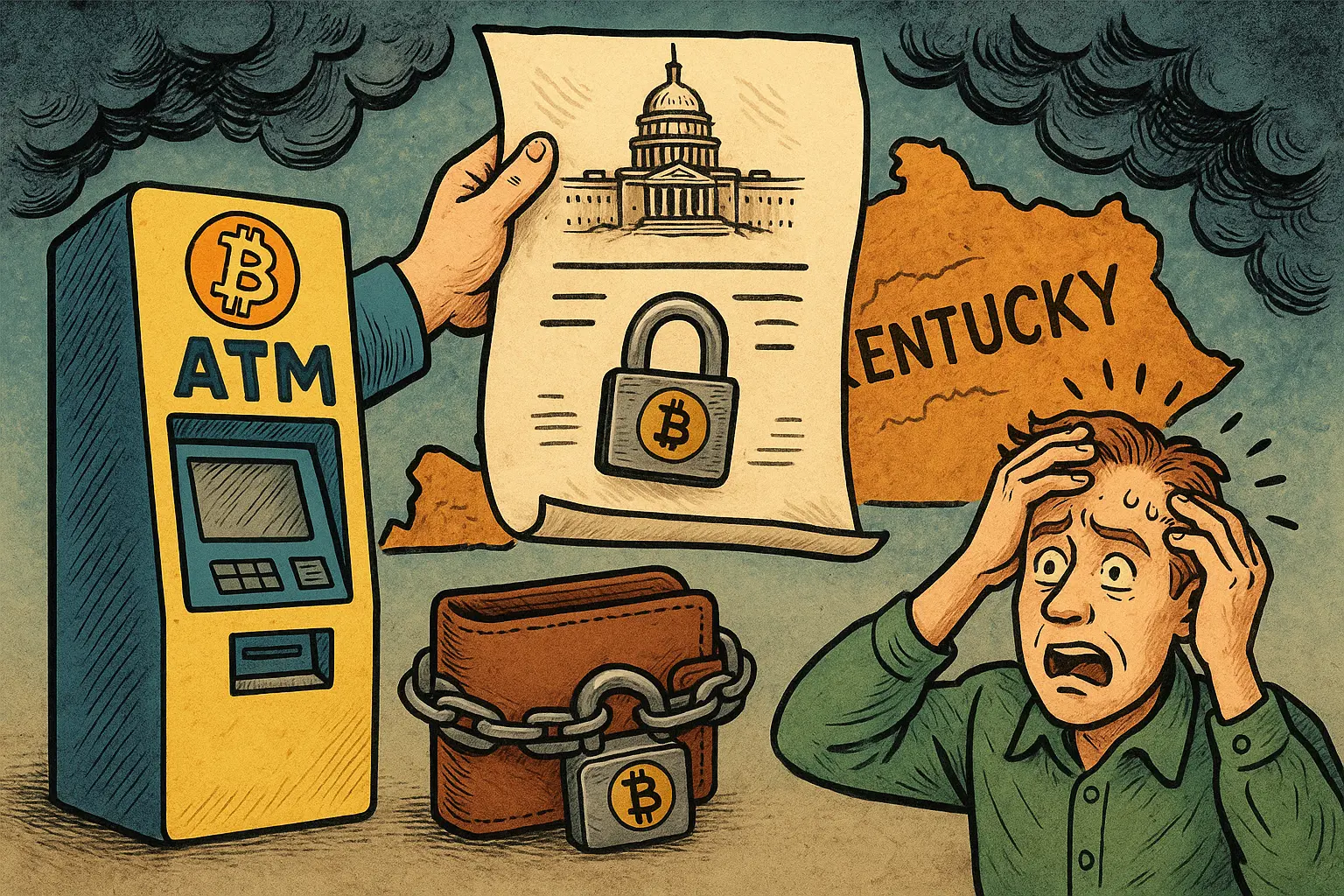
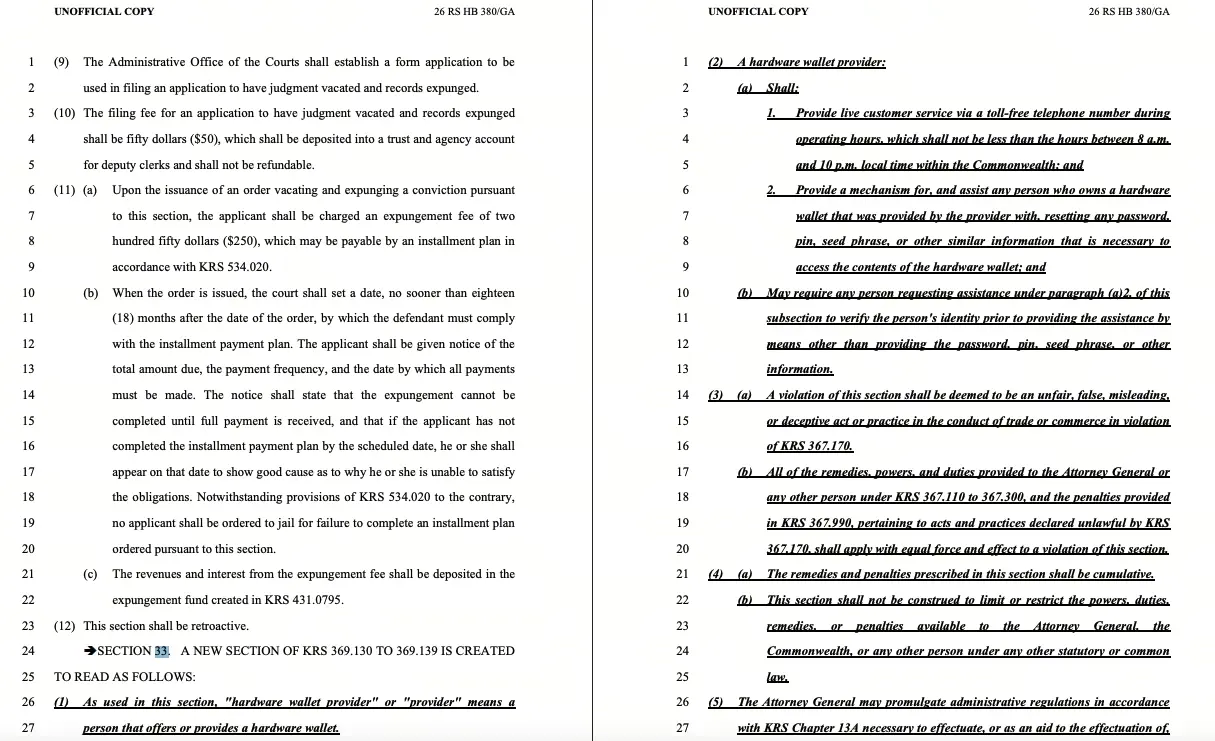
Kentucky House Bill 380 (HB380) recently added Amendment 33, which requires hardware wallet (cold wallet) providers to “provide mechanisms and assist anyone” in resetting access credentials, including passwords, PINs, and seed phrases. The Bitcoin Policy Institute (BPI) points out that this clause is technically impossible for non-custodial cold wallets, as the core design of non-custodial architecture is that even manufacturers cannot access or recover user private keys or seed phrases.
The core controversy of Article 33: the technical contradiction between hardware wallet architecture and backdoor requirements
 (Source: U.S. House of Representatives)
HB380 was originally a regulation bill targeting cryptocurrency self-service kiosks such as Bitcoin ATMs, covering licensing, transaction limits, and consumer protections. The later addition of Amendment 33 unexpectedly extended its scope to include cold wallet manufacturers.
The technical architecture of non-custodial cold wallets is based on the principle that “private keys are controlled solely by the user, and no third party, including manufacturers, can access or recover them.” Critics argue that forcing backdoors not only violates the fundamental design of non-custodial wallets but also directly undermines the security premise of cold wallets as self-custody tools.
Three core issues raised by critics
Technically impossible to implement: Once the seed phrase is lost in a non-custodial wallet, even the manufacturer cannot reset it. Requiring “assistance in resetting” contradicts the fundamental technical architecture of hardware wallets.
Undermines Bitcoin’s core security guarantees: The backdoor clause fundamentally weakens the security assumption that private keys cannot be accessed by third parties, damaging the trustworthiness of the entire non-custodial system.
Encourages users to shift to centralized institutions: If non-custodial cold wallets are forced out of the market due to non-compliance, users will be compelled to turn to centralized custodial services, increasing third-party trust risks.
Conor Brown, Executive Director of the Bitcoin Policy Institute, stated directly on X: “Kentucky is about to suddenly ban self-custody.”
Legislative conflict between HB380 and HB701: Kentucky’s contradictory crypto policies
Amendment 33 of HB380 directly conflicts with Kentucky’s existing cryptocurrency legislation. In March 2025, Kentucky enacted House Bill 701 (HB701), which explicitly protects individuals’ “independent control over secure digital assets and private keys,” limiting regulatory interference in self-custody. It is widely regarded as a milestone law strengthening self-custody rights.
If HB380’s Amendment 33 is ultimately passed, the two laws will create a direct legal conflict over self-custody, weakening the protections of HB701 and causing an internal contradiction in Kentucky’s cryptocurrency regulatory framework.
Increasing regulation of cryptocurrency ATMs across US states; Minnesota proposes a complete ban
The controversy over HB380 occurs amid a broader tightening of Bitcoin ATM regulations across US states. Recently, Minnesota lawmakers proposed legislation to ban all cryptocurrency self-service terminals within the state, triggered by multiple scams, including cases where elderly residents were tricked into sending money to scammers via Bitcoin ATMs.
Minnesota officials believe current transaction limits and disclosure requirements are insufficient to prevent fraud. The proposal aims to dismantle the existing regulatory framework entirely and replace it with a complete ban. The “tougher regulation” in Kentucky and the “total ban” in Minnesota illustrate the accelerating divergence in US state legislation on Bitcoin ATMs.
Frequently Asked Questions
What is the core requirement of Article 33 in Kentucky HB380?
Article 33 requires cold wallet providers to “provide a mechanism and assist anyone” in resetting access credentials, including passwords, PINs, and seed phrases. Critics argue this effectively mandates manufacturers to embed a “backdoor” in non-custodial products, which is fundamentally incompatible with the principles of non-custodial architecture.
Why can’t non-custodial cold wallets provide a seed phrase reset mechanism?
The core principle of non-custodial wallets is that “no third party, including the manufacturer, can access or recover user private keys.” Losing the seed phrase means it cannot be recovered, which is the foundation of their security. Forcing a backdoor would destroy this security model at the technical architecture level, fundamentally undermining trust in the entire non-custodial system.
Could HB380’s Article 33 be modified before passing?
HB380 has already passed the Kentucky House and is currently under review in the Senate. Since Article 33 was added as a late amendment, legislators still have the opportunity to modify or remove it before the final vote. Organizations like the Bitcoin Policy Institute are actively advocating for legislative revisions.
Disclaimer: The information on this page may come from third parties and does not represent the views or opinions of Gate. The content displayed on this page is for reference only and does not constitute any financial, investment, or legal advice. Gate does not guarantee the accuracy or completeness of the information and shall not be liable for any losses arising from the use of this information. Virtual asset investments carry high risks and are subject to significant price volatility. You may lose all of your invested principal. Please fully understand the relevant risks and make prudent decisions based on your own financial situation and risk tolerance. For details, please refer to
Disclaimer.
Related Articles
White House Mediates Clarity Act Stablecoin Dispute, Witt Reveals Legislative Timeline
Patrick Witt announced at the Solana Policy Institute summit that the White House mediated a stablecoin dispute to advance the Clarity Act. The compromise allows banks and crypto firms to together address regulatory concerns, with future focus on crypto taxation and blockchain integration strategies among financial institutions.
GateNews32m ago
Hong Kong SFC Investment Committee Warns Prediction Market Trading May Constitute Illegal Gambling
The Hong Kong SFC warns that prediction markets are speculative and not investment products, lacking regulatory protection. They involve gambling elements, potentially making them illegal. The committee urges the public to differentiate between investment and gambling.
GateNews2h ago
Economist Proposes National USD Stablecoin to Eliminate Currency Controls in Venezuela
Alejandro Grisanti, head of Ecoanalitica, proposed issuing a national USD stablecoin as part of a series of measures to lift currency controls in Venezuela. This system would complement the current auction system, allowing the excluded sector to receive dollars via blockchain rails.
Key
Coinpedia4h ago
Elizabeth Warren Accuses SEC Chair Paul Atkins of Misleading Congress Over Enforcement Decline
Senator Elizabeth Warren accused SEC Chair Paul Atkins of misleading Congress about enforcement actions' decline. With only 456 new cases in 2025, concerns arise regarding the SEC's effectiveness and the regulatory landscape for cryptocurrency and market oversight.
GateNews5h ago
CLARITY Act Delay Continues as Senator Thom Tillis Signals Ongoing Talks
Lawmakers are delaying the CLARITY Act due to ongoing negotiations on stablecoin provisions, with timing uncertain and potential markup pushed to late April or early May. Kevin Warsh’s financial disclosures add complexity to regulatory discussions.
CryptoFrontNews8h ago
Democratic Senators Question Lax AML Oversight of Major CEX Over $1.7B Iran-Linked Crypto Flows
Democratic senators are scrutinizing the Trump administration's oversight of a cryptocurrency exchange linked to $1.7 billion in Iranian transactions, questioning its AML controls and a lenient bank settlement on sanctions evasion.
GateNews11h ago


