Brazil’s public security agencies have a new weapon for fighting organized crime after national legislators approved a measure allowing them to use confiscated cryptocurrency in their efforts.
On Wednesday, Brazil’s legislative branch published Law No. 15.358, establishing a legal framework for combating organized crime. The law allows authorities to prohibit transactions on crypto exchanges by treating digital assets as instruments in a crime, and confiscate crypto to be used to fund public security.
“For the purposes of forfeiture of assets, any asset that has been used to commit a crime shall be considered an instrument of the crime, even if it was not intended exclusively for that purpose,” said a translation of the law, which included:
“The forfeited assets and valuables may be used provisionally by public security agencies for police re-equipment, training, and special operations, subject to authorization from the judge overseeing the execution of the sentence.”
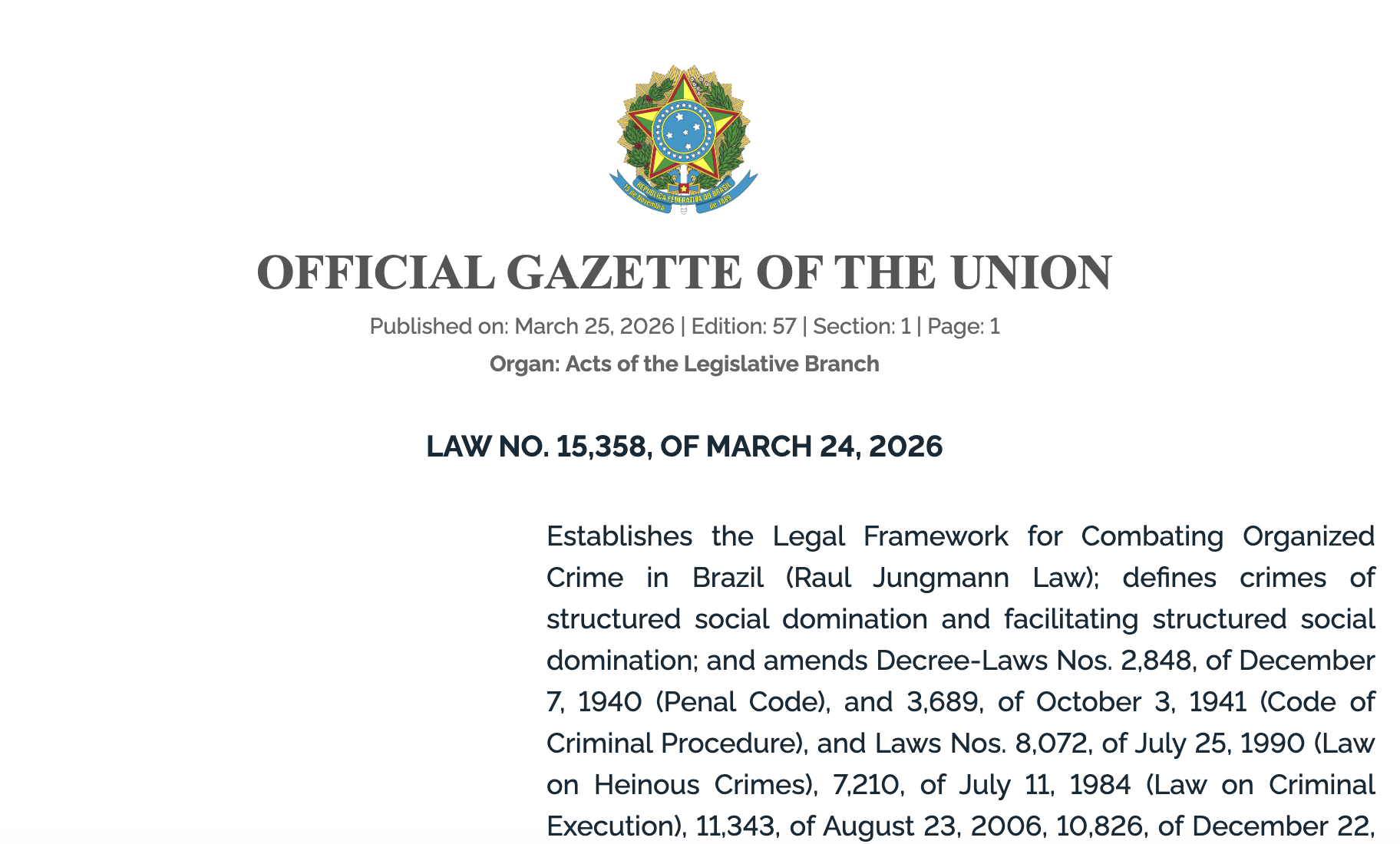
_Source: _Brazil’s National Press (translated from Portuguese)
Notably, the law would authorize Brazil to coordinate and cooperate with international authorities for investigation and asset recovery, including in cases potentially involving digital assets. With a population of more than 213 million, many of whom use crypto, the legislation could have significant implications for the Brazilian government’s war chest.
**Related: **__Brazil’s Pix instant payment system expands to Argentina
The signing of the law followed reports that Brazil’s Finance Minister, Dario Durigan, planned to delay talks on changing the country’s tax policy on crypto. According to reports, Durigan aimed to avoid divisive changes to tax policy, and would push discussions until after Brazil’s presidential election in October.
In 2025, the Brazilian Federal Police’s Operation Lusocoin targeted a laundering and foreign exchange evasion architecture of massive scale, according to TRM Labs. Authorities estimate that the network moved tens of billions of Brazilian reais through a web of shell companies, OTC crypto brokers, and non-custodial wallets.
Brazil is still reviewing a national crypto reserve
In contrast to countries like the US, where crypto seized as part of criminal cases could be used to bolster a national digital asset stockpile, Brazil’s law would divert the funds to public security measures like police training. However, Brazil’s government discussed a proposal to create a national Bitcoin (BTC) reserve in August 2025.
The BTC reserve bill, initially introduced in 2024, could allow Brazil to allocate up to 5% of the country’s treasury to purchase Bitcoin. In February, lawmakers reintroduced the legislation, expanding its scope to allow for the purchase of up to one million BTC. It was unclear as of March if the bill would have enough support to pass in the future.
**Magazine: **__Nobody knows if quantum secure cryptography will even work
Cointelegraph is committed to independent, transparent journalism. This news article is produced in accordance with Cointelegraph’s Editorial Policy and aims to provide accurate and timely information. Readers are encouraged to verify information independently. Read our Editorial Policy https://cointelegraph.com/editorial-policy
- #Cryptocurrencies
- #Law
- #Government
- #Security
- #Brazil
- #Regulation
Disclaimer: The information on this page may come from third parties and does not represent the views or opinions of Gate. The content displayed on this page is for reference only and does not constitute any financial, investment, or legal advice. Gate does not guarantee the accuracy or completeness of the information and shall not be liable for any losses arising from the use of this information. Virtual asset investments carry high risks and are subject to significant price volatility. You may lose all of your invested principal. Please fully understand the relevant risks and make prudent decisions based on your own financial situation and risk tolerance. For details, please refer to
Disclaimer.
Related Articles
Kalshi appeals Nevada event contract ban; CFTC jurisdiction dispute may reach the Supreme Court
Prediction market platform Kalshi has appealed a ruling by the state of Nevada banning its event contracts, and the U.S. Ninth Circuit Court of Appeals held oral arguments on April 17, but did not issue an immediate decision after the hearing. The core dispute in the case is whether Kalshi’s event contracts are “swap agreements” that fall under the jurisdiction of the Commodity Futures Trading Commission (CFTC), or whether they must be regulated by state-level activity under gambling licensing regimes. Multiple legal experts predict that the case may ultimately be appealed to the U.S. Supreme Court.
MarketWhisper1h ago
CFTC Chairman Selig: Prediction-market fraudsters will face harsh legal penalties; will not pause rulemaking
In a House hearing, U.S. CFTC Chairman Selig emphasized a “zero-tolerance policy” toward market fraud and manipulation. He responded to questions regarding a $500 million oil futures transaction and said the CFTC is drafting rules to regulate prediction markets. Selig also mentioned a cooperation memorandum of understanding with the SEC to strengthen oversight of digital assets. Given that the CFTC currently has only one commissioner—himself—Selig emphasized operational efficiency and will hire new staff to enhance regulatory capacity.
MarketWhisper3h ago
MTN Nigeria Suspends Xtratime Airtime and Data Borrowing Service to Comply with Digital Lending Regulations
MTN Nigeria has suspended its Xtratime service due to new regulatory compliance from the FCCPC. While normal purchases continue, the suspension aims to align with upcoming digital lending rules. The company does not foresee significant financial impact and will monitor user response.
GateNews8h ago
Pakistan Opens Banking System to Licensed Crypto Firms, Reversing 2018 Ban
Pakistan's central bank has opened its banking system to licensed virtual asset service providers, reversing a previous ban. This change, following the Virtual Assets Act 2026, allows crypto businesses access to banking services under strict regulations.
GateNews11h ago
Musk’s X Money hasn’t launched yet—but it’s already making headlines! Mizuho says it will shake up the U.S. payments market and also downgrades PayPal’s rating
Elon Musk’s financial product X Money is expected to launch in April, potentially upending the U.S. payments market and putting pressure on PayPal, as Mizuho Securities has downgraded PayPal’s rating to “Neutral.” However, regulatory variables have become the main challenge, especially the legal uncertainty surrounding crypto-asset payments and yield-generating products. X has also rolled out a “Cashtags” feature that integrates real-time financial data.
ChainNewsAbmedia12h ago
Major South Korean CEX Places SPURS Token on Trading Alert List
A South Korean cryptocurrency exchange has added the SPURS token to its trading alert list due to poor market performance and investor risks. Deposits are temporarily suspended while the token is reviewed until July 16, 2026.
GateNews13h ago


