Cambodia’s parliament passed legislation targeting compounds used to defraud victims through scams, including those involving cryptocurrency.
In a Friday notice, the Senate of the Kingdom of Cambodia announced that the chamber had unanimously approved the draft law with no amendment, with 58 senators voting yes. According to reports, the draft bill, which would still need the king’s approval before becoming law, imposed prison time between two to five years and up to $125,000 in fines for certain crimes, or twice the time in prison and penalties if part of a gang or targeting multiple victims.
“The draft law stipulates the establishment of criminal rules to fill the gaps and deficiencies in the current law, which will contribute significantly to addressing challenges that pose serious risks to social security, the economy and citizens, including affecting Cambodia’s reputation, as well as improving the effectiveness of the fight against fraud through technological systems, aiming to contribute to the preservation and protection of public security and order, and improving the effectiveness of cooperation in combating this crime,” said a translation of the Friday Senate notice on the bill.
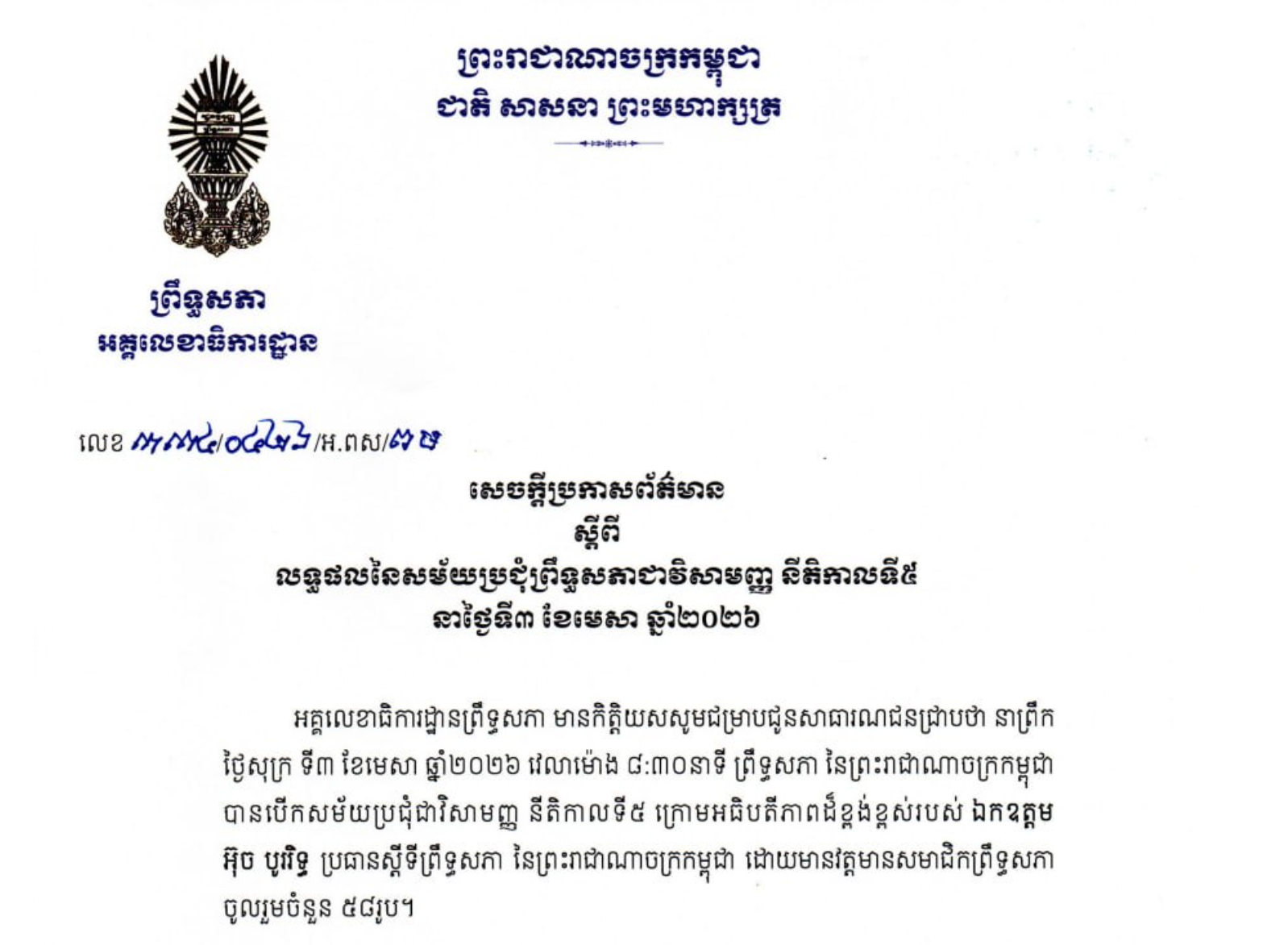
_Friday notice announcing the crypto bill’s passage. Source: _Senate of the Kingdom of Cambodia
According to a 2025 report from the US State Department, Cambodia’s government “frequently downplayed scam operation cases as labor disputes,” never arresting or prosecuting any owner or operator of a suspected scam compound. The Cambodian operations are just some of many across parts of Southeast Asia, where compounds are alleged sources of forced labor.
**Related: **__UK sanctions $20B scam market by cutting ‘legitimate’ crypto ties
The passage of the bill followed UK authorities sanctioning the operators of a Cambodia-based scam center, and the country extraditing to China the leader of a criminal syndicate with alleged tied to scam compounds. Cambodia’s national assembly advanced the bill on March 30, with all 112 members voting yay.
What happens in these scam compounds?
According to a 2024 UN News report that explored a compound in the Philippines, scam centers like the ones targeted under the Cambodian bill were massive undertakings, with facilities designed so that the residents would never need to leave. Although many of the workers were responsible for carrying out the scams, they were also “trafficked here, held against their will” and “exposed to violence” in the compounds.
“The people who work here are basically fenced off from the outside world,” said the report. “All their daily necessities are met. There are restaurants, dormitories, barbershops and even a karaoke bar. So, people don’t actually have to leave and can stay here for months.”
**Magazine: **__Your guide to surviving this mini-crypto winter
Cointelegraph is committed to independent, transparent journalism. This news article is produced in accordance with Cointelegraph’s Editorial Policy and aims to provide accurate and timely information. Readers are encouraged to verify information independently. Read our Editorial Policy https://cointelegraph.com/editorial-policy
- #Law
- #Cambodia
- #Crimes
- #Scams
- #Regulation
Disclaimer: The information on this page may come from third parties and does not represent the views or opinions of Gate. The content displayed on this page is for reference only and does not constitute any financial, investment, or legal advice. Gate does not guarantee the accuracy or completeness of the information and shall not be liable for any losses arising from the use of this information. Virtual asset investments carry high risks and are subject to significant price volatility. You may lose all of your invested principal. Please fully understand the relevant risks and make prudent decisions based on your own financial situation and risk tolerance. For details, please refer to
Disclaimer.
Related Articles
Encourage innovation! A U.S. judge and a French judge ban Arizona from regulating prediction markets, and suspend the prosecution of Kalshi
A U.S. federal district court ruled that Arizona is prohibited from using its gambling laws to prosecute prediction market platform Kalshi, finding that the Commodity Futures Trading Commission has exclusive jurisdiction. The ruling affects the boundary between state and federal authority in financial market regulation, while Kalshi insists that its business is a financial product rather than traditional gambling. Decisions regarding prediction markets vary from state to state, and the Trump family has also expressed support for prediction markets.
CryptoCity11m ago
Can bypassing FSC regulations on using credit cards to buy crypto be possible? Odin Ding promotes a Wallet Pro service for buying crypto with US debit cards
OdinTai推出OwlPay和Wallet Pro服务,专注于B2B跨境支付,结合稳定币技术与国际金融系统,展现其金融科技转型。通过与MoneyGram合作,Wallet Pro实现现金购买稳定币的跨国汇款,并在美国市场运作。该公司的境外模式规避了台湾严格的监管,并在新法草案下挑战市场竞争格局,未来将影响本地业者的合规策略。
CryptoCity1h ago
Encourage innovation! A U.S. judge bans Arizona’s regulation of prediction markets, and suspends the prosecution of Kalshi.
A U.S. federal district court ruled that Arizona is barred from using its gambling laws to prosecute prediction market platform Kalshi, finding that the federal Commodity Futures Trading Commission has exclusive jurisdiction. The decision affects the boundary between state and federal authority in financial market regulation, while Kalshi insists that its business is a financial product rather than traditional gambling. Rulings on prediction markets vary across states, and the Trump family has also expressed support for prediction markets.
CryptoCity3h ago
Solana cofounder toly: a base-layer stablecoin should be built that can only be frozen with authorization from the court
Solana co-founder toly noted that the industry needs a stablecoin that can only be frozen under a court order, opposing other freeze factors. He suggested that the protocol issue a stablecoin with custom freeze strategies on the base layer and strengthen security measures. This view stems from a recent response by Circle to the Drift protocol hack incident, sparking discussions about centralized stablecoins.
GateNews3h ago
Hong Kong’s first batch of stablecoin issuers has been unveiled! Out of 36 applications, only 2 received licenses: HSBC and TetherPoint Finance
The Hong Kong Monetary Authority has announced the inaugural stablecoin issuer licensing scheme, and Tidepoint Financial Technology, led by HSBC Bank and Standard Chartered Bank, has been approved. This regulatory framework is designed to protect users’ interests, promote the application of compliant stablecoins, address financial pain points, and drive the development of Hong Kong’s digital assets.
CryptoCity4h ago
Is it possible to bypass Financial Supervisory Commission regulations to buy crypto by card? Odingding rolls out a U.S. debit card crypto purchase service, Wallet Pro
OdinTin launches OwlPay and Wallet Pro services, focusing on B2B cross-border payments. By combining stablecoin technology with international financial systems, it demonstrates its fintech transformation. Through a partnership with MoneyGram, Wallet Pro enables cross-border transfers to buy stablecoins with cash and operates in the U.S. market. The company’s offshore model avoids Taiwan’s strict regulation, and under the new draft law, it challenges the market’s competitive landscape, which will affect local businesses’ compliance strategies in the future.
CryptoCity4h ago


