
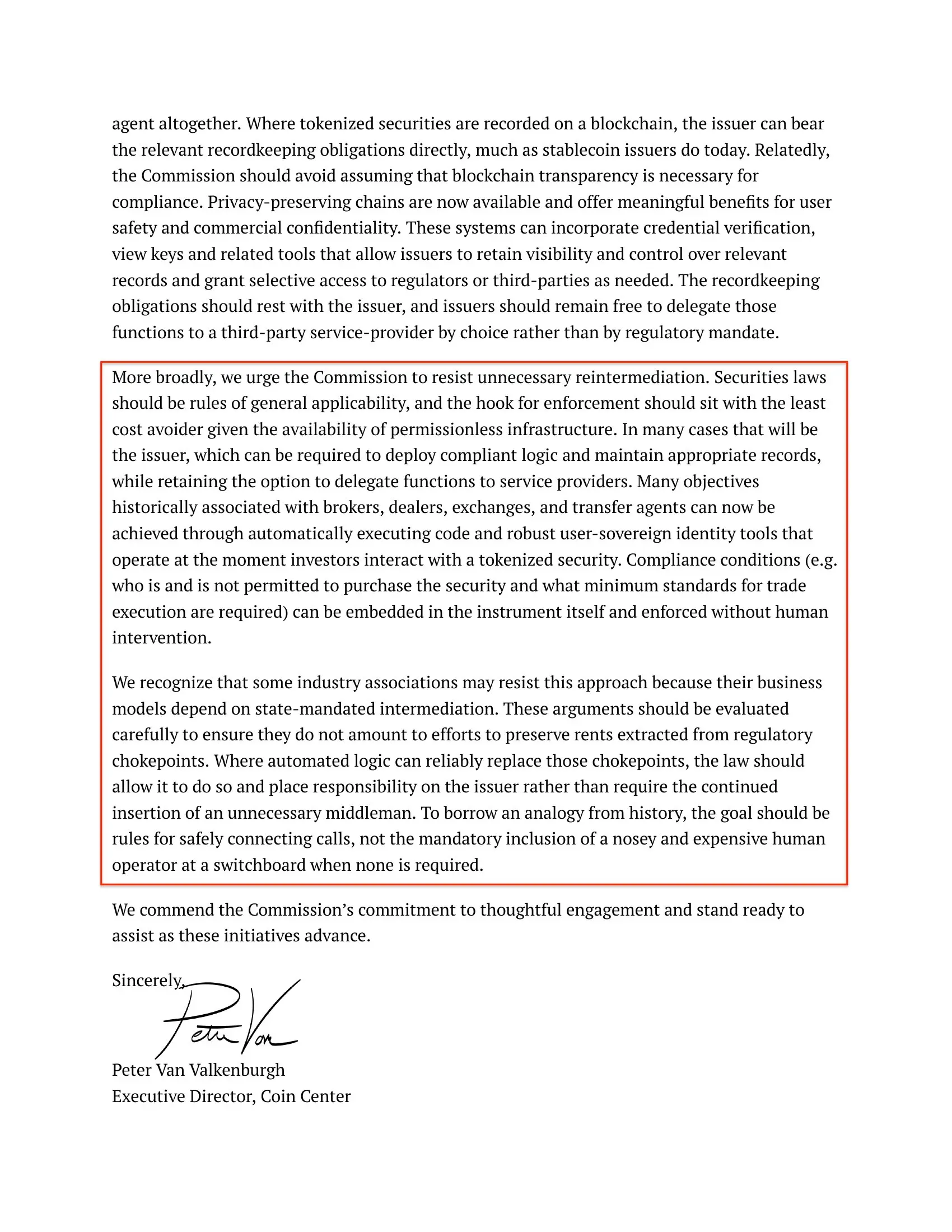
Cryptocurrency Policy Think Tank Coin Center published a letter to the U.S. Securities and Exchange Commission (SEC) on March 18, urging the SEC to stop handling crypto market issues through no-action letters on a case-by-case basis and instead systematically establish clear regulations. The letter states that while case-by-case relief can provide short-term certainty, it “leads to fragmentation, implicit regulatory favoritism, and unequal treatment among projects.”
Coin Center’s Three Core Arguments
 (Source: Coin Center)
Coin Center’s advocacy is based on three mutually reinforcing reasons:
Structural Favoritism: Obtaining a no-action letter requires significant legal resources and proactive engagement with regulators. Coin Center points out that “regulators will inevitably favor those online or intermediary entities with the resources and motivation to seek relief,” effectively excluding smaller projects with limited resources.
Regulatory Fragmentation: Each no-action letter applies only to specific circumstances and cannot create industry-wide standards. Instead, it results in numerous unique legal situations that are difficult to replicate, making it hard to share compliance costs across the industry effectively.
Misunderstanding the Public Nature of Crypto: Coin Center emphasizes that “the true value of crypto networks lies in their function as practical public goods, not services operated by private companies.” The logic of individual case letters fundamentally contradicts the nature of crypto networks as public infrastructure.
Recent No-Action Cases: The Reality of Fragmented Regulation
While Coin Center advocates for systemic regulation, the SEC and the U.S. Commodity Futures Trading Commission (CFTC) have continued issuing no-action letters in recent months:
CFTC to Phantom Technologies: Confirmed that under certain conditions, crypto wallet service provider Phantom is exempt from registration as a introducing broker (latest case).
SEC to Two Decentralized Infrastructure (DePIN) Projects: Removed enforcement barriers for specific types of crypto projects.
SEC September 2025 Letter: Allowed investment advisors to use state trust companies as crypto custodians.
Notably, the SEC has also released a more systematic classification notice for digital assets, providing a “coherent token classification” framework for digital commodities, collectibles, tools, stablecoins, and securities, indicating progress toward institutionalization. Meanwhile, on March 12, the SEC and CFTC signed a Memorandum of Understanding (MOU) to initiate joint regulatory coordination, ending decades of jurisdictional disputes.
Legislative Path: The Systemic Solution of the CLARITY Act
Beyond administrative reforms, the U.S. Congress is advancing the CLARITY Act, which aims to establish a clear legislative framework for digital asset regulation, explicitly defining which assets fall under SEC or CFTC jurisdiction. This reduces legal ambiguity and ensures more consistent regulatory treatment for the crypto industry. If passed, the Act’s scope and legal certainty will far surpass any individual no-action letter, embodying Coin Center’s advocacy for “systematic rules prioritized over case-by-case relief.”
Frequently Asked Questions
Q: What is the core reason Coin Center opposes no-action letters?
A: Coin Center believes no-action letters only protect large, resourceful projects capable of actively seeking relief, inherently favoring well-funded institutions. They also create industry fragmentation, as each letter applies only to specific situations and cannot establish industry-wide regulatory clarity.
Q: What recent crypto-related no-action letters has the SEC issued?
A: Recent cases include letters to two DePIN projects and a September 2025 letter allowing investment advisors to use state trust companies as crypto custodians. The CFTC recently issued a letter to Phantom Technologies, allowing it to avoid broker registration under certain conditions.
Q: What is the significance of the CLARITY Act for crypto regulation?
A: The CLARITY Act is a legislative effort in Congress to provide a clear digital asset jurisdiction framework for the SEC and CFTC, reducing legal ambiguity and ensuring unified regulatory treatment. Compared to individual no-action letters, the legislative framework offers broader applicability and certainty, aligning with Coin Center’s advocacy for systemic regulation.
Disclaimer: The information on this page may come from third parties and does not represent the views or opinions of Gate. The content displayed on this page is for reference only and does not constitute any financial, investment, or legal advice. Gate does not guarantee the accuracy or completeness of the information and shall not be liable for any losses arising from the use of this information. Virtual asset investments carry high risks and are subject to significant price volatility. You may lose all of your invested principal. Please fully understand the relevant risks and make prudent decisions based on your own financial situation and risk tolerance. For details, please refer to
Disclaimer.
Related Articles
SEC Crypto Shift Clarifies Rules Without Blanket Approval
The SEC has adopted a more lenient stance on crypto regulation, allowing some interfaces to operate without broker-dealer registration, but has not given blanket approval for the industry. Recent guidance clarifies how crypto assets are categorized, emphasizing that federal securities laws apply mainly to digital securities. Enforcement activity has decreased as the agency focuses on fraud and market integrity.
CryptoFrontier6h ago
Polish lawmakers want to overturn the president’s veto of the cryptocurrency bill but failed again in their latest attempt to push it through.
Poland’s parliament failed to override the president’s veto of the cryptocurrency regulatory bill, stalling the process of digital-asset legislation and making it one of the few countries in the EU that has not yet implemented the MiCA framework. Differences between the president and the government over the bill’s content led to a political stalemate, affecting market confidence and legal transparency.
ChainNewsAbmedia7h ago
Polish Parliament Fails to Override President's Veto on Crypto Law; PM Alleges Russian Interference
Polish lawmakers failed to override President Nawrocki's veto on a cryptocurrency regulation bill aimed at aligning with EU standards. Tensions rise as accusations emerge of Russian influence in a major crypto exchange amid liquidity issues and lack of regulation.
GateNews10h ago
White House Mediates Clarity Act Stablecoin Dispute, Witt Reveals Legislative Timeline
Patrick Witt announced at the Solana Policy Institute summit that the White House mediated a stablecoin dispute to advance the Clarity Act. The compromise allows banks and crypto firms to together address regulatory concerns, with future focus on crypto taxation and blockchain integration strategies among financial institutions.
GateNews16h ago
Hong Kong SFC Investment Committee Warns Prediction Market Trading May Constitute Illegal Gambling
The Hong Kong SFC warns that prediction markets are speculative and not investment products, lacking regulatory protection. They involve gambling elements, potentially making them illegal. The committee urges the public to differentiate between investment and gambling.
GateNews18h ago
Economist Proposes National USD Stablecoin to Eliminate Currency Controls in Venezuela
Alejandro Grisanti, head of Ecoanalitica, proposed issuing a national USD stablecoin as part of a series of measures to lift currency controls in Venezuela. This system would complement the current auction system, allowing the excluded sector to receive dollars via blockchain rails.
Key
Coinpedia21h ago


