Bitcoin (BTC) often receives negative perceptions from some investors due to sharp two-digit declines, causing heavy losses for late buyers. However, historical data shows that investment outcomes can vary significantly over time if investors hold long-term.
Long-term Investment Performance of Bitcoin: Lessons from Historical Data
Since 2017, investors who bought Bitcoin near market cycle peaks faced losses of 40%–50% within the following two years. However, extending the holding period beyond three years often turned initial losses into gains.
Conversely, investors who bought near market bottoms during downturns reaped substantial profits, often achieving triple-digit growth over two to three years. On-chain valuation metrics also play a key role in identifying potential accumulation zones.
Impact of Investment Timing on Returns
Bitcoin cycle data shows that investment performance varies greatly depending on when you buy and how long you hold. Over a two-year period, Bitcoin’s performance tends to be highly volatile, especially if purchased near cycle peaks. However, extending the holding period to three years generally improves returns.
For example, investors who bought BTC at the 2017 market peak experienced a 48.6% loss after two years amid the 2018 bear market. But, holding for three years turned this position into a 108.7% profit.
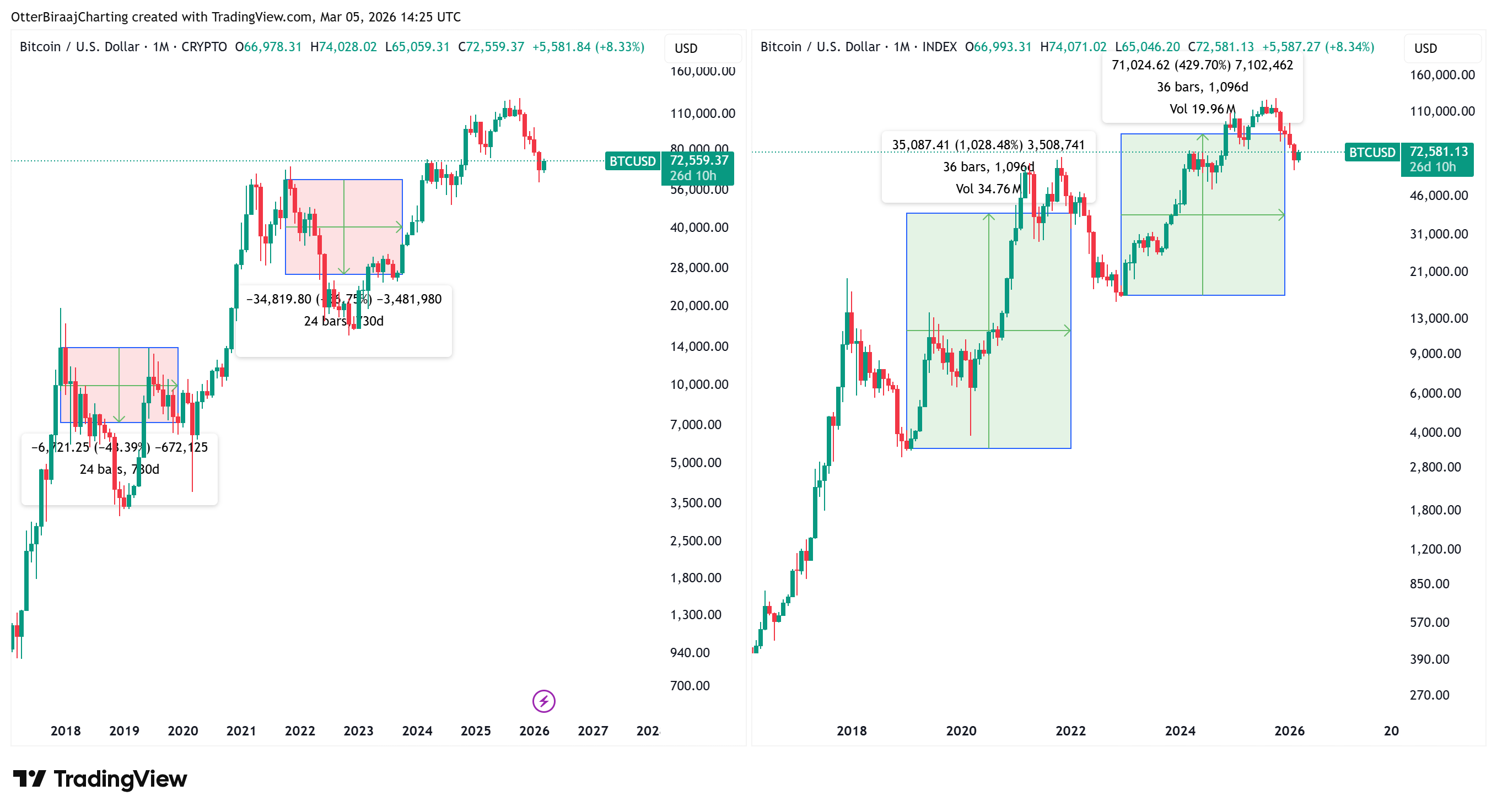 Bitcoin’s decline and gains over two and three years | Source: Cointelegraph/TradingView A similar trend appears in the next cycle. Investors who bought near the 2021 peak faced a 43.5% loss after two years, but by the third year, their investment yielded a 14.5% profit.
Meanwhile, those who bought near market bottoms achieved remarkable gains. Buying close to the 2019 bottom resulted in an 871% profit after two years and 1,028% after three. Similarly, positions bought near the 2022 cycle bottom saw about 465% growth after two years and 429% after three.
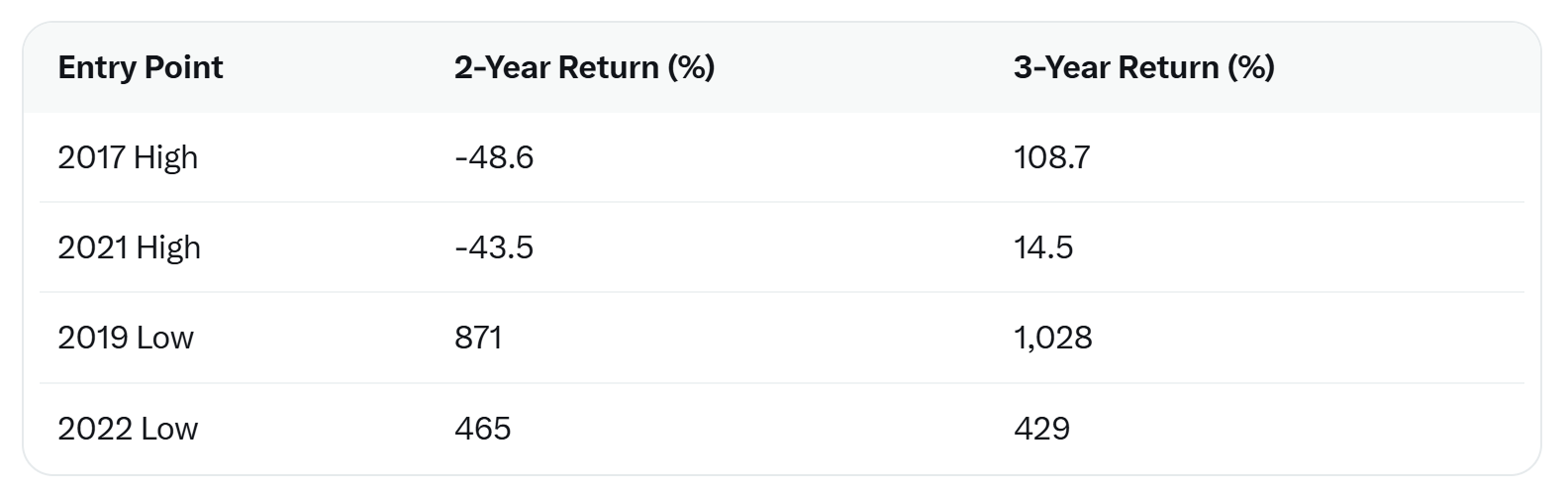 Bitcoin purchase timing and net returns over two to three years | Source: Cointelegraph Overall, historical data reveals a consistent pattern: two-year holding periods often lead to significant losses if bought near cycle peaks. However, extending the holding period to three years generally results in profitable outcomes. Notably, investments made near market bottoms tend to see the strongest growth in both two- and three-year periods.
Real Price Index of BTC and Buying Opportunities at the Bottom
On-chain valuation metrics, especially the realized price, offer important clues about optimal accumulation zones. The realized price measures the average price at which Bitcoin was last moved on-chain. Historically, deep price dips often bring Bitcoin’s price close to or below this level, creating attractive accumulation zones.
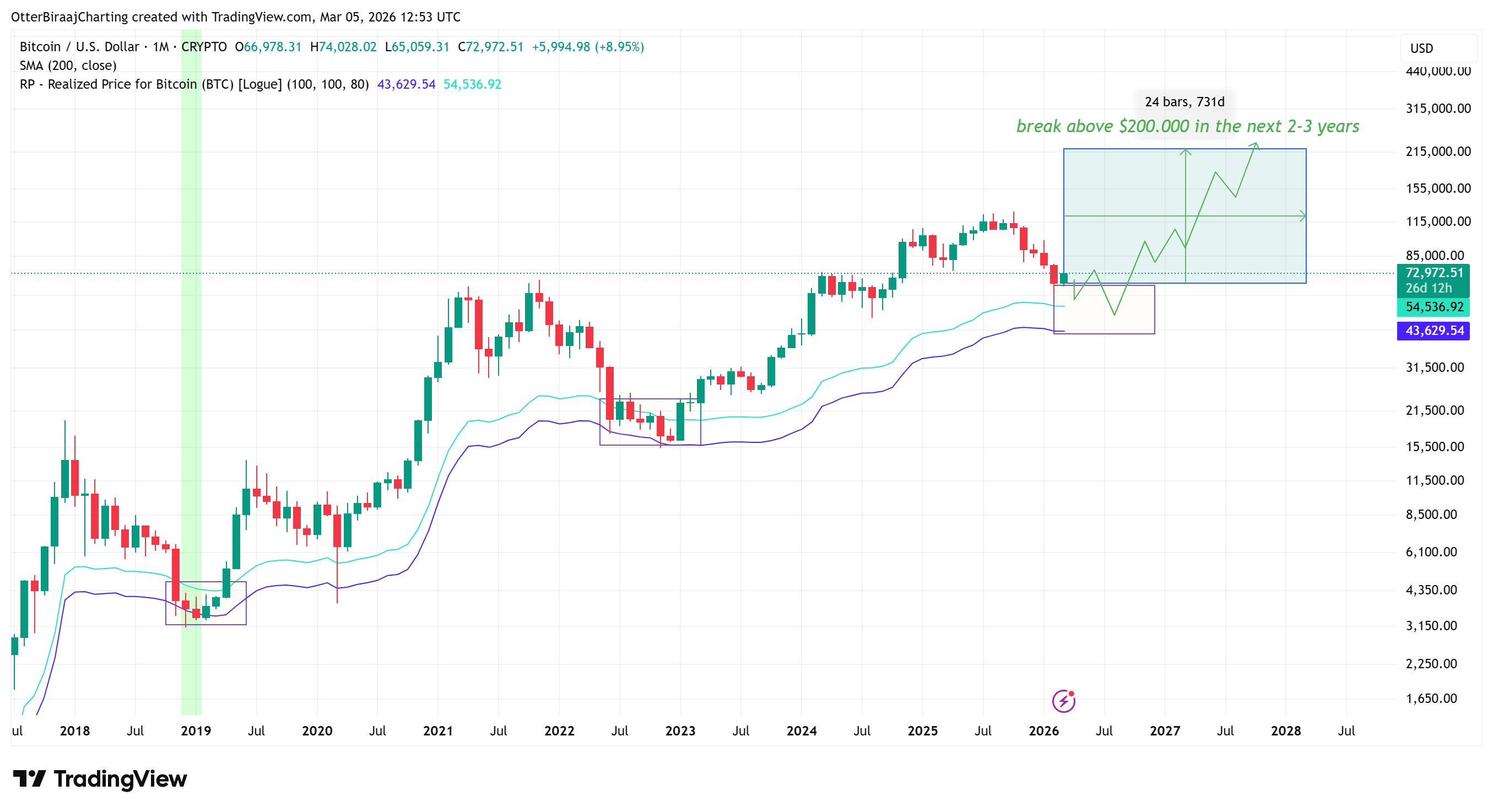 Bitcoin’s realized price range | Source: Cointelegraph/TradingView Since 2015, realized price bands have repeatedly aligned with cycle bottoms, and Bitcoin’s price has often rebounded strongly from these levels, sparking multi-year bull runs. Currently, Bitcoin’s realized price hovers around $55,000, while the shifted realized price is approximately $42,000.
Historical data also shows that investors accumulating near market bottoms tend to buy when prices are around or below these valuation bands. This presents an opportunity to optimize long-term profits.
Long-term Holding: The Key to Risk Reduction
Many studies emphasize the importance of long-term holding. According to Matt Hougan, Chief Investment Officer at Bitwise, adding Bitcoin to a traditional 60/40 portfolio improved both cumulative returns and risk-adjusted returns across all three-year periods studied. The win rate reached 93% over two-year holds, with a 5% allocation providing optimal balance.
Another Bitwise study, based on data from July 2010 to February 2026, shows the probability of loss drops to just 0.7% when holding Bitcoin for three years. The risk further decreases to 0.2% over five years and disappears entirely over ten years.
In contrast, short-term trading strategies carry higher risks. Day traders face potential losses of up to 47.1%, and even one-year holding periods have a 24.3% chance of loss.
Conclusion
Historical data indicates that Bitcoin is highly volatile in the short term but offers significant profit potential for patient investors. Choosing the right entry points, especially during market downturns, combined with long-term holding strategies, can help minimize risks and maximize gains. In an ever-changing financial landscape, Bitcoin remains a compelling asset for long-term investors.
Disclaimer: The information on this page may come from third parties and does not represent the views or opinions of Gate. The content displayed on this page is for reference only and does not constitute any financial, investment, or legal advice. Gate does not guarantee the accuracy or completeness of the information and shall not be liable for any losses arising from the use of this information. Virtual asset investments carry high risks and are subject to significant price volatility. You may lose all of your invested principal. Please fully understand the relevant risks and make prudent decisions based on your own financial situation and risk tolerance. For details, please refer to
Disclaimer.
Related Articles
Zonda Exchange Discloses 4,500 BTC Cold Wallet as Private Keys Remain Untransferred
Zonda, a Polish crypto exchange, revealed a cold wallet with 4,503 BTC amid a withdrawal crisis. CEO Przemysław Kral addressed fund misappropriation allegations and promised legal action against false claims, emphasizing that private keys were never transferred due to the former CEO's disappearance.
GateNews18m ago
Ben McKenzie Slams Bitcoin on Jon Stewart Show
Actor Ben McKenzie appeared on The Weekly Show with Jon Stewart on Aug. 14 in a segment titled "The Other Side of Bitcoin: Crypto Corruption," where he delivered a sharp critique of Bitcoin and the broader cryptocurrency industry. McKenzie, known for his film and television work, has become a
CryptoFrontier32m ago
BTC edges up 0.46% in 15 minutes: institutional fund outflows and macro risk-off sentiment in sync drove the move
From 15:00 to 15:15 (UTC) on 2026-04-16, BTC logged a +0.46% return within 15 minutes. The price fluctuated in a range of 73,939.7 to 74,440.0 USDT, with an amplitude of 0.68%. During this time window, market attention increased, short-term volatility intensified, and fund-flow characteristics changed noticeably.
The main driver of this deviation is the continued outflow of large amounts of capital from exchanges. According to on-chain data, in the past 24 hours the net flow was -14,408.84 BTC, mainly concentrated in large transfer ranges of more than $1 million (especially>$10M net outflow -12,987.03 BTC). This shows that institutions and large holders actively reduced their BTC holdings on exchanges, and short-term selling pressure was significantly lowered. Against the backdrop of persistently weak liquidity, with order book depth remaining at a low level for a long time, the price has become more sensitive to medium-sized buy orders—amplifying the impact of even modest inflows on spot market price action.
In addition, macro conditions changed in parallel and produced a synchronized effect: easing geopolitical tensions in the Middle East boosted overall market sentiment. International gold prices rose, global equity markets hit new highs, and the market re-evaluated the probability of the Federal Reserve cutting rates within the year, further increasing investor attention to safe-haven assets (including BTC). At the same time, on-chain data indicates that the “whale” trading activity during this phase is at an annual low (>$1M transfers fell to 1,485 transactions). With heavy market wait-and-see sentiment and limited short-term supply, BTC’s responsiveness to sudden buy-side capital was further enhanced.
Investors should be reminded that current market liquidity is still fragile. Insufficient order book depth increases the market’s sensitivity to large capital movements, and short-term volatility may intensify. Going forward, focus on further shifts in on-chain large-fund flows, changes in price action as it breaks through support or resistance regions, and the risks and opportunities brought by related macro policies and geopolitical developments. Please continue to track key data and stay alert to any sudden shocks during the period of abnormal moves.
GateNews1h ago
Bitcoin Transactions Face 70-Page Tax Filing Burden Annually
According to Nicholas Anthony of the Cato Institute's Center for Monetary and Financial Alternatives, spending Bitcoin on everyday purchases creates an unexpected tax compliance nightmare. The IRS treats Bitcoin as property, not currency, meaning every transaction—even a $5 coffee
CryptoFrontier1h ago
Bitcoin, Ethereum and Solana ETFs Record Positive Net Inflows on April 16
Gate News message, according to the April 16 update, Bitcoin ETFs recorded a 1-day net inflow of +2,855 BTC (+$209.95M) and a 7-day net inflow of +11,849 BTC (+$871.52M). Ethereum ETFs showed a 1-day net inflow of +15,477 ETH (+$35.44M) and a 7-day net inflow of +90,366 ETH (+$206.94M). Solana ETFs
GateNews1h ago
Bitcoin Breaks Below $74K as 24-Hour Decline Reaches 0.02%
Gate News message, April 16 — Bitcoin fell below the $74,000 level, currently trading at $73,906 with a 24-hour decline of 0.02%.
GateNews2h ago


