Author: Fenrir, Crypto City
Federal Reserve Issues Guidance: Tokenized Securities Are Subject to Same Regulatory Capital Standards as Traditional Securities
The U.S. Federal Reserve (Fed), together with the Federal Deposit Insurance Corporation (FDIC) and the Office of the Comptroller of the Currency (OCC), recently released a new FAQ document explaining how tokenized securities are treated for regulatory capital purposes. Regulators explicitly state that banks holding or processing tokenized securities should follow the same capital rules as traditional securities.
The regulatory document notes that the technological form of issuing or trading securities (such as whether blockchain or distributed ledger technology is used) generally does not change the capital treatment of the asset. In other words, as long as the legal rights and risk profile of the asset are the same as those of traditional securities, the regulatory capital requirements should remain consistent.
Banking regulators indicate that this approach reflects the “technology-neutral” principle of the regulatory framework. The legal nature and risk assessment of financial assets are the core criteria for capital rules; the issuance format and technological platform do not influence this regulatory standard.
Blockchain Format Does Not Affect Regulatory Requirements; Capital Rules Remain Consistent
In banking regulation, capital adequacy ratio is a key indicator. Banks must hold a certain proportion of high-quality capital and liquid assets to buffer against market volatility and potential losses.
The regulators clearly state that if a security is recognized as a qualifying financial asset, its tokenized form does not alter how it is accounted for in capital calculations. For example, a tokenized bond or stock on a bank’s books should be treated the same as its non-tokenized version.
Regulators also note that tokenized securities, when compliant with existing laws and risk management standards, can be used as financial collateral. When banks use these assets as collateral, they must follow the same haircut and risk management standards as traditional securities.
Additionally, regulators emphasize that the blockchain type does not impact capital treatment. Whether tokenized securities are issued or traded on permissioned or permissionless blockchains, the regulatory capital rules remain the same.
Rapid Growth of Tokenized Assets Accelerates Clarification of Applicable Regulations
In recent years, financial institutions have actively converted traditional assets like stocks, bonds, and real estate into digital tokens on blockchain to improve trading efficiency and market liquidity.
Data from market research firm RWA.xyz shows that the global market size for tokenized real-world assets (RWA) is approximately $26.25 billion, with tokenized U.S. Treasury products making up the largest share. The tokenized stock market is about $110 million, still in early development stages.
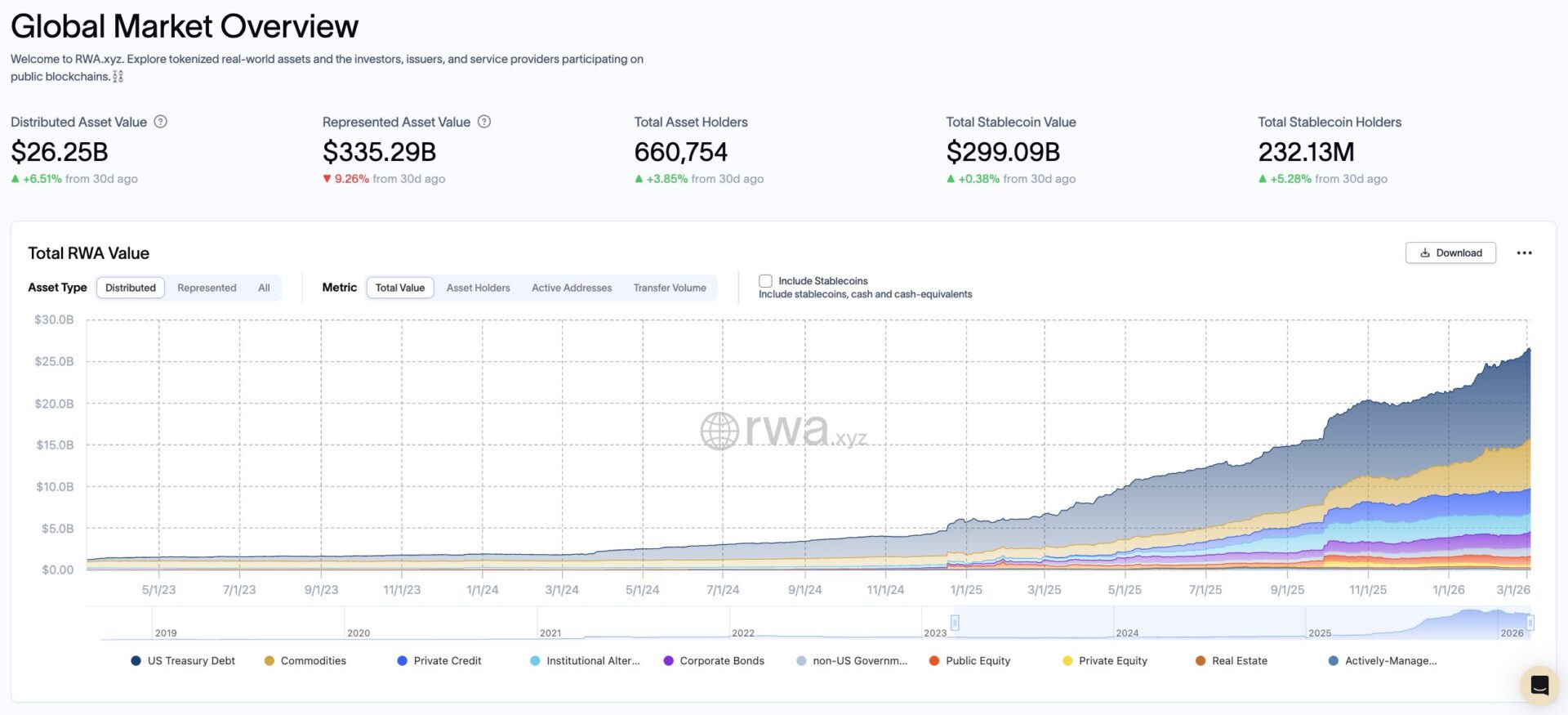
Image source: RWA.xyz
Global market size for tokenized real-world assets (RWA) is approximately $26.25 billion
Financial industry players generally believe that tokenized securities can bring multiple efficiency improvements, including 24-hour trading, real-time settlement, and lower transaction costs. Some trading platforms and fintech companies have already launched tokenized stock products in Europe, allowing investors to trade traditional listed company stocks via blockchain as tracking assets.
However, tokenized securities still need to align with legal and regulatory frameworks of traditional finance. The U.S. Securities and Exchange Commission (SEC) earlier this year stated that tokenized securities fall under federal securities laws and must comply with the same registration, disclosure, and investor protection rules.
U.S. SEC Clarifies “Tokenized Securities” Regulations, Fully Incorporating Securities Laws
Gradually Clarifying Regulatory Attitudes
The recent guidance from the Fed and other banking regulators signals the gradual integration of blockchain finance into the banking system. Over the past few years, U.S. banking regulators have been relatively cautious about crypto assets and blockchain technology, creating high uncertainty for financial institutions promoting related activities.
As interest in tokenized assets grows among financial institutions, regulators are beginning to clarify how existing financial laws apply to blockchain assets. The core significance of this capital rules clarification is to confirm that tokenized securities will not face additional capital burdens or stricter regulatory treatment due to their technological form.
Market observers note that clarifying capital rules is highly significant for the banking industry. Capital adequacy ratio is one of the core constraints on all banking activities. With clearer regulatory frameworks, banks can better assess the risks and costs associated with tokenized securities.
Tokenized securities are seen as an important bridge connecting traditional finance and blockchain markets. In the future, cooperation models between banks, asset managers, and crypto financial platforms are expected to evolve as related regulations continue to develop.
Disclaimer: The information on this page may come from third parties and does not represent the views or opinions of Gate. The content displayed on this page is for reference only and does not constitute any financial, investment, or legal advice. Gate does not guarantee the accuracy or completeness of the information and shall not be liable for any losses arising from the use of this information. Virtual asset investments carry high risks and are subject to significant price volatility. You may lose all of your invested principal. Please fully understand the relevant risks and make prudent decisions based on your own financial situation and risk tolerance. For details, please refer to
Disclaimer.
Related Articles
The central bank issues a digital currency report—does it directly refute Qu Bo? If Taiwan issues a CBDC, merchants generally cannot refuse to accept it
The central bank released a report stating that Taiwan’s CBDC development will follow a phased promotion strategy. In the short term, it is not urgent to issue retail CBDC; the focus is on wholesale CBDC and the infrastructure for asset tokenization. The central bank emphasized that CBDC will not increase the money supply and will have legal standing. As a rule, merchants may not refuse to accept it, in order to prevent the payment market from becoming overly dependent on the private sector.
ChainNewsAbmedia4h ago
U.S. Treasury Secretary Bessent: Fed Will Cut Rates Further; Oil Price Gains Not Translating to Inflation Expectations
U.S. Treasury Secretary Bessent indicated that the Federal Reserve may lower interest rates further, emphasizing that rising oil prices have not impacted inflation expectations, as they remain detached from broader economic price pressures.
GateNews5h ago
Trump's Fed Chair Pick Kevin Warsh Has $131M–$209M Net Worth, Holds Crypto and AI Investments
Kevin Warsh, nominated by Trump for Federal Reserve chair, is the wealthiest candidate in recent history, with a net worth up to $209 million. His diverse investments include Silicon Valley, fintech, and AI. Despite potential conflicts, he has a modern view on digital assets.
GateNews9h ago
Bank of Korea Governor Nominee Shin Hyun-song Signals Openness to CBDC and Private Stablecoins, Unveils Won Internationalization Plan
Shin Hyun-song, nominee for Bank of Korea governor, acknowledged the coexistence of CBDCs and stablecoins at a confirmation hearing. He proposed a three-pronged approach for the won's internationalization and pledged to divest foreign assets to prevent conflicts of interest.
GateNews11h ago
Former U.S. Treasury Secretary Yellen Says Fed Rate Cut Still Possible This Year
Former Treasury Secretary Janet Yellen believes the Federal Reserve may cut interest rates this year, despite uncertainty from the Iran war and oil price volatility. She sees a broad supply shock impacting various sectors but suggests stable inflation expectations make rate hikes unlikely.
GateNews12h ago
Fed Chair Nominee Kevin Warsh Discloses Crypto Investments Ahead of Senate Hearing
Kevin Warsh, nominated for Federal Reserve Chair, reported investments in over 20 digital asset companies. His portfolio includes DeFi platforms, blockchain networks, and Web3 projects. The Senate Banking Committee may advance his nomination, raising potential conflict of interest concerns.
GateNews16h ago


