
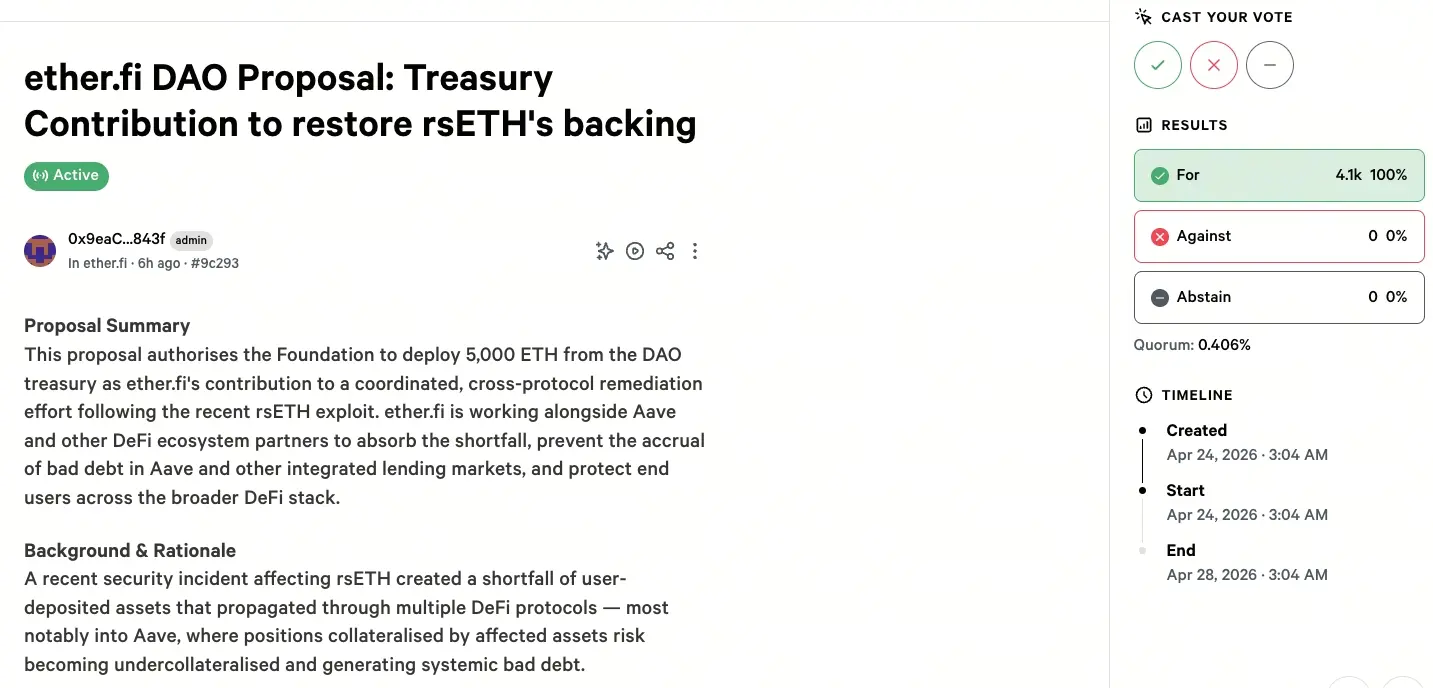
The EtherFi Foundation submitted a governance proposal on April 24, authorizing the transfer of up to 5,000 ETH from the DAO treasury to inject into the cross-protocol rescue pool addressing the rsETH vulnerability incident. This is intended to fill the collateral shortfall and prevent bad debt from emerging in Aave and other DeFi lending markets. This is part of EtherFi’s “DeFi United” coordinated rescue action.
Proposal Background: How the rsETH Vulnerability Creates Systemic Bad-Debt Risk
(Source: EtherFi)
Recent security incidents affecting rsETH have caused users’ deposited assets to come up short, and the risk has spread across multiple DeFi protocols. The most notable among them is Aave: positions using affected assets as collateral face the risk of being under-collateralized and could potentially lead to systemic bad debt.
In the proposal, EtherFi states that this is both a “principally correct action” and an important investment in the long-term resilience of the DeFi ecosystem. This is because a healthy and robust DeFi market is directly tied to the interests of ETHFI holders and EtherFi users.
Use of Funds and Execution Framework: Two Deployment Tracks for 5,000 ETH
According to the proposal details, the 5,000 ETH will be used across two core directions: (1) absorb user-funding shortfalls; and (2) prevent bad debt from forming in Aave and other DeFi venues that hold exposure to the affected assets.
The funds will be coordinated for deployment with other ecosystem partners (including Aave, etc.), and the allocation methodology, counterparties, and allocation framework will be disclosed together with the execution details. After DAO approval, the Foundation will publish the complete coordinated rescue framework within 7 days and will begin deploying promptly.
DAO Governance Terms: Fund Recovery and Termination Conditions
The rescue plan will be terminated under any of the following conditions: (a) the coordinated rescue is completed; (b) the 5,000 ETH cap is reached; or © the rescue plan is modified or terminated by subsequent governance voting.
It is worth noting that if the rescue funds are recovered after the plan is completed through compensation, insurance, legal proceedings, or on-chain recovery, the recovered amount will be returned to the DAO treasury (capped at the deployment amount of this proposal). After the remediation is completed, any unused ETH will also be returned to the treasury. DAO voting options include: For (approve the rescue plan), Against (do not approve), and Abstain.
Frequently Asked Questions
Why does EtherFi need to provide rescue funds for the rsETH vulnerability?
As an important protocol in the Ethereum liquid staking ecosystem, EtherFi’s collateral issues directly affect the health of lending markets such as Aave that use related assets as collateral. EtherFi’s position in the proposal is that protecting end users and maintaining the health of the DeFi market is the fundamental interest behind the protocol’s long-term development—not merely a charitable act.
If there is ETH left over or funds are recovered after the rescue plan is completed, how will it be handled?
Per the proposal terms, any unused ETH after completion of the rescue plan will be fully returned to the EtherFi DAO treasury. If funds are recovered afterward through compensation, insurance, legal proceedings, or on-chain recovery methods, the recovered amount will likewise be returned to the DAO treasury, capped at the amount deployed in this round.
Which protocols are included in the “DeFi United” coordinated rescue action?
“DeFi United” is a cross-protocol coordinated rescue action that brings together EtherFi, Aave, and multiple other DeFi protocols to jointly fill the collateral shortfall caused by the rsETH vulnerability. EtherFi’s proposal clearly states that it is working with “Aave and other DeFi ecosystem partners,” and the complete list of participating protocols will be published within 7 days after DAO approval.
Disclaimer: The information on this page may come from third parties and does not represent the views or opinions of Gate. The content displayed on this page is for reference only and does not constitute any financial, investment, or legal advice. Gate does not guarantee the accuracy or completeness of the information and shall not be liable for any losses arising from the use of this information. Virtual asset investments carry high risks and are subject to significant price volatility. You may lose all of your invested principal. Please fully understand the relevant risks and make prudent decisions based on your own financial situation and risk tolerance. For details, please refer to
Disclaimer.
Related Articles
Bitmine Raises ETH Staking to 70% of Holdings With $320M Latest Push
Gate News message, April 24 — Bitmine, the largest Ethereum treasury company led by Tom Lee, staked approximately $320 million worth of ether over the past 24 hours, bringing its total staked holdings to over 70% of its overall position.
The company moved roughly 75,600 ETH to a major CEX for
GateNews51m ago
Hyperliquid Trader neoyokio.eth Averages Down CHIP Position to $3.4M at $0.098
Gate News message, April 24 — Hyperliquid trader neoyokio.eth added to their 3x leveraged CHIP long position earlier today, increasing holdings from $2.2 million to $3.4 million with an average entry price of $0.098, according to Hyperinsight monitoring. The position is currently underwater by
GateNews2h ago
Ripple RLUSD Gains Wanchain Bridge Support Across XRPL, Ethereum, and Cardano
Gate News message, April 24 — Ripple's RLUSD stablecoin has expanded its cross-chain reach after Wanchain added bridge support for the asset. The integration enables RLUSD transfers across the XRP Ledger, Ethereum, Cardano, and Wanchain networks, creating multiple interoperability routes for users m
GateNews3h ago
Ethereum Spot ETF 10-Day Inflow Streak Ends With $75.936M Net Outflow
Gate News message, April 24 — Ethereum spot ETFs recorded a total net outflow of $75.936 million yesterday (April 23), ending a 10-day streak of consecutive net inflows, according to SoSoValue data.
Grayscale Ethereum Mini Trust ETF (ETH) led inflows with $19.758 million in net deposits, bringing i
GateNews4h ago
Belarus: Crypto banks can use 26 digital assets and conduct 11 types of business
According to a report by the Belarusian news agency BelTA on April 23, Alexander Yegorov, First Deputy Chairman of the National Bank of Belarus, announced at the “2026 Digital Bank” conference that the Belarusian crypto-banking framework allows the use of 26 cryptocurrencies and 11 types of operations, as set out in accordance with Belarusian Decree No. 19, “On certain regulatory issues in the field of crypto banks and digital tokens.”
MarketWhisper5h ago
Grayscale Ethereum Staking Mini ETF Records $337M Inflows in Q1, Leads U.S. ETP Providers
Gate News message, April 24 — Grayscale's Ethereum Staking Mini ETF attracted $337 million in inflows during the first quarter of 2026, ranking first among U.S. ETP providers, according to Grayscale CEO Peter Mintzberg posting on X. The achievement reflects strong institutional demand for Ethereum s
GateNews5h ago


