US Senator Cynthia Lummis has dismissed claims that the Digital Asset Market Clarity Act fails to protect decentralized finance innovators from legal repercussions, rebutting that recent changes to the draft will make it the “strongest protection for DeFi and developers ever enacted.”
Her comments on Friday came in direct response to crypto lawyer Jake Chervinsky, who argued that Title 3 of the current draft undermines the Blockchain Regulatory Certainty Act — another crypto bill focused on developer protections — by subjecting non-custodial software developers to know-your-customer obligations.
“Don’t believe the FUD,” Lummis said, adding, “We have worked on a bipartisan basis for the last few weeks to make changes to Title 3 that make this bill the strongest protection for DeFi and developers ever enacted. We have to pass the Clarity Act to get these protections.”
The latest changes to the CLARITY Act have not been publicly released.
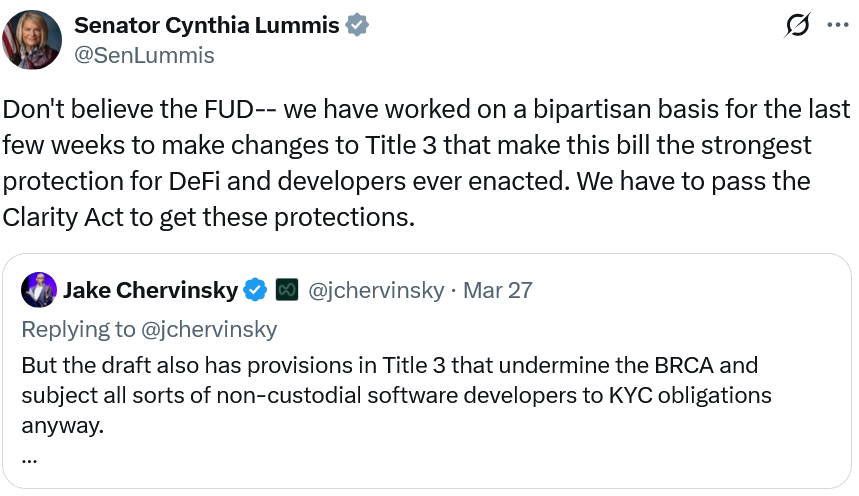
_Source: _Cynthia Lummis
Chervinsky said these DeFi protection provisions have been overshadowed by intense focus on stablecoin rewards provisions in the CLARITY Act.
His biggest issue with the Senate Banking Committee’s latest CLARITY Act draft is that Title 3’s money transmitter definitions could still expose many non-custodial DeFi builders to liability.
This is despite the CLARITY Act incorporating the BRCA in section 604, which clarifies that non-controlling developers and providers of non-custodial software are not to be treated as financial institutions subject to Bank Secrecy Act KYC obligations.
“The biggest challenge is ensuring non-custodial software developers aren’t misclassified as money transmitters,” Chervinsky argued.
“That’s non-negotiable for DeFi, and it’s still unsettled.”
His concerns come amid several high-profile prosecutions and convictions of developers in the US in recent months, including Tornado Cash co-founder, Roman Storm, who was convicted in August 2025 of conspiracy to operate an unlicensed money transmitting business.
**Related: **__Delaware eyes stablecoin licensing framework under banking laws
US lawmakers have said the CLARITY Act is moving closer toward a Senate Banking Committee markup expected in April after recent bipartisan progress on stablecoin rewards provisions.
Passage of the CLARITY Act is necessary to ensure DeFi developers are afforded legal protections under the BRCA, Lummis noted.
**Magazine: **__Are DeFi devs liable for the illegal activity of others on their platforms?
Cointelegraph is committed to independent, transparent journalism. This news article is produced in accordance with Cointelegraph’s Editorial Policy and aims to provide accurate and timely information. Readers are encouraged to verify information independently. Read our Editorial Policy https://cointelegraph.com/editorial-policy
- #Law
- #United States
- #Bills
- #Developers
- #DeFi
- #Regulation
Disclaimer: The information on this page may come from third parties and does not represent the views or opinions of Gate. The content displayed on this page is for reference only and does not constitute any financial, investment, or legal advice. Gate does not guarantee the accuracy or completeness of the information and shall not be liable for any losses arising from the use of this information. Virtual asset investments carry high risks and are subject to significant price volatility. You may lose all of your invested principal. Please fully understand the relevant risks and make prudent decisions based on your own financial situation and risk tolerance. For details, please refer to
Disclaimer.
Related Articles
Bypassing FSC regulations to buy crypto with a credit card: Is it possible? Odin Ding promotes Wallet Pro, a service for buying crypto with a U.S. debit card
OwlPay and Wallet Pro services launched by OdinTing use stablecoin technology to enable B2B cross-border payments, and partner with international payment giants to showcase its expansion ambitions in the fintech space. By operating from abroad, OdinTing bypasses Taiwan’s regulatory restrictions, offering fast virtual-asset trading; meanwhile, as it faces the newly promulgated Virtual Asset Services Act, it is likely to become a reference template for other foreign-invested companies entering the Taiwan market.
CryptoCity27m ago
Nigeria SEC Chief Vows Crackdown on Naira Manipulators, Plans to Delist NGN from P2P Platforms
Nigeria's SEC, led by Emomotimi Agama, will intensify efforts to tackle naira manipulation in the crypto sector by removing the currency from peer-to-peer platforms. Following previous enforcement actions, industry stakeholders are urging for clearer regulations and a unified policy approach.
GateNews46m ago
JPMorgan CFO Warns Stablecoins Could Become 'Regulatory Arbitrage' Tool
JPMorgan CFO Jeremy Barnum cautioned that stablecoins could create regulatory arbitrage, offering bank-like services without necessary oversight. He advocated for a clearer regulatory framework for digital assets, prioritizing consistency over speed.
GateNews2h ago
Encouraging innovation! A U.S. judge bans Arizona’s regulators from prediction markets and suspends the prosecution of Kalshi
A U.S. federal district court has ruled that Arizona is barred from using its gambling law to sue the prediction market platform Kalshi, finding that the Federal Commodity Futures Trading Commission has exclusive jurisdiction. The ruling affects the boundary between state and federal authority in financial market regulation, and Kalshi maintains that its business falls under financial products rather than traditional gambling. Courts in different states have issued differing rulings on prediction markets, and the Trump family has also expressed support for prediction markets.
CryptoCity2h ago
Can bypass Financial Supervisory Commission (FSC) rules to buy crypto by card? Odin Travel launches a U.S. card-based crypto purchase service, Wallet Pro.
OwlPay and Wallet Pro services launched by Odin Tithing use stablecoin technology to enable B2B cross-border payments, and partner with international payment giants to demonstrate its expansion ambitions in the fintech space. Through offshoring operations, Odin Tithing bypasses Taiwan’s regulatory restrictions, offering fast virtual-asset trading; meanwhile, faced with the newly promulgated Virtual Asset Services Act, it is expected to become a reference template for other foreign-funded companies entering the Taiwan market.
CryptoCity3h ago
Encourage innovation! A U.S. judge bans Arizona-regulated prediction markets and suspends prosecution against Kalshi.
A U.S. federal district court has ruled that Arizona is barred from using the gambling law to prosecute the prediction market platform Kalshi, finding that the federal Commodity Futures Trading Commission has exclusive jurisdiction. The ruling affects the line between state and federal authority over financial market regulation, while Kalshi maintains that its business is a financial product rather than traditional gambling. Decisions on prediction markets vary from state to state, and the Trump family has also expressed support for prediction markets.
CryptoCity5h ago


