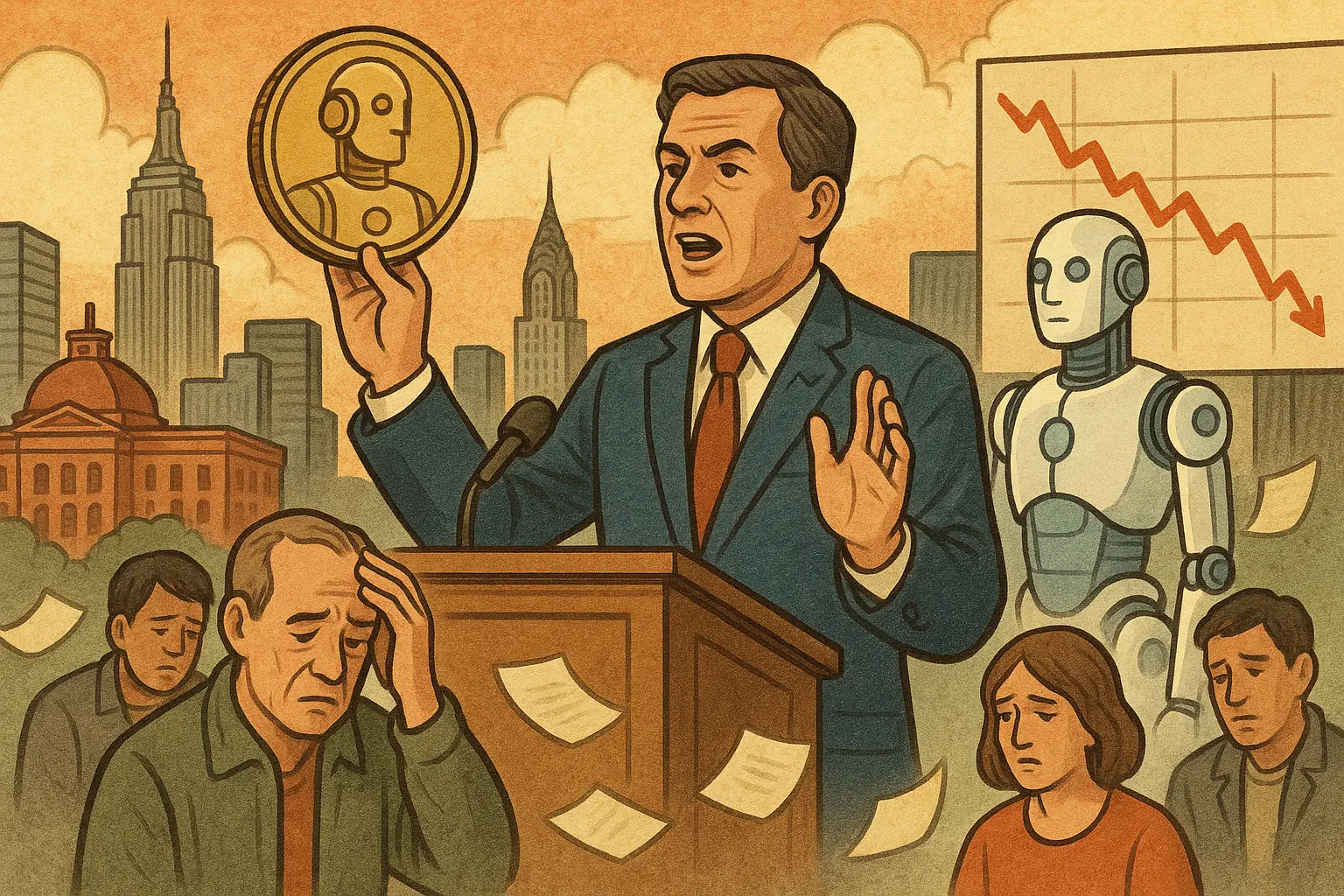
New York state legislator and congressional candidate Alex Bores announced on Sunday an “AI dividend” plan, aiming to make direct payments to U.S. citizens when artificial intelligence significantly replaces American workers. The announcement comes after a Goldman report found that AI adoption has already led to the loss of about 16k jobs per month in the United States; tech giants including Amazon, Meta, Intel, and Microsoft have all announced large-scale layoffs in succession.
Design mechanisms of the AI dividend plan: trigger conditions and how the funds are used
(Source: Alex Bores)
The AI dividend plan is not a fixed universal basic income (UBI). Instead, it sets trigger conditions—only when AI “significantly replaces American workers” will it be activated. In addition to making direct dividend payments to U.S. citizens, the funds will be used in three directions: investing in “workforce transition, training, and education”; building AI oversight and safety infrastructure; and incentivizing employers to choose hiring humans rather than AI.
The funding-raising mechanism includes: taxing the use of AI, holding equity in leading AI companies, and reforming the tax treatment of labor and capital. Bores is currently positioning this policy as a key platform for his congressional campaign, and whether it can be implemented depends on whether his campaign is successful.
Divergence between the two institutions: how severe is the AI unemployment impact, really?
A Goldman report shows that AI adoption has led to the loss of about 16k jobs per month in the United States, and the large-scale layoffs by Amazon, Meta, Intel, and Microsoft are considered to be directly related to AI efficiency-driven substitution.
However, a more cautious assessment was provided in a report published by Morgan Stanley on April 14: so far, AI’s impact on the labor market is “relatively mild,” and there is no sufficient evidence indicating that widespread unemployment is already occurring. Morgan Stanley cites historical patterns showing that waves of new technology long-term have typically also promoted job growth—while at the same time acknowledging that artificial intelligence may break this historical rule.
Policy backdrop: political responses amid the tech giants’ layoff wave
The proposal of the AI dividend plan reflects the U.S. political establishment’s growing attention to how AI is affecting the job market. How to allocate the productivity gains brought by AI is becoming a campaign issue for more and more political figures. From conception to implementation, the plan still faces several major challenges, including quantifying the trigger conditions, the legality of an AI usage tax, the enforcement mechanisms for holding equity in AI companies, and how to avoid negative impacts on AI innovation.
Frequently asked questions
What are the trigger conditions of the AI dividend plan, and does it amount to universal basic income?
The AI dividend is not a universal basic income (UBI). Its key difference lies in the setting of trigger conditions—only when AI “significantly replaces American workers” will it be activated. The plan is positioned as an “insurance mechanism,” not a fixed baseline income. The specific quantitative trigger criteria (such as an unemployment-rate threshold) have not been explained in detail in public statements.
Why do Goldman and Morgan Stanley assess the AI unemployment impact differently?
Goldman focuses on presenting substitution effects that have already occurred (16k job losses per month), while Morgan Stanley evaluates from a longer historical perspective, concluding that the impact is “mild” for now, and citing historical precedents that after technological substitution, job growth typically follows. At the same time, it also acknowledges that AI’s disruptive potential may differ from past technology revolutions.
Is this plan legislatively feasible?
The plan is currently still at the campaign-proposal stage. The premise for implementation is that Bores successfully wins a seat in Congress and secures sufficient political support in Congress. The AI usage tax and mandatory shareholding mechanisms involved in the plan may face strong resistance from the tech industry and capital markets.
Disclaimer: The information on this page may come from third parties and does not represent the views or opinions of Gate. The content displayed on this page is for reference only and does not constitute any financial, investment, or legal advice. Gate does not guarantee the accuracy or completeness of the information and shall not be liable for any losses arising from the use of this information. Virtual asset investments carry high risks and are subject to significant price volatility. You may lose all of your invested principal. Please fully understand the relevant risks and make prudent decisions based on your own financial situation and risk tolerance. For details, please refer to
Disclaimer.
Related Articles
OpenAI Reaches $1 Trillion Pre-IPO Valuation Amid Race with SpaceX and Anthropic
OpenAI nears a $1T implied pre-IPO via on-chain bets; SpaceX and Anthropic target similar valuations as AI infrastructure costs surge, driving subscription revenue while Anthropic faces pricing confusion.
GateNews45m ago
DeepSeek's Valuation Surges Past $20 Billion as Tencent and Alibaba Weigh Investments
DeepSeek seeks >$20B as Tencent/Alibaba discuss investment; Nvidia warns US chip edge could be undermined by Huawei; AI funding continues to surge with Vast Data's $1B round and OpenAI/Anthropic/xAI investments.
DeepSeek aims for a valuation above $20 billion amid talks with Tencent and Alibaba, while Nvidia warns that shifting AI models to Huawei chips could erode U.S. lead. The piece also notes a global surge in AI funding, including Vast Data's $1 billion round at a $30 billion valuation and major investments in OpenAI, Anthropic, and xAI.
GateNews2h ago
OpenClaw, Hermes, and SillyTavern Confirmed in GLM Coding Plan Support
Zhipu AI PM Li announces OpenClaw, Hermes, and SillyTavern as supported GLM Coding Plan projects; other tools will be evaluated case-by-case. Do not share credentials or use subscriptions as API access; contact support for error 1313.
Zhipu AI product manager Li announced that OpenClaw, Hermes, and SillyTavern are officially supported under the GLM Coding Plan, with other tools evaluated case-by-case. The note cautions against sharing credentials or using subscriptions as API access and directs users with error 1313 to contact support.
GateNews5h ago
Google Cloud CEO: Gemini to Power Apple's Personalized Siri Rollout in 2026
Summary: Gemini will power a personalized Apple Siri in 2026, built on Apple's Foundation Models and Gemini collaboration; Apple tests a chat-like Siri in iOS 27/macOS 27, slated for WWDC 2026.
Abstract: Google Cloud's Gemini is set to power a personalized Apple Siri by 2026, blending Gemini with Apple's Foundation Models under a roughly $1 billion collaboration. Apple is testing a redesigned, chat-like Siri in iOS 27/macOS 27, with a Dynamic Island interface and new features, ahead of a WWDC 2026 unveiling on June 8.
GateNews6h ago
SpaceX $60B Cursor Deal Fuels SBF's Pardon Push as FTX's $200K Stake Now Worth $3B
Gate News message, April 22 — SpaceX announced a major partnership with AI coding startup Cursor today, with an option to acquire the company for $60 billion. The deal has given fresh ammunition to Sam Bankman-Fried (SBF), who is currently incarcerated and pushing for a presidential pardon, as it de
GateNews6h ago
Chegg Stock Crashes 99% as AI Disrupts Edtech Market
Summary: Chegg soared during online-education demand, then AI tools disrupted its model, triggering massive layoffs and a collapse below $2, with broader AI-driven shifts hitting crypto miners and fintech firms.
Abstract: This article examines Chegg's rise as a pandemic-era edtech darling and its ensuing decline amid the rapid adoption of generative AI, which provides quick answers and undercuts Chegg's value proposition. It documents 2025 layoffs and the stock's plunge toward delisting, and frames Chegg's experience within a broader AI disruption reshaping tech and crypto: Bitcoin miners pivot to AI operations, and AI-native strategies redefine competitiveness in fintech and beyond.
CryptoFrontier6h ago


