
Layer 1 blockchain Pharos announced its native token PROS tokenomics framework on April 21. The total supply of PROS is 1 billion tokens, including a 6% airdrop. Both the core team and investors are subject to a lock-up of 12 months plus linear release over 36 months. The staking inflation policy is divided into two phases: for the first six months before the mainnet launch it is 0%, from the seventh month onward it is 5% per year, after which the foundation adjusts it dynamically based on network operations.
PROS Genesis Supply Allocation Overview
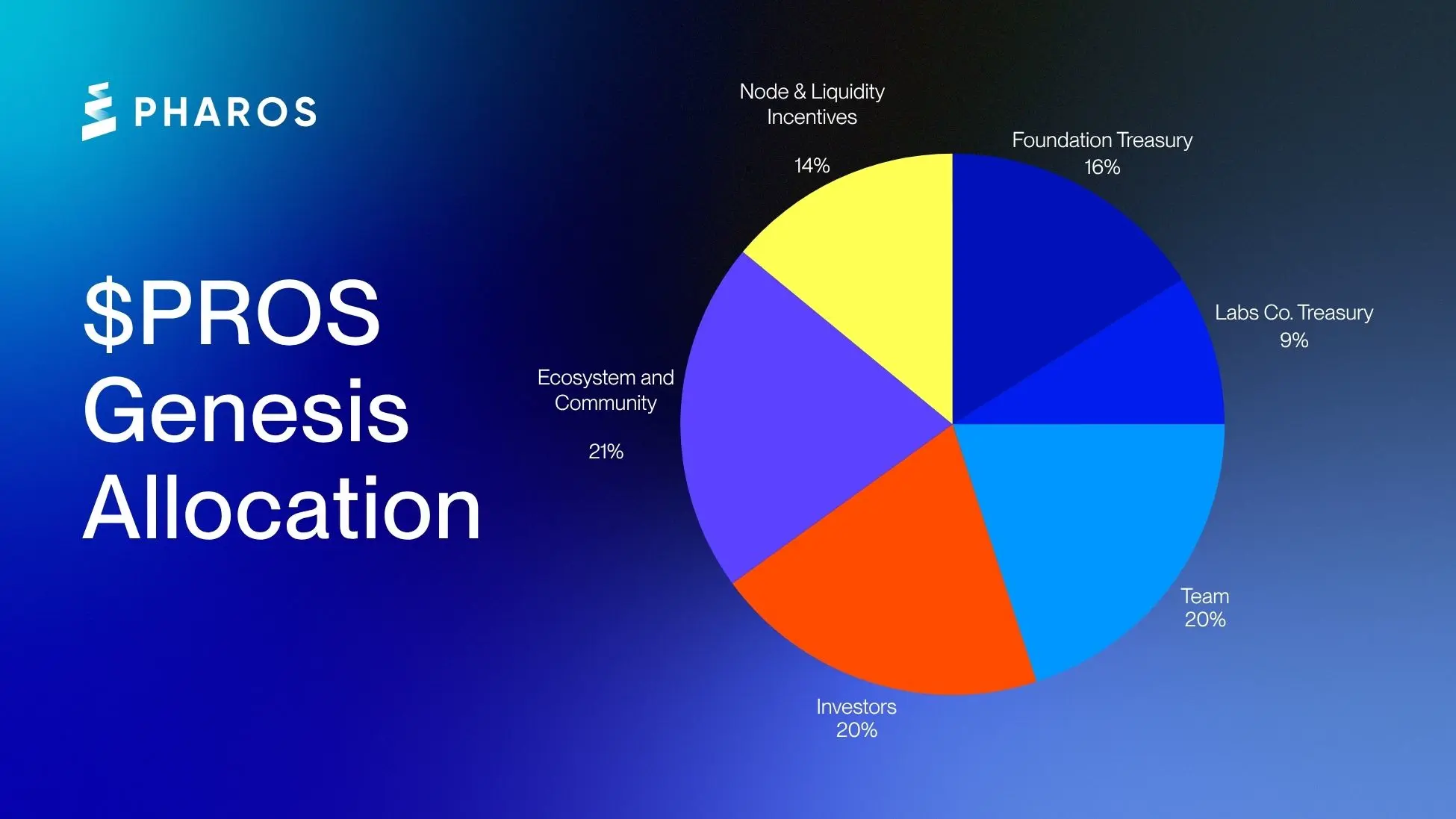
Pharos uses a structured token issuance framework, aiming to reduce short-term supply pressure and promote long-term development:
Foundation Treasury: 16%, with the lock-up period extended to as long as 48-60 months
Lab Co. Treasury: 9%, adopting an extended vesting period
Core Team: 20%, 12 months locked + 36 months linear release
Investors (Private Placement): 20%, 12 months locked + 36 months linear release
Ecosystem and Community: 21%, including a 6% airdrop (1% unlocked at TGE, 5% reserved for future community growth)
Node and Liquidity Incentives: 14%
During the TGE period, only part of the genesis tokens are expected to enter circulation, while the rest will be unlocked gradually according to the published issuance plan.
PROS Token Utility: From Transaction Fees to RWA-Specific Applications
PROS serves multiple functions within the Pharos network. At the base network level, it acts as the payment medium for transaction fees and on-chain execution costs, and as adoption increases, it may perform partial token burn to create deflationary pressure. In terms of security and governance, PROS protects network security through PoS staking, and as a governance token it allows holders to propose and vote on network upgrades and ecosystem initiatives.
At the RWA application layer, potential specific uses for PROS include stablecoin collateral, prioritized access to financial primitives, and using staked RWA for network security (subject to future governance decisions). This design differentiates Pharos from most general-purpose Layer 1 blockchains by making institutional-grade financial applications its core objective.
Staking Inflation Policy: The Logic of a Phased Design
Pharos adopts a phased staking issuance policy. For the first six months after the mainnet goes live, the staking inflation rate is 0%, aiming to maintain early supply discipline and avoid unnecessary dilution pressure during the price discovery phase. Starting from the seventh month, the annual inflation rate is set at 5% to introduce a sustainable security budget for validator incentives and long-term ecosystem expansion. After that, the foundation may dynamically adjust the inflation rate based on staking participation levels, the need for validator incentives, and the state of overall ecosystem development.
Frequently Asked Questions
What is Pharos, and how does it differ in positioning from other Layer 1s?
Pharos is a high-performance Layer 1 public blockchain that uses a PoS consensus mechanism, focused on real-world financial applications (RWA), stablecoin infrastructure, and a payment-grade on-chain experience. Its clear design orientation toward RWA differentiates it from most general-purpose Layer 1 blockchains. The mainnet officially launched on December 12, 2025.
How exactly will the 6% PROS airdrop be released?
The 6% community airdrop is a subset of the 21% ecosystem and community allocation. Of this, 1% will be unlocked immediately at TGE (token generation event), and 5% will be reserved for future community growth plans and airdrop incentives. The specific release schedule will be announced based on subsequent community planning.
Why adopt a zero-inflation transition to a phased design that reaches 5% annualized?
Pharos believes that token issuance should reflect the network’s development stages: the initial 0% inflation maintains supply discipline, reduces dilution impact on early holders, and provides sufficient room for price discovery in the market. The 5% annual inflation introduced after the seventh month provides a sustainable source of funds to support validator incentives and the network’s long-term security; the balance between the two is the core logic of the entire framework design.
Disclaimer: The information on this page may come from third parties and does not represent the views or opinions of Gate. The content displayed on this page is for reference only and does not constitute any financial, investment, or legal advice. Gate does not guarantee the accuracy or completeness of the information and shall not be liable for any losses arising from the use of this information. Virtual asset investments carry high risks and are subject to significant price volatility. You may lose all of your invested principal. Please fully understand the relevant risks and make prudent decisions based on your own financial situation and risk tolerance. For details, please refer to
Disclaimer.
Related Articles
Singapore Jeweler Mustafa Gold Launches MG999 Yield-Bearing Gold Token with FundBridge and Libeara
Gate News message, April 23 — Singapore-based jeweler Mustafa Gold has partnered with asset management firm FundBridge Capital and tokenization platform Libeara to launch MG999, a yield-bearing digital token that tracks gold prices. The token provides investors with gold exposure while generating re
GateNews4m ago
XRP Expands to Solana as wXRP Drives DeFi Access
Key Insights
Wrapped XRP on Solana surpasses 834,000 tokens, enabling new DeFi access while strengthening cross-chain liquidity and expanding XRP utility beyond its native ledger.
Ethereum and Solana dominate DeFi activity, while XRP Ledger trails significantly, driving the need for
CryptoNewsLand7h ago
XRP Breakout Holds as XRPL Lending Vote Gains Momentum
XRP shows weekly strength, trading above EMAs after breaking from a descending wedge; XRPL advances XLS-65/66 lending upgrades with pooled vaults and fixed-term loans; derivatives rise in volume, open interest, and options activity.
Abstract: This report notes XRP's persistent weekly momentum and price strength above key moving averages following a breakout from a descending wedge. It covers XRPL validators voting on XLS-65 and XLS-66, enabling native lending, pooled liquidity vaults, and fixed-term loans to expand on-chain financial activity. It also reports rising derivatives participation, with higher trading volume, open interest, and a surge in options activity, suggesting increasing trader positioning for a continued breakout.
CryptoNewsLand8h ago
XRP Surges 24,602% Despite Ripple's Ongoing Sales — Debate Reignites Over Token Dump Claims
Viral thread claims Ripple sells XRP monthly to fund operations and dilute holders. It cites 100B total supply, 55B locked, 1B/month release, 70–80% relocked, and 200–300M XRP for ops (~$400M/mo); critics say price tracks Bitcoin and escrow dilution fades.
Abstract: The article examines claims that Ripple systematically sells XRP to fund operations, detailing the tokenomics (100B XRP, 55B in escrow with 1B/mo release and relocking, 200–300M for ops) and presenting counterarguments that XRP price movements align more with Bitcoin, not ongoing sales, while escrow shrinkage reduces future dilution and XRP has posted large gains since inception.
GateNews8h ago
Syed Sameer steps in as power broker in Justin Sun–WLFI standoff
Sameer Group CEO Syed Sameer is offering to broker a private deal to unfreeze Justin Sun's blacklisted WLFI tokens, drawing backlash from retail holders shut out of negotiations.
Summary
Sameer Group CEO Syed Sameer has publicly offered to broker a deal to unfreeze Justin Sun's blacklisted WLFI
Cryptonews8h ago
SocGen's SG-FORGE Onboards 15 Crypto Clients as EU Rules Drive Banks Deeper Into Digital Assets
Gate News message, April 22 — Société Générale's SG-FORGE unit has signed 15 crypto clients as Europe's new regulatory framework pushes traditional banks deeper into the digital asset space. The client base includes crypto exchanges, brokers, and wallet providers, according to Jean-Marc Stenger,
GateNews9h ago


