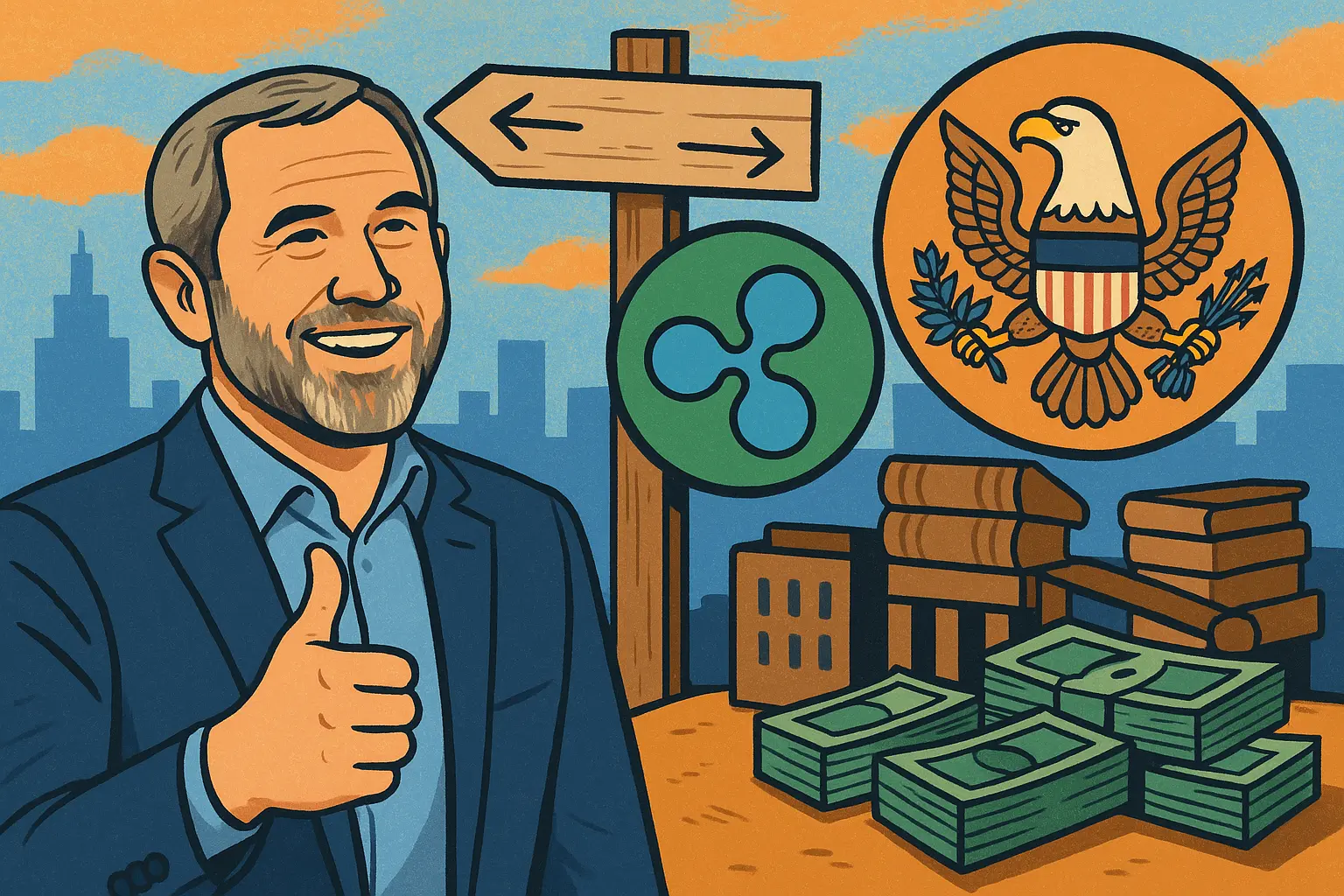
Ripple CEO Brad Garlinghouse publicly praised the regulatory direction shift promoted by Paul Atkins, the newly appointed chair of the U.S. Securities and Exchange Commission (SEC), on April 20, describing it as “a refreshing breath that helps people get their senses back.” Garlinghouse sees the SEC’s policy shift as a core driver behind improving sentiment in the U.S. crypto market.
Garlinghouse’s direct comparison of SEC’s old and new policies
On the X platform, Garlinghouse directly contrasted the governance styles of the two SEC chairpersons. He said, “By contrast, Paul Atkins is like a breath of fresh air. He is the model SEC leadership should be—focused on what truly matters: protecting investors and fostering innovation that helps investors and the market.”
He also criticized Gensler: “Under Gary Gensler’s leadership, the SEC has clearly lost its way. He has declared war on a technology. This is an illegal misuse of power… The courts made the same ruling.”
Atkins himself also criticized the agency’s past overreliance on enforcement actions in the crypto space last week, saying the market had faced years of trouble due to a lack of viable compliance paths.
Atkins’s regulatory framework: clarity, lighter compliance, and an innovation exemption
SEC chair Atkins has designated digital assets as “our top priority,” and has listed crypto policy as a major priority for 2026. On April 21, he outlined the direction in detail: reducing the burden of compliance, strengthening coordination with the U.S. Commodity Futures Trading Commission (CFTC), and introducing an upcoming “innovation exemption.”
The “innovation exemption” is intended to allow market participants to promote on-chain tokenized securities trading within a limited compliance framework, while providing a buffer period for long-term rulemaking—reflecting the SEC’s broader effort to keep regulation aligned with an evolving market infrastructure while maintaining investor protection.
Ripple v. SEC: a milestone for establishing XRP’s legal status
The historical context of this regulatory shift is closely tied to the final outcome of Ripple v. SEC. The case was filed in December 2020 and was concluded in August 2025. The court ruling established the legal distinction between XRP sales by the company and XRP trading in the public markets: programmed XRP sales on exchanges do not constitute securities transactions, while direct institutional sales violate securities laws. Ripple ultimately faced a $125 million penalty, which was later further reduced to $50 million (far below the $2 billion the SEC initially sought); both sides withdrew their appeals to formally end the case.
Frequently Asked Questions
What link is there between Atkins’s SEC chair term and Garlinghouse’s assessment?
Atkins’s policy focus has shifted from enforcement to legislation, emphasizing providing a clear compliance path for the crypto industry. This closely aligns with what Ripple argued during the lawsuit—that crypto regulation should be based on rules that market participants can understand and follow. Garlinghouse’s praise is both an assessment of his personal leadership style and a reflection of the industry’s overall expectations for a more predictable regulatory framework.
What exactly are the “innovation exemption” measures in the SEC’s plans?
The “innovation exemption” is a mechanism the SEC plans to roll out, allowing market participants to test and promote on-chain tokenized securities trading within a limited compliance framework, while the SEC simultaneously develops longer-term formal rules. The measure is designed to prevent compliance innovations from getting stuck during the rulemaking process, and is one of the concrete implementations of the SEC’s policy shift.
What far-reaching impact does the final outcome of Ripple v. SEC have on the crypto industry?
The court ruling established a legal precedent that “exchange token transactions do not automatically constitute securities transactions.” It directly undermined the SEC’s position of categorizing all token transactions as securities under the “Howey Test,” providing an important legal foundation for subsequent crypto regulatory frameworks. The industry views it as one of the key catalysts driving the SEC’s policy shift.
Disclaimer: The information on this page may come from third parties and does not represent the views or opinions of Gate. The content displayed on this page is for reference only and does not constitute any financial, investment, or legal advice. Gate does not guarantee the accuracy or completeness of the information and shall not be liable for any losses arising from the use of this information. Virtual asset investments carry high risks and are subject to significant price volatility. You may lose all of your invested principal. Please fully understand the relevant risks and make prudent decisions based on your own financial situation and risk tolerance. For details, please refer to
Disclaimer.
Related Articles
SoFi Adds XRP Deposits, Ripple: Broader Access Drives Practical Growth
American fintech company SoFi Technologies announced on April 21 that it would add XRP deposit services to its platform, bringing this digital asset into the national chartered bank environment overseen by the Office of the Comptroller of the Currency (OCC). SoFi currently supports trading of 27 cryptocurrencies and offers a range of crypto deposit features. Ripple says this is the path to real utility-driven growth.
MarketWhisper2h ago
SoFi Enables XRP Deposits but Restricts Withdrawals, Drawing User Criticism
Gate News message, April 21 — SoFi announced that its crypto business now supports XRP deposits, but the platform currently does not allow withdrawals to external wallets. Users can only hold or trade XRP within the platform and cannot transfer tokens to on-chain wallets.
Some users criticized the
GateNews6h ago
XRP Price Near $1.45 as ETF Inflows Build Pressure
Key Insights
Institutional XRP ETF inflows reached $41.6 million over four days, lifting assets under management above $1.08 billion and strengthening market confidence.
XRP faces strong resistance near $1.45, where CoinGlass data highlights a short max
CryptoNewsLand10h ago
XRP Expands to Solana as wXRP Drives DeFi Access
Key Insights
Wrapped XRP on Solana surpasses 834,000 tokens, enabling new DeFi access while strengthening cross-chain liquidity and expanding XRP utility beyond its native ledger.
Ethereum and Solana dominate DeFi activity, while XRP Ledger trails significantly, driving the need for
CryptoNewsLand10h ago
XRP Expands to Solana as wXRP Drives DeFi Access
Key Insights
Wrapped XRP on Solana surpasses 834,000 tokens, enabling new DeFi access while strengthening cross-chain liquidity and expanding XRP utility beyond its native ledger.
Ethereum and Solana dominate DeFi activity, while XRP Ledger trails significantly, driving the need for
CryptoNewsLand10h ago
Arthur Hayes: I'll Believe in XRP's Use at Scale When I See On-Chain Evidence
Arthur Hayes calls for on-chain evidence of XRP at scale; Iran tolls on oil tankers reportedly paid in Bitcoin to bypass sanctions, with pre-cleared shipments. Jim Rickards cites Ripple as part of a broader crypto-led parallel financial system.
Abstract: The article compares Hayes's demand for XRP's real-world on-chain use with reports of Bitcoin toll payments by Iran and notes Rickards' view that Ripple could play a role in a broader crypto-driven parallel financial system.
GateNews12h ago


