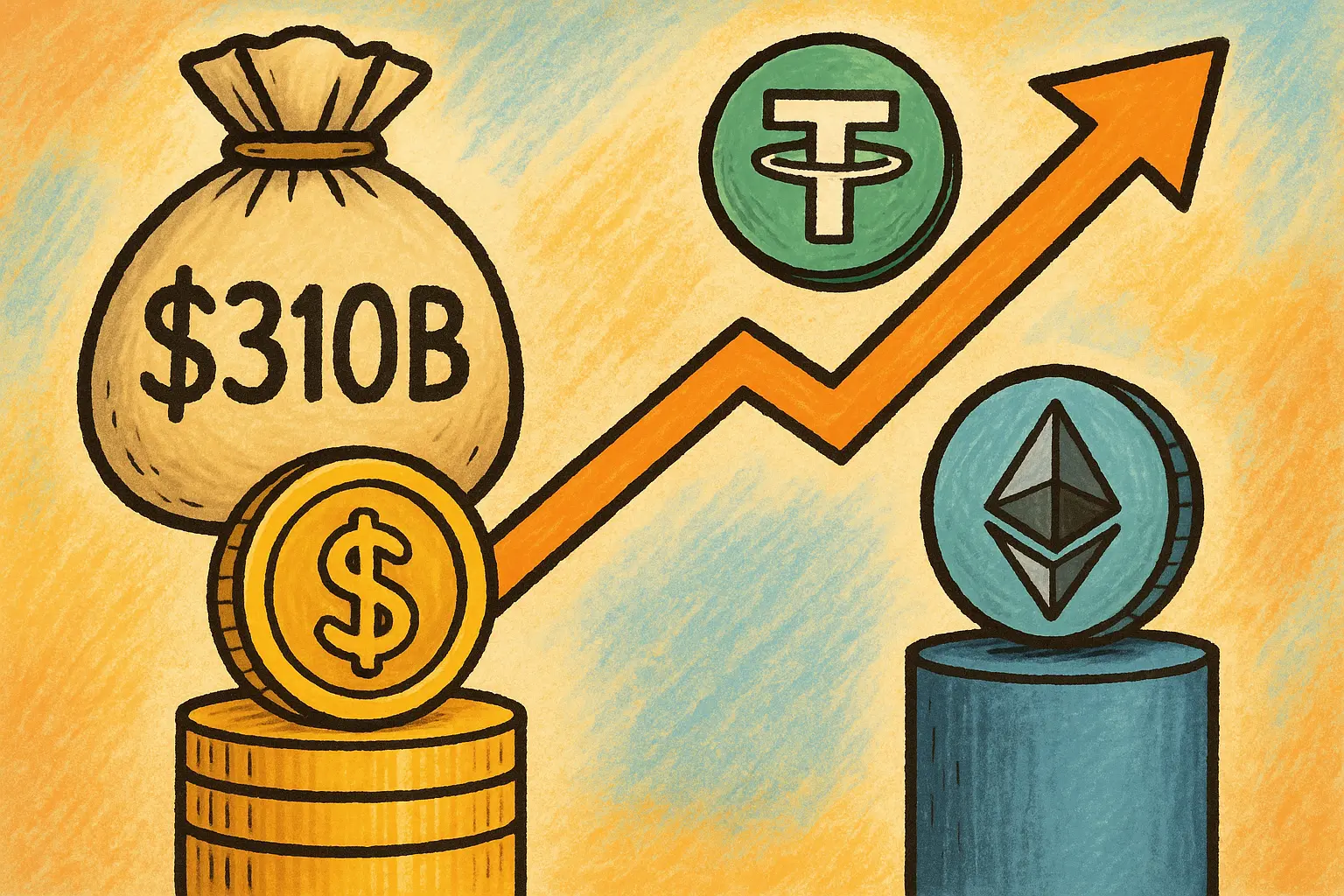
Ethereum (ETH) is facing the most severe structural challenges since its inception in the cryptocurrency market’s second-largest asset position. This threat is dominated by Tether’s stablecoin USDT, which has grown in market capitalization by 622.50% over the past five years, far exceeding Ethereum’s growth of approximately 11.75% during the same period. The global stablecoin market size has also surged from about $5 billion in 2020 to now $310 billion.
Five-Year Race Data Comparison: Growth Gap Reveals Structural Divergence
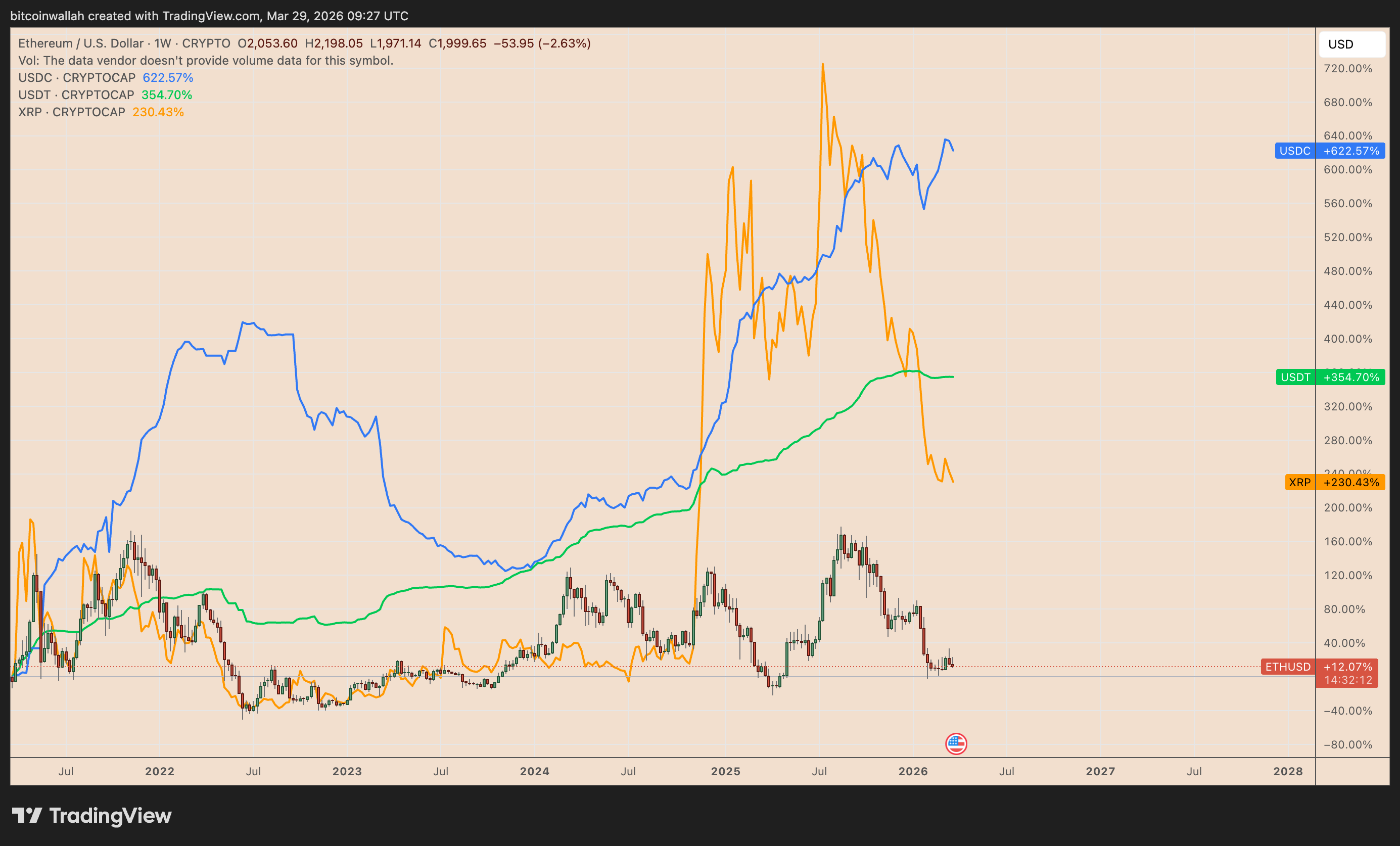 (Source: Trading View)
In specific numerical terms, Ethereum’s market capitalization has grown from about $21.5 billion to approximately $240 billion over the past five years, an increase of about 11.75%. During the same period, USDT’s market capitalization skyrocketed from about $25.5 billion to over $184 billion, with a growth rate of 622.50%. The growth rates of XRP and USDC have also surpassed Ethereum during the same period, indicating that ETH’s lag is not merely a temporary market fluctuation but reflects a deeper structural divergence.
The betting distribution on Polymarket reinforces the market consensus on this trend: the probability of a flip has surged from 17% in January to over 59% now, with the speed of market sentiment shift far exceeding most observers’ expectations.
Deep Reasons for Ethereum’s Lag: Fundamental Differences in Risk Appetite Logic
There are fundamental differences in the growth logic of ETH and USDT. Ethereum’s market capitalization heavily relies on rising ETH prices, requiring an overall recovery in market risk appetite to drive it; while USDT’s expansion stems from investors actively seeking “crypto dollars,” parking funds in stablecoins during risk-off periods or while waiting for entry opportunities, serving as dry powder. The current macro environment is evidently unfavorable for ETH:
Geopolitical Pressure: The ongoing U.S.-Iran conflict and uncertainty in the Middle East systematically suppress risk appetite.
Monetary Policy Shift: Expectations for rate cuts by the Federal Reserve have significantly cooled, with the market even starting to price in the possibility of rate hikes, directly compressing the valuation space for high-risk assets.
Continued Withdrawal of Institutional Funds: The assets under management of U.S. spot Ethereum ETFs have shrunk from $31.86 billion last October to $11.76 billion this March, a reduction of about 65%.
Tether’s market share in the global stablecoin market remains at 58%. In a risk-off environment, funds continue to flow into USDT rather than boosting ETH’s market capitalization, creating an irreversibly structural divergence between the two.
Technical Analysis: Bear Flag Pattern Confirmed, $1,250 as Key Downside Target
From a technical analysis perspective, Ethereum is currently exhibiting a typical bear flag pattern, with prices decisively breaking below the downward trend line, and downward momentum is strengthening. If the current downward trend continues, the technical downside target points to around $1,250, with the time window falling around June 2026.
This potential decline will further widen the gap between ETH’s market capitalization and that of USDT, providing additional technical support for the continuous rise in the flip probability. The weekly fund flows of U.S. spot Ethereum ETFs remain a key short-term indicator for assessing whether institutional confidence can rebound.
Frequently Asked Questions
What specifically does Ethereum’s “flip” refer to, and why does it not involve Bitcoin?
Here, “flip” refers to USDT’s market capitalization surpassing Ethereum, causing it to lose its position as the second-largest asset in the cryptocurrency market. This is entirely different from the concept of Ethereum surpassing Bitcoin in a “big flip,” which currently has a very low probability. The source of this threat is the rapid expansion of the stablecoin sector rather than competition from Bitcoin.
Why has USDT’s growth far outpaced Ethereum?
Ethereum’s market capitalization growth relies on rising market risk appetite and price increases; USDT, on the other hand, benefits from investors’ demand for safety, acting as a parking tool for funds during periods of heightened market volatility or while waiting for entry opportunities. The current defensive environment created by geopolitical risks and uncertainties in monetary policy naturally favors the expansion of stablecoins, which is detrimental to ETH’s market capitalization growth.
What impact does a 65% shrinkage in spot Ethereum ETFs have on future markets?
The assets under management of U.S. spot Ethereum ETFs have drastically shrunk from $31.86 billion to $11.76 billion, reflecting a continuous decline in institutional demand for ETH. ETF fund flows are an important forward-looking indicator of institutional confidence; ongoing net outflows could further pressure ETH’s market capitalization and accelerate the rise in Polymarket’s flip probability.
Disclaimer: The information on this page may come from third parties and does not represent the views or opinions of Gate. The content displayed on this page is for reference only and does not constitute any financial, investment, or legal advice. Gate does not guarantee the accuracy or completeness of the information and shall not be liable for any losses arising from the use of this information. Virtual asset investments carry high risks and are subject to significant price volatility. You may lose all of your invested principal. Please fully understand the relevant risks and make prudent decisions based on your own financial situation and risk tolerance. For details, please refer to
Disclaimer.
Related Articles
Vitalik Buterin Outlines Ethereum's 5-Year Roadmap Focused on Quantum Security and Scalability
Vitalik Buterin presented Ethereum's five-year roadmap, focusing on quantum security and scalability. Key goals include increasing gas limits, implementing Zero Knowledge Proofs, and enhancing transaction confirmation times by 2028, despite challenges with quantum-resistant signatures.
GateNews1h ago
Bitmine bought 101,627 ETH in a single week, worth $230 million: the largest single-week purchase in 2026, with ETH holdings nearing 5 million coins
Bitmine Immersion Technologies bought 101,627 ETH against the market trend, with a total value exceeding $230 million, becoming the largest one-week purchase in 2026. The company holds nearly 5 million ETH, accounting for 4.12% of the total supply, and may affect ETH’s circulating supply and market valuation. While other treasury firms are reducing their purchases, Bitmine has strengthened its position in the ETH space with an advantage-driven strategy. Investors in Taiwan can participate by directly buying ETH, joining Bitmine, or waiting for authorization of an ETH ETF.
ChainNewsAbmedia2h ago
ETH Whale Takes Profit on 20,000 ETH Worth $46.33M, Realizes $551K Gain
On April 20, an ETH whale closed a 4,000 ETH long position, earning $144,000, while another address took profit on 20,000 ETH, realizing $551,000 in gains and holding an additional 20,000 ETH.
GateNews2h ago
Bitmine Immersion Technologies Increases ETH Holdings by 101,627, Total Stake Reaches 4.976M
Bitmine Immersion Technologies has increased its Ethereum holdings by 101,627 tokens, totaling 4,976,485. The company also holds 199 BTC and significant equities in Eightco Holdings and Beast Industries, with staked ETH valued at around $7.7 billion.
GateNews3h ago
Major CEX Launches Event Contracts For Short-Term BTC And ETH Price Trading
A global exchange has launched Event Contracts, allowing users to bet on Bitcoin and Ethereum price movements over set timeframes. This simplified trading option features low costs and automatic settlement, aimed at easing short-term investment strategies.
GateNews5h ago
Kelp DAO Hack Attributed to Lazarus Group; eth.limo Domain Hijacked via Social Engineering
LayerZero reported that the Kelp DAO exploit, attributed to North Korea's Lazarus Group, led to a loss of $292 million in rsETH tokens due to vulnerabilities in its decentralized verifier network. Additionally, eth.limo faced a domain hijacking from a social engineering attack, but DNSSEC mitigated severe damage.
GateNews5h ago


