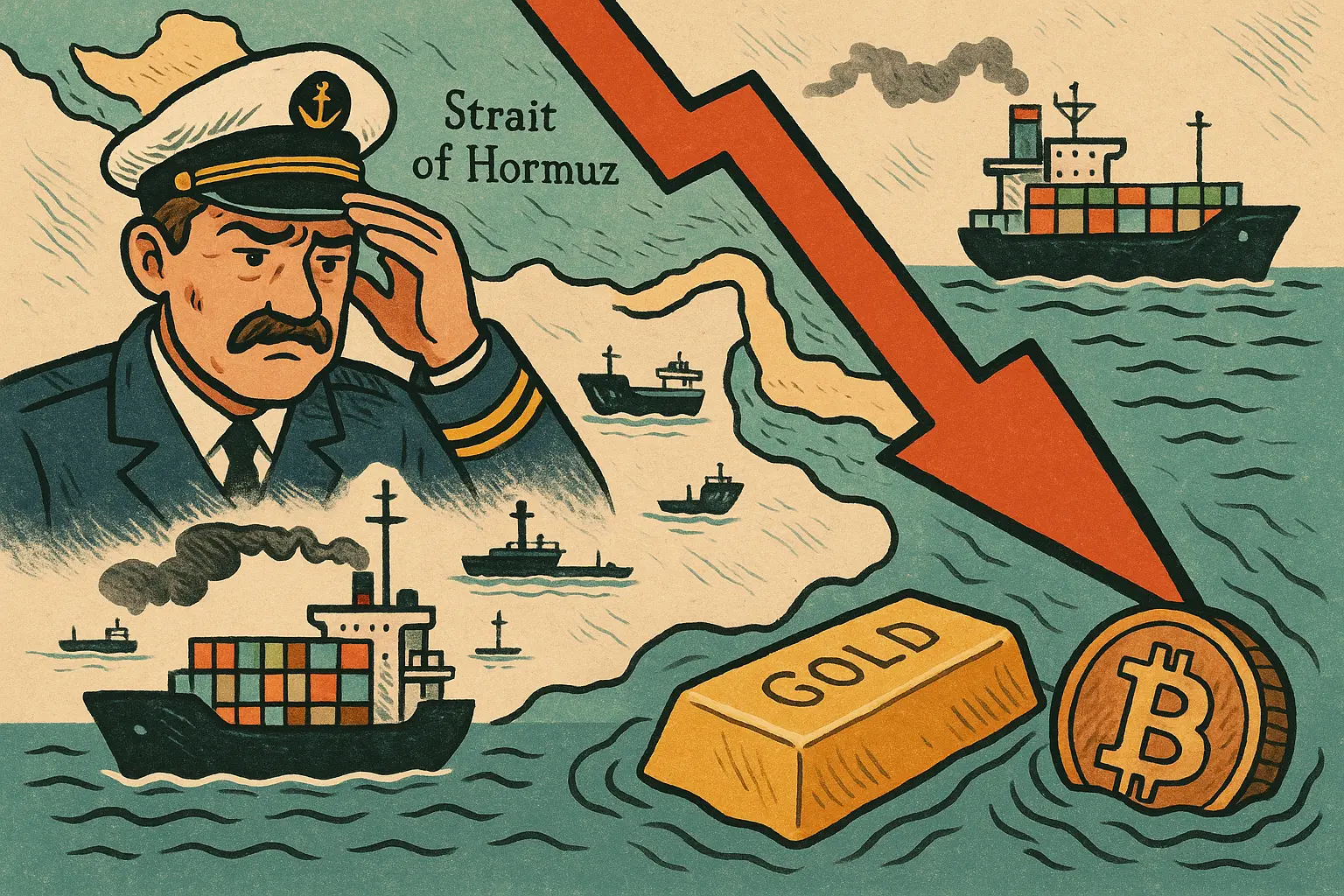
Since the United States and Israel launched military actions against Iran, the daily shipping volume through the Strait of Hormuz connecting the Persian Gulf to global markets has plummeted by approximately 95%, triggering chain reactions in the global energy and capital markets. Gold has fallen for seven consecutive days, with Bitcoin also retreating. The UK, France, Germany, Italy, the Netherlands, and Japan issued a joint statement, pledging to take necessary actions to ensure the safe passage of ships through the Strait of Hormuz, in an effort to mitigate further shocks to energy prices.
Hormuz Strait Crisis: Market Chain Reactions from Blocked Shipping Routes
The Strait of Hormuz is the world’s most critical oil and natural gas transportation corridor, with about 20% of global seaborne oil passing through daily. It is also the only outlet for several major Middle Eastern LNG producers. The 95% reduction in shipping is not a temporary fluctuation but a substantial disruption to the global energy supply chain.
The blockage of key routes has triggered multiple market reactions—investors are selling precious metals to increase cash liquidity while seeking investment targets that can benefit directly from rising energy prices. Gold, traditionally a safe-haven asset, has not only failed to rise but has been sold off due to liquidity pressures, highlighting the nonlinear market behavior under extreme geopolitical shocks.
However, gold has not continued to decline indefinitely. After breaking below $4,600, spot gold prices showed a technical rebound, closing on Thursday at $4,680.99, up 0.70% intraday, indicating support at certain levels.
Market Performance Comparison: Gold, Silver, and Bitcoin
During the Hormuz Strait crisis, the three major assets exhibited markedly different trends. The current market situation is summarized as follows:
- Gold: Down for seven days in a row, with a maximum intraday decline of 6%; after falling below $4,600, it rebounded to around $4,680, now at its lowest level since early February.
- Silver: Declined over 13%, pressured by expectations of weakening industrial demand and liquidity sell-offs.
- Bitcoin: Briefly surged past $75,000 before the Middle East tensions intensified, then retreated to around $69,000; since the outbreak of conflict involving Iran, Bitcoin’s overall performance has outperformed gold.
Bryan Tan, a trader at crypto market maker Wintermute, pointed out that although Bitcoin has shown greater resilience compared to gold, it lacks the momentum for further gains above $75,000. This suggests that during highly volatile news periods, investors should remain cautious, keep sufficient capital when buying on dips, and avoid blind entries.
Six Countries’ Joint Statement and Long-term Energy Outlook
In response to the blockade stalemate in the Strait of Hormuz, international diplomatic efforts are accelerating. The joint statement from the UK, France, Germany, Italy, the Netherlands, and Japan indicates that Western allies and major energy importers have prioritized ensuring the Strait’s navigability. However, the statement does not specify concrete military or non-military measures.
On the production side, QatarEnergy confirmed that facilities at Ras Laffan Industrial City—the world’s largest LNG facility accounting for 20% of global LNG supply—were severely damaged in missile attacks. Repairs are expected to take three to five years, further worsening the already tense global energy supply situation.
James Meadway, co-director of the Verdant Economic Policy Think Tank, warned in an interview that the current energy crisis is not a short-term fluctuation but involves “serious disruption” to oil and natural gas production, emphasizing that the current situation will lead to a “significant and long-term increase in energy prices.”
Frequently Asked Questions
Q: What does a 95% reduction in Hormuz Strait shipping mean?
The Strait of Hormuz is the most critical maritime energy transportation route globally, with nearly all oil and LNG exports from Saudi Arabia, Iraq, Kuwait, the UAE, and Iran passing through here. A 95% reduction means that the main pipeline for global seaborne oil is almost halted. The impact on energy markets is equivalent to a severe short-term shortage of global oil supplies, which explains the recent extreme volatility in oil and natural gas prices.
Q: Why does gold not rise but fall during geopolitical crises?
Gold’s status as a safe-haven asset usually drives prices higher amid uncertainty. However, in extreme geopolitical shocks, markets can experience a “liquidity crisis” effect—investors, urgently needing cash for margin calls or other liquidity needs, are forced to sell gold, which is otherwise considered a safe haven. This phenomenon occurred during the 2008 financial crisis and the early COVID-19 pandemic. The seven-day decline in gold partly reflects this “liquidity priority over safe-haven” market dynamic.
Q: Does Bitcoin’s performance in this crisis confirm its status as “digital gold”?
Bryan Tan from Wintermute noted that Bitcoin did outperform gold after the outbreak of conflict involving Iran, but it lacked follow-through buying above $75,000, indicating that institutions have not yet actively increased Bitcoin holdings as a war-time hedge. Bitcoin’s relative strength may more reflect its liquidity characteristics and portfolio structure rather than a market consensus that it is the preferred safe-haven asset during wartime.
Disclaimer: The information on this page may come from third parties and does not represent the views or opinions of Gate. The content displayed on this page is for reference only and does not constitute any financial, investment, or legal advice. Gate does not guarantee the accuracy or completeness of the information and shall not be liable for any losses arising from the use of this information. Virtual asset investments carry high risks and are subject to significant price volatility. You may lose all of your invested principal. Please fully understand the relevant risks and make prudent decisions based on your own financial situation and risk tolerance. For details, please refer to
Disclaimer.
Related Articles
Trump First Explicitly Said “Regime Change” for Iran: The White House Officially Forwarded Three Signals
Trump first directly mentioned Iran’s “regime change” in a public statement, and explicitly said that the U.S. side would not be influenced by Israel. He used Venezuela as an analogy, implying that the U.S. may adopt a long-term pressure strategy against Iran. This will change the negotiation framework and increase the risk of oil-price and market volatility. Taiwan investors need to pay attention to the oil price trend, the reaction at the Fed hearing, and the agenda of the U.S.-China summit.
ChainNewsAbmedia28m ago
Solana CPO Vibhu Buys $10K XRP to Demonstrate wXRP Potential as Liquidity Hits $1M in 24 Hours
Solana's Chief Product Officer bought $10,000 in XRP to showcase wXRP's utility, driving $1 million in liquidity within 24 hours. This highlights growing interoperability in DeFi and signals a shift in liquidity flows as ecosystems merge.
GateNews1h ago
Bitcoin $7.9 billion options expire this Friday, and the $75,000 level could be a pullback indicator
Bitcoin is about to face the expiration of options contracts with a notional value of roughly $7.9 billion. The current price is around $75,000. Market analysts warn that this price range carries substantial upside and negative gamma risk, which could trigger a squeeze or a pullback. The biggest pain point is at $71,000—if the price cannot hold steady, it will face pullback pressure. In addition, the accumulation of short positions could lead to a short squeeze, which would then drive the price higher.
ChainNewsAbmedia2h ago
XRP Community Split on CLARITY Act as Sell-the-News Skepticism Rises
While the CLARITY Act has garnered unprecedented institutional backing—including support from the White House, Coinbase CEO Brian Armstrong, and Senator Cynthia Lummis—the XRP community is divided on whether the legislative momentum represents a genuine catalyst or a "sell-the-news" trap. Reddit and
CryptoFrontier4h ago
DeFi Hack Triggers $9 Billion in Outflows from Aave as Stolen Tokens Used as Collateral
A recent hack draining nearly $300 million from a crypto project led to a liquidity crisis on Aave, causing users to withdraw around $9 billion. Concerns over collateral quality prompted mass withdrawals, highlighting risks in DeFi lending.
GateNews6h ago
Crypto Expert Claims Altseason Peak Is Just Starting, XRP Could Lead With Explosive Gains
Crypto expert claims altseason peak is just starting.
The price of XRP could lead with explosive gains soon.
Several altcoin assets are showing steady bullish signals.
The crypto market has seen very slow growth in altcoin prices this bull cycle. While the price of Bitcoin (BTC), the
CryptoNewsLand6h ago


