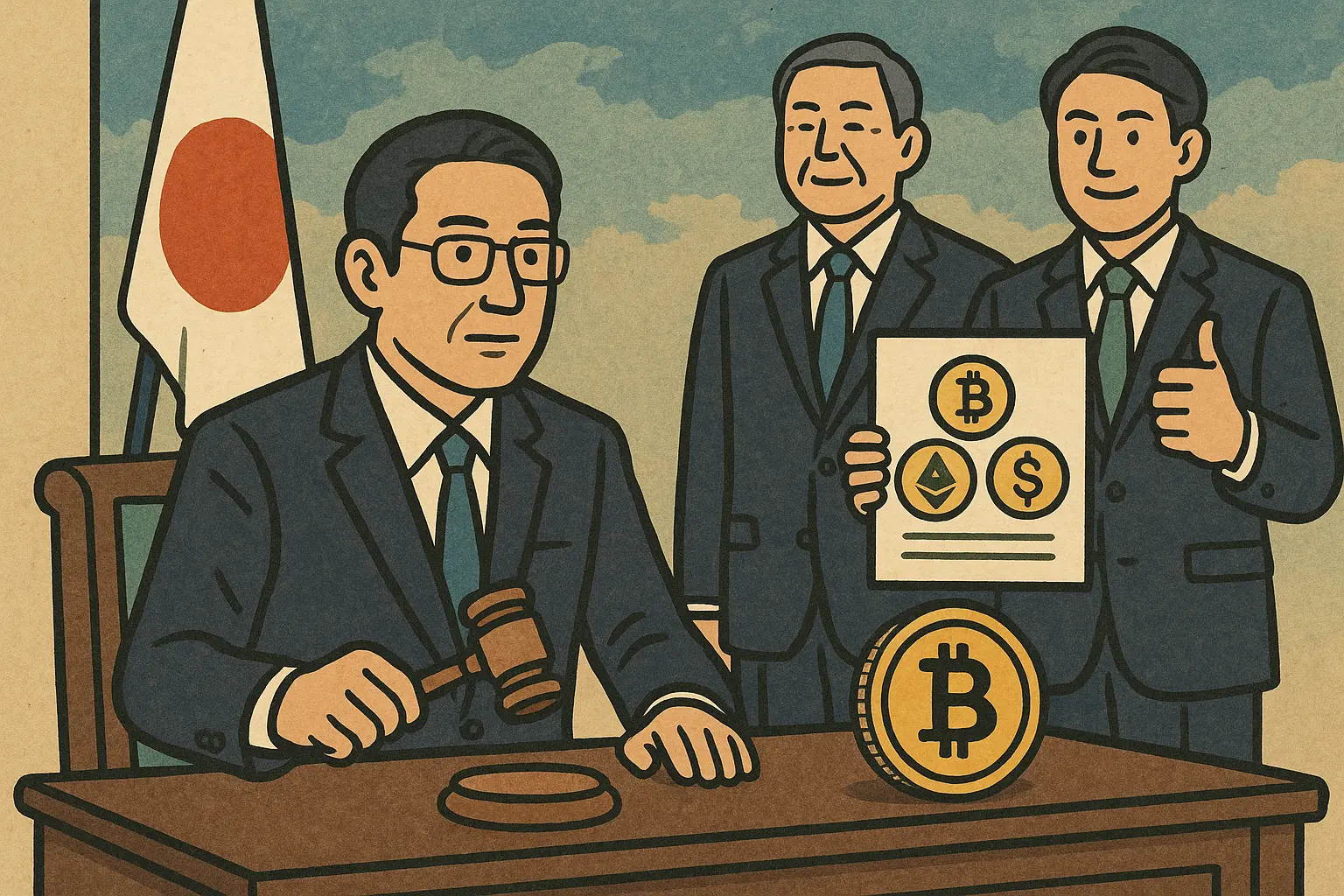
On April 10, the Japanese government formally approved amendments to the Financial Instruments and Exchange Act at a Cabinet meeting. For the first time, it classifies crypto assets as financial instruments and brings them under regulatory oversight. The amendments explicitly prohibit insider trading using material nonpublic information, and at the same time require crypto-asset issuers to assume an annual information disclosure obligation. The amendments also significantly raise the maximum criminal penalties for noncompliant businesses. If the current Diet session completes the legislative process, the amendments are expected to take effect officially in fiscal year 2027.
Regulatory framework shift: from the Payment Services Act to the Financial Instruments and Exchange Act
Previously, Japan’s Financial Services Agency (FSA) regulated crypto assets under the Payment Services Act, treating them as payment instruments. As the use of crypto assets for investment purposes continues to expand, the share of users holding them for profit has risen significantly, and the current regulatory framework can no longer effectively protect investors’ interests.
Against this background, the FSA decided to move the regulatory framework to the Financial Instruments and Exchange Act, so that crypto assets are placed, in legal terms, alongside traditional financial products such as stocks and bonds. Relevant businesses will also face compliance standards similar to those for traditional financial institutions. This transition further aligns Japan’s crypto regulatory framework with the mainstream financial regulations of G7 major economies.
Key provisions of the amendments: stronger obligations and upgraded penalties go hand in hand
Main changes in this round of amendments
Prohibition of insider trading: Explicitly prohibits trading crypto assets using material nonpublic information, filling the gap in current regulations
Annual information disclosure obligation: Crypto-asset issuers must periodically disclose financial and business information to the relevant authorities and investors
Change of business name: Registered businesses are officially renamed from “crypto-asset exchange business operators” to “crypto-asset trading business operators”
Harsher criminal penalties: The maximum prison term for unlicensed operators is increased from 3 years to 10 years, and the maximum fine is increased from 3M yen to 10M yen
Government position: advancing market fairness and investor protection on two tracks
In a press conference after the Cabinet meeting, Japan’s Minister of Finance Satsuki Katayama said: “We will expand the supply of growth capital to respond to changes in the financial and capital markets, and ensure market fairness, transparency, and investor protection.”
This legislation is Japan’s systematic regulatory response to the trend of crypto assets being used for investment. In the short term, the rise in compliance costs for businesses may bring some adjustment pressure, but in the long run, a more完善 regulatory environment will help attract institutional capital into the market and enhance Japan’s international standing as a compliant crypto trading hub.
Frequently asked questions
When will the amendments to Japan’s Financial Instruments and Exchange Act take effect?
The amendments were approved by the Cabinet on April 10, but they still need to complete the legislative process through the current Diet session. If they pass smoothly, they are expected to be officially implemented in fiscal year 2027.
What specific impacts will the amendments have on crypto businesses operating in Japan?
Businesses must fulfill annual information disclosure obligations, comply with the prohibitions on insider trading, and update their registered business name to “crypto-asset trading business operator.” If businesses continue operating without holding a valid license, the maximum penalties can include up to 10 years in prison and a fine of 10M yen.
Why did Japan reclassify crypto assets from a payment instrument to a financial product?
The Financial Services Agency (FSA) states that in recent years, the investment use of crypto assets has increased significantly, and the regulatory framework under the Payment Services Act, which is centered on payment instruments, is no longer sufficient to effectively address the market situation. Therefore, Japan is shifting to apply the broader scope of the Financial Instruments and Exchange Act.
Disclaimer: The information on this page may come from third parties and does not represent the views or opinions of Gate. The content displayed on this page is for reference only and does not constitute any financial, investment, or legal advice. Gate does not guarantee the accuracy or completeness of the information and shall not be liable for any losses arising from the use of this information. Virtual asset investments carry high risks and are subject to significant price volatility. You may lose all of your invested principal. Please fully understand the relevant risks and make prudent decisions based on your own financial situation and risk tolerance. For details, please refer to
Disclaimer.
Related Articles
Kalshi appeals Nevada event contract ban; CFTC jurisdiction dispute may reach the Supreme Court
Prediction market platform Kalshi has appealed a ruling by the state of Nevada banning its event contracts, and the U.S. Ninth Circuit Court of Appeals held oral arguments on April 17, but did not issue an immediate decision after the hearing. The core dispute in the case is whether Kalshi’s event contracts are “swap agreements” that fall under the jurisdiction of the Commodity Futures Trading Commission (CFTC), or whether they must be regulated by state-level activity under gambling licensing regimes. Multiple legal experts predict that the case may ultimately be appealed to the U.S. Supreme Court.
MarketWhisper1h ago
CFTC Chairman Selig: Prediction-market fraudsters will face harsh legal penalties; will not pause rulemaking
In a House hearing, U.S. CFTC Chairman Selig emphasized a “zero-tolerance policy” toward market fraud and manipulation. He responded to questions regarding a $500 million oil futures transaction and said the CFTC is drafting rules to regulate prediction markets. Selig also mentioned a cooperation memorandum of understanding with the SEC to strengthen oversight of digital assets. Given that the CFTC currently has only one commissioner—himself—Selig emphasized operational efficiency and will hire new staff to enhance regulatory capacity.
MarketWhisper3h ago
MTN Nigeria Suspends Xtratime Airtime and Data Borrowing Service to Comply with Digital Lending Regulations
MTN Nigeria has suspended its Xtratime service due to new regulatory compliance from the FCCPC. While normal purchases continue, the suspension aims to align with upcoming digital lending rules. The company does not foresee significant financial impact and will monitor user response.
GateNews7h ago
Pakistan Opens Banking System to Licensed Crypto Firms, Reversing 2018 Ban
Pakistan's central bank has opened its banking system to licensed virtual asset service providers, reversing a previous ban. This change, following the Virtual Assets Act 2026, allows crypto businesses access to banking services under strict regulations.
GateNews11h ago
Musk’s X Money hasn’t launched yet—but it’s already making headlines! Mizuho says it will shake up the U.S. payments market and also downgrades PayPal’s rating
Elon Musk’s financial product X Money is expected to launch in April, potentially upending the U.S. payments market and putting pressure on PayPal, as Mizuho Securities has downgraded PayPal’s rating to “Neutral.” However, regulatory variables have become the main challenge, especially the legal uncertainty surrounding crypto-asset payments and yield-generating products. X has also rolled out a “Cashtags” feature that integrates real-time financial data.
ChainNewsAbmedia12h ago
Major South Korean CEX Places SPURS Token on Trading Alert List
A South Korean cryptocurrency exchange has added the SPURS token to its trading alert list due to poor market performance and investor risks. Deposits are temporarily suspended while the token is reviewed until July 16, 2026.
GateNews13h ago


