
On Wednesday, Patrick Wieth, Executive Director of the White House Digital Asset Advisory Committee, directly addressed the core controversy between cryptocurrencies and the banking sector on the X platform. He explicitly supported the legitimacy of stablecoin yields and presented a key argument overlooked by banking critics: when foreign investors exchange their local currency for stablecoins issued by U.S. institutions, it signifies new net capital flowing into the U.S. banking system, rather than withdrawals from existing bank deposits.
The White House’s Core Argument: Foreign Conversion Brings New Capital, Not Deposit Shifts
(Source: Trading View)
Wieth’s explanation is based on the operational mechanics of stablecoins. Most U.S. stablecoin issuers hold USD or U.S. Treasury bonds as reserves equivalent to each token, meaning that whenever a foreign user exchanges their local currency for USDC or USDT, the USD funds are actually flowing into U.S. reserves from abroad, not being withdrawn from U.S. bank deposits.
Wieth explicitly pointed out in his post that in debates over the GENIUS and CLARITY bills, the dimension of “deposit inflow” is often “overlooked”: “The huge global demand for the dollar—foreigners exchanging their local currency for stablecoins issued by U.S. entities—means there is new net capital flowing into the U.S. banking system.”
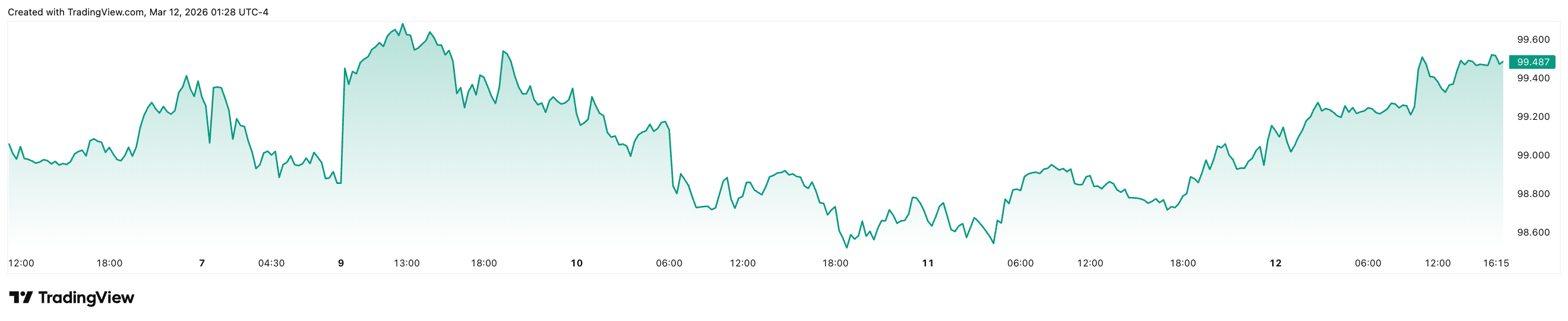
This argument is supported by the dollar index (DXY), which fell to a near four-year low of 95.818 on January 28 this year, then rebounded 3.80% to 99.468, reflecting ongoing global demand for dollar assets (including dollar stablecoins).
Banking Concerns and Crypto Industry’s Counter: Key Dispute in the Game
Wieth’s stance is a direct response to the banking sector’s claim that “stablecoin yields are stealing deposits.” Recently, Standard Chartered estimated that widespread adoption of stablecoins could lead to a reduction of about one-third of U.S. bank deposits. This estimate has become a core argument for community banks and traditional financial institutions opposing the inclusion of stablecoin yield provisions in the CLARITY bill.
Christopher Williston, President of the Texas Independent Bankers Association, was particularly forceful: “In the fight for the liquidity that supports our home economy, we cannot back down.” He believes that making concessions during legislative discussions could harm community banks’ lending capacity and local economic productivity.
However, the crypto industry’s response is markedly different. Austin Campbell, founder of Zero Knowledge Consulting, pointed out the potential ironic outcome of this conflict: “If community banks and crypto can’t find a way to cooperate, we already know who the winners will be… and that’s the big banks.”
Wieth’s analogy in this debate is even more pointed, comparing the opposition to stablecoin yields by community banks to “arsonists threatening to burn down their own house”—implying that if community banks cling to anti-crypto stances, they may ultimately harm their long-term interests by hindering the financial innovation ecosystem.
FAQs
Q: How exactly do stablecoin yields ‘bring in new capital’ rather than ‘steal deposits’?
The difference lies in the source of funds. The concern over “deposit shifting” refers to U.S. depositors transferring their deposits from banks into stablecoins, causing a drain on bank funds. Wieth’s argument focuses on “external inflows”: when foreign users exchange their local currency for dollar stablecoins, the USD reserves (held as U.S. Treasuries or cash by the issuer) are entering the U.S. financial system from abroad as new funds, not involving any transfer of existing bank deposits.
Q: What are the differences between the GENIUS and CLARITY bills regarding stablecoin yields?
The GENIUS Act establishes a federal regulatory framework for stablecoins, including 1:1 reserve requirements, and explicitly states that stablecoin issuers cannot pay interest or yields directly, distinguishing them from bank deposits. The CLARITY bill’s debate includes whether crypto trading platforms (not issuers) should be allowed to offer rewards or incentives for holding stablecoins, which the banking industry views as a form of indirect yield payment.
Q: Are community banks’ concerns justified?
Banking sector concerns are not unfounded. Standard Chartered’s estimates suggest that if stablecoins become widespread, some U.S. depositors might indeed shift their deposits to higher-yield stablecoin products, especially when interest rate differentials are significant. However, as Wieth points out, considering the dimension of global foreign inflows, the overall impact remains debatable. Campbell’s warning also suggests that if banks take an overly hard stance, it could accelerate the dominance of large banks in digital financial infrastructure.
Disclaimer: The information on this page may come from third parties and does not represent the views or opinions of Gate. The content displayed on this page is for reference only and does not constitute any financial, investment, or legal advice. Gate does not guarantee the accuracy or completeness of the information and shall not be liable for any losses arising from the use of this information. Virtual asset investments carry high risks and are subject to significant price volatility. You may lose all of your invested principal. Please fully understand the relevant risks and make prudent decisions based on your own financial situation and risk tolerance. For details, please refer to
Disclaimer.
Related Articles
Circle quietly wires USDC into crypto’s new settlement spine
Circle's new USDC Bridge aims to turn cross‑chain transfers into a near‑invisible backend plumbing layer for on‑chain dollars, replacing fragmented bridges with a single bank‑style ledger experience operated end‑to‑end by Circle itself.
Summary
Circle has launched a native USDC Bridge, a burn‑a
Cryptonews13h ago
Newly Created Wallet Deposits $1.99M USDC to Hyperliquid, Opens 5x Leveraged ASTER Long
Gate News message, April 18 — According to Onchain Lens, a newly created wallet deposited $1.99 million USDC to Hyperliquid and opened a 5x leveraged long position in ASTER.
GateNews16h ago
Circle faces a class action lawsuit from Drift; USDC freeze obligations spark legal debate
Representing more than 100 members, Joshua McCollum, a Drift Protocol investor, filed a lawsuit against Circle on Wednesday in the U.S. District Court for the District of Massachusetts. The lawsuit alleges that in the April 1 theft incident involving approximately $280 million worth of Drift Protocol, Circle allowed the attacker to transfer roughly $230 million USDC to Ethereum via a cross-chain transfer protocol.
MarketWhisper04-17 02:45
Circle Faces Class Action Lawsuit Over $230M Unblocked USDC in Drift Protocol Attack
Circle faces a class action lawsuit for failing to freeze $230 million in stolen USDC after the Drift Protocol attack. Plaintiffs argue that Circle's protocols allowed attackers to move and convert the stolen funds without intervention, raising concerns about the company's responsibilities in monitoring cross-chain transfers.
GateNews04-17 01:46
New Wallet Deposits $7.45M USDC to HyperLiquid and Purchases 169,838 HYPE
Gate News message, a newly created wallet deposited $7.45M USDC into HyperLiquid and bought 169,838 HYPE at $43.86. Of that, 10,000 HYPE has been sent for staking.
GateNews04-17 00:34
Drift Protocol Switches From USDC to USDT, Secures $127.5M Recovery Support From Tether
Drift Protocol announced a recovery plan backed by $150 million after a $280 million exploit, transitioning from USDC to USDT, impacting 128,000 users. The plan links user balance restoration to ongoing trading, following criticism of Circle's response to the hack.
GateNews04-16 20:31


