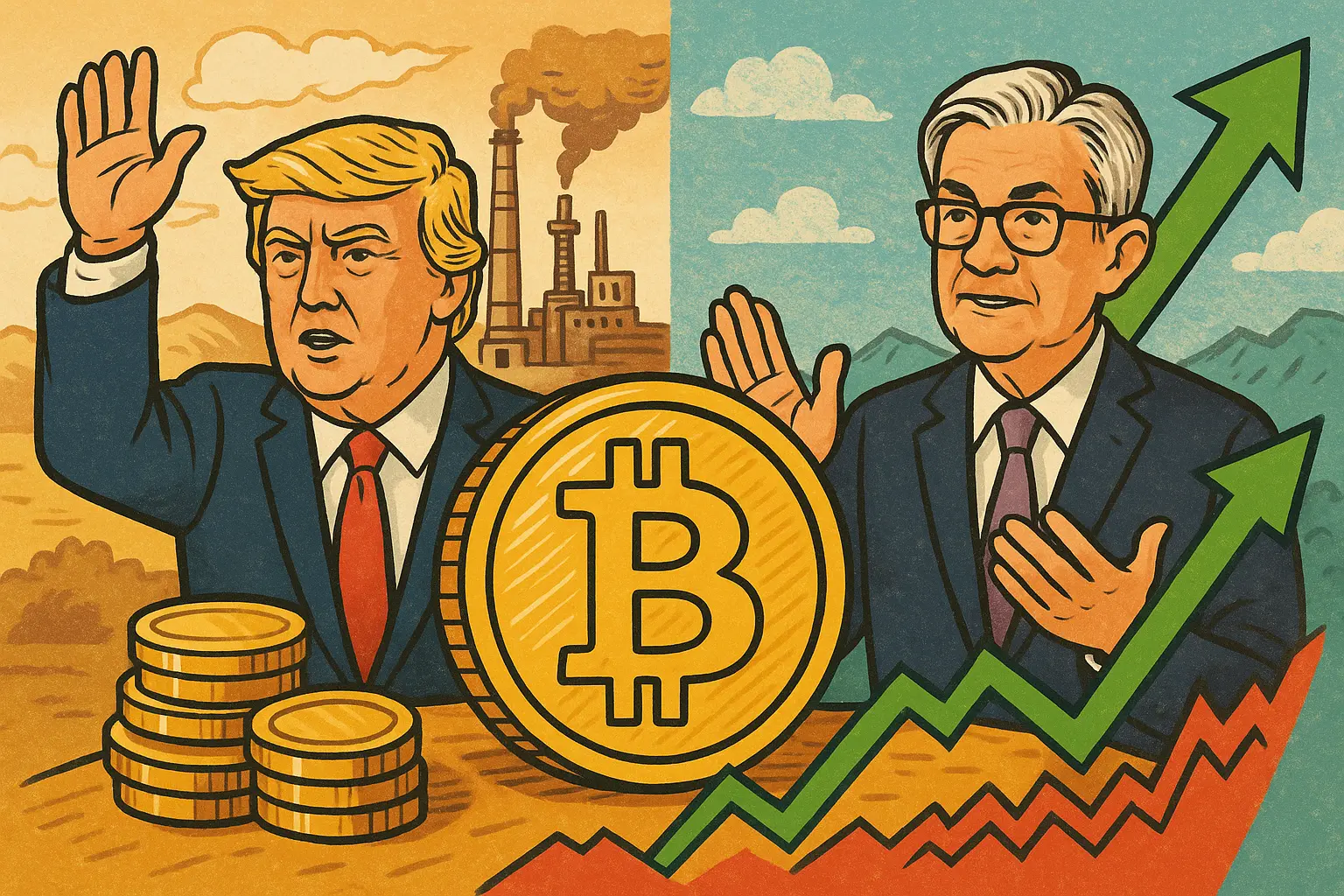
On March 31, Bitcoin regained part of its losses, rising back above $67,000. The main driver behind this rebound has been diplomatic signals at the geopolitical level: White House press secretary Leavitt said that Trump wants to reach an agreement with Iran before an April 6 deadline, boosting the market’s near-term expectations of easing tensions between the U.S. and Iran. At the same time, Federal Reserve Chair Powell said he is inclined to keep interest rates unchanged, a stance that has also provided short-term support for risk assets.
The core reasons Bitcoin is up today: the diplomatic window is opening
The Trump administration announced that, at Iran’s request, it has suspended retaliatory actions against Iran’s energy facilities for 10 days, expiring at 8:00 p.m. Eastern Time on April 6, after which it will resume. The White House clearly stated that the president hopes to reach an agreement before the deadline—this is the most diplomatically significant public statement between the U.S. and Iran since “Operation Epic Fury” began 31 days ago.
Driven by short-lived improvements in market sentiment tied to expectations of de-escalation, Bitcoin rebounded from its monthly low—an upswing described by analysts as a “cautious optimism” rally. However, on the same day, Baghae, a spokesperson for Iran’s Ministry of Foreign Affairs, denied that direct negotiations had been initiated between the two sides, saying the U.S. is conveying negotiation proposals through third-party intermediaries such as Pakistan. He added that Iran’s position on the ceasefire has not changed, reminding the market not to overinterpret the diplomatic signals.
The Hormuz toll bill: the risk of added supply disruption can’t be ignored
On the same day, Iran’s parliament passed a bill to levy tolls on commercial vessels transiting the Strait of Hormuz. The fee per tanker could be as high as $2 million, and the bill also intends to ban ships associated with countries the U.S., Israel, or those that have imposed unilateral sanctions on Iran from transiting, with the toll to be paid in Iranian rials. The White House immediately issued a clear statement that it does not support the measure.
The Strait of Hormuz carries about 20% of global oil trade. If the related restrictions are implemented, it would further push up oil prices, strengthen inflation pressures, reduce the Federal Reserve’s room to cut rates, and create a new round of structural burden for risk assets.
The Federal Reserve’s stance and three key scenarios for what comes next
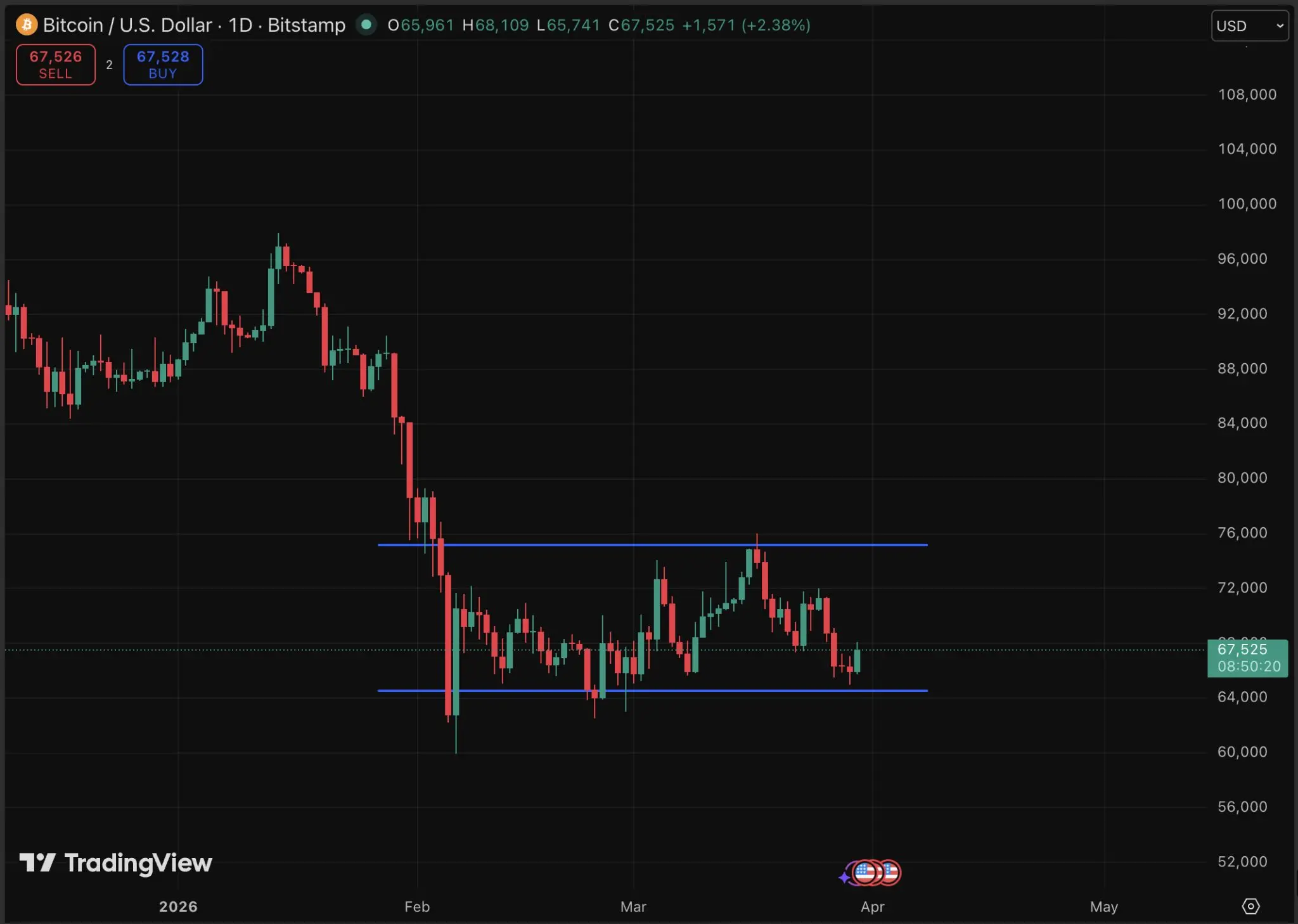 (Source: Trading View)
On Monday, Powell said that before the impact of the Iran energy disruption is still unclear, the Federal Reserve is inclined to take a “look-through” approach to rising oil prices and keep interest rates unchanged; however, at the same time, he warned that if inflation expectations drift for the long term, the Federal Reserve might have no choice but to take action. “The Fed’s loudspeaker,” Nick Timiraos, noted that the threshold for rate cuts has risen clearly compared with several months ago, shrinking the market’s expectations for accommodative policy.
On the technical front, $65,000 is a key line in the sand for the bulls, while the main resistance is around $73,000. Analysts laid out three scenario frameworks for what comes next:
Bullish scenario: U.S.-Iran de-escalation confirms, the dollar weakens, and macro risk appetite rebounds—Bitcoin returns to $75,000 and moves toward the $80,000 psychological level
Base scenario: The market waits for diplomatic progress and macro data verification, with Bitcoin trading sideways between $67,000 and $73,000
Bearish scenario: A break below the $65,000 support level (especially if macro shock conditions reappear) would open the downside path toward $58,000 to $60,000
Frequently Asked Questions
Why is Bitcoin up today, and what is the main catalyst?
The main catalyst behind today’s rise is the diplomatic signal between the U.S. and Iran. The White House said Trump wants to reach an agreement before the April 6 deadline, which boosted the market’s short-term expectations for easing geopolitical tensions, thereby lifting risk-asset sentiment briefly. The Fed’s Powell leaning toward keeping interest rates unchanged also provided additional support for this rebound.
Why is the April 6 deadline important for Bitcoin’s price action?
April 6 is the expiration date of the Trump administration’s suspension of strikes against Iran’s energy facilities. If any diplomatic framework agreement is reached before that date, it could trigger a sharp drop in oil prices, a rapid rebound in market risk appetite, and push Bitcoin toward the resistance level of $73,000 to $75,000. If talks break down and military actions resume, then the $65,000 support level will face an immediate test.
What potential impact does Iran’s Hormuz toll bill have on Bitcoin?
If the bill is implemented, the global oil supply chain would face a new round of disruptions, pushing up oil prices and strengthening inflation pressures, which would further narrow the Federal Reserve’s room to cut rates. A high-interest-rate environment structurally weighs on risk assets such as Bitcoin, potentially offsetting the short-term positive effects brought by diplomatic de-escalation—this is the uncertainty source the market needs to closely monitor right now.
Disclaimer: The information on this page may come from third parties and does not represent the views or opinions of Gate. The content displayed on this page is for reference only and does not constitute any financial, investment, or legal advice. Gate does not guarantee the accuracy or completeness of the information and shall not be liable for any losses arising from the use of this information. Virtual asset investments carry high risks and are subject to significant price volatility. You may lose all of your invested principal. Please fully understand the relevant risks and make prudent decisions based on your own financial situation and risk tolerance. For details, please refer to
Disclaimer.
Related Articles
Gate Daily (April 17): Musk’s X Money hits a roadblock with New York crypto regulation; Yuga Labs appoints a new CEO
Bitcoin (BTC) is flat at $74,920. A ceasefire between Israel and Lebanon has taken effect, and Trump says Iran agreed not to develop nuclear weapons. Mizuho Bank warns that Musk’s X Money could be affected by New York’s crypto regulation. Yuga Labs replaces its CEO: Greg Solano becomes Chairman of the Board, and Michael Figge takes over. The market is broadly optimistic. A record-high Bitcoin buying wave in the past decade has emerged, suggesting the price may be moving toward $90,000.
MarketWhisper04-17 01:37
Solana and Ripple's 'XRP' Posts Highlight $100M Wrapped XRP Integration
Solana's recent post about "XRP" led to Ripple's reply, influencing XRP's price. This comes amid the launch of wrapped XRP on Solana through Hex Trust and LayerZero, attracting significant liquidity, highlighting an evolving collaboration in the crypto space.
GateNews04-16 11:51
Gate Daily Report (April 16): Tether may have purchased 951 BTC; Virginia enacts crypto property law
Bitcoin continues to rise, reaching $74,630. Tether uses its profits to buy 951 bitcoins. Virginia passes an unclaimed property law, requiring idle cryptocurrency to be transferred to the state government. U.S. stocks are driven by tech stocks, and the S&P 500 index hits a new high. Crypto market dynamics show that investors are paying attention to geopolitical conditions and U.S. monetary policy.
MarketWhisper04-16 01:46
Polygon Launches sPOL to Unlock $3.6B in Staked POL and Boost Staker Rewards
Polygon has launched sPOL, a liquid staking token, enabling greater liquidity for staked POL tokens. Audited for security, sPOL allows stakers to earn rewards while using assets in DeFi, with initial liquidity from the treasury and live pools on Uniswap V4.
GateNews04-15 07:12
XRP Today News: CLARITY Act Pushes Through in May, Standard Chartered Bank Turns Bullish on $8
Ripple CEO Garlinghouse confirmed at the summit that the CLARITY Act’s goal for passage is by the end of May, and said that the controversy surrounding stablecoin yield rates is nearing resolution. If the bill passes, XRP is expected to rise to $5–$10; otherwise, it could fall back to $1.2. The bill’s passage would create a regulatory framework for the digital asset market, clarify XRP’s classification as a commodity, and reduce compliance barriers for institutional investors.
MarketWhisper04-15 02:58


