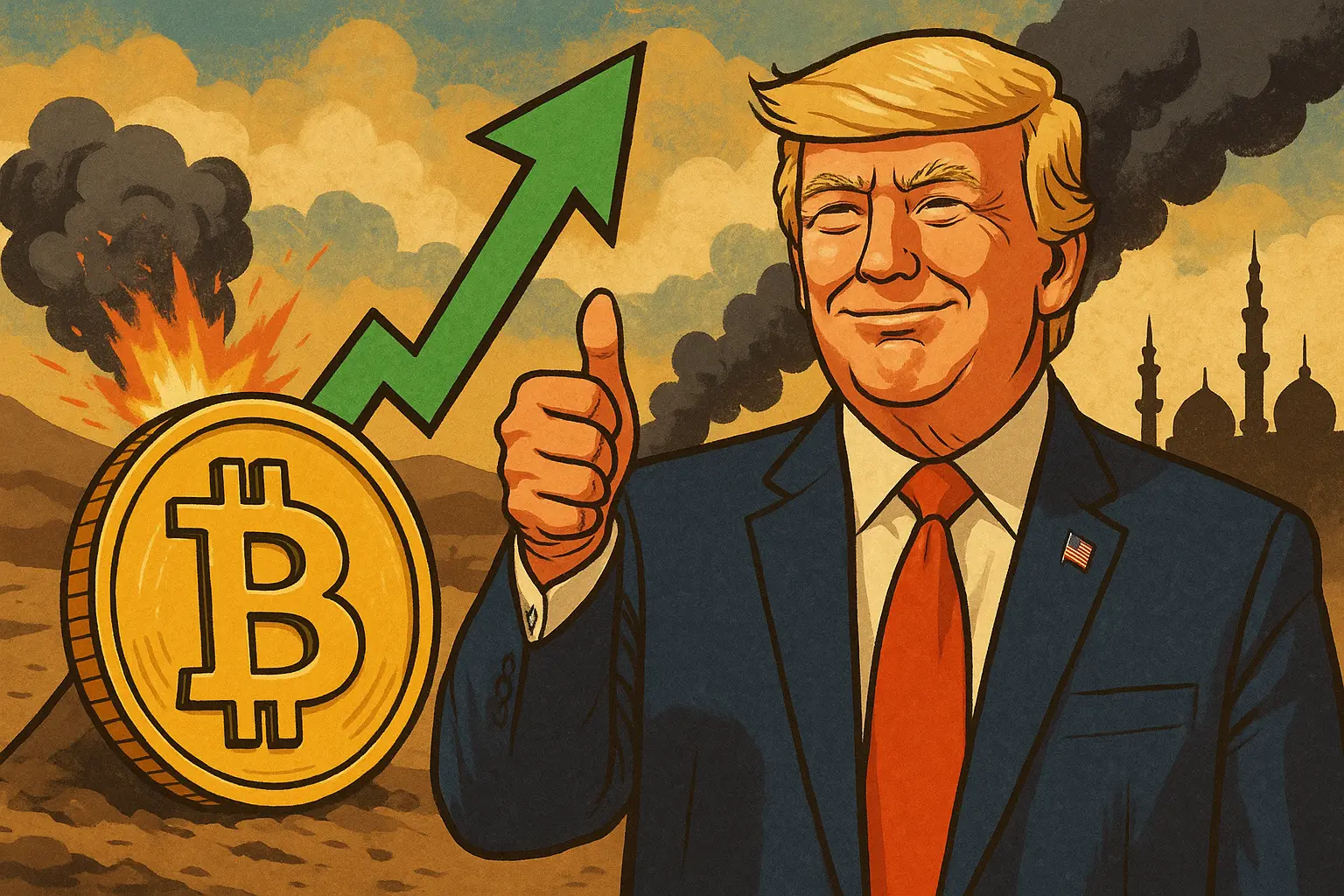
U.S. President Trump announced on April 22 that the Iran ceasefire deadline will be extended. At the request of Pakistan’s Army Chief of Staff and prime minister, the U.S. will wait for Iran to submit a unified proposal before moving forward, while continuing to maintain a naval blockade and stay on heightened alert. Iran refused to take part in the next round of talks scheduled in Islamabad, and the Strait of Hormuz was closed again. Bitcoin rebounded to $76,000, and analyst DonAlt sees this as a key early warning level for gauging the outlook for the next phase.
A diplomatic turning point in Trump’s ceasefire extension: from hardline readiness to waiting for a unified proposal
Earlier on April 22, when Trump was being interviewed, he also said he did not want to extend the ceasefire, adding that if an agreement could not be reached, the U.S. military was “ready” to strike Iran. Only a few hours later, Trump announced an extension. The media, including the Associated Press and The Washington Post, pointed out that this happened after the prospects for negotiations deteriorated sharply.
Iran’s key reason for refusing to attend the talks is that Tehran accuses the U.S. of violating the ten-point framework formed through Pakistan’s mediation, and raised demands that go beyond the framework during the first round of talks in Islamabad. Iran said that attending under current conditions would be “a waste of time.” Its nuclear enrichment capability and missile programs are domestic matters for Iran and it does not accept any outside interference. Vice President Vance’s previously planned trip to lead a delegation to Pakistan was also canceled.
The Strait of Hormuz closes again: energy markets’ volatility weighing on oil prices
The semi-official Tasnim news agency linked to Iran’s Islamic Revolutionary Guard Corps announced that the Strait of Hormuz will be closed until further notice, citing the U.S. continued to detain ships related to Iran (including the oil tanker M/T Tifani). Under normal circumstances, the Strait of Hormuz processes about 21 million barrels of oil per day, accounting for around 20% of global supply. The closure has triggered a force majeure declaration, and Brent crude fell to around $95 per barrel.
Notably, data from the U.S. Treasury shows that in 2025 foreign investors continued to buy a record $1.55 trillion worth of U.S. financial assets, indicating that global capital still views the U.S. as a core safe haven. Geopolitical tensions and capital flows are sharply at odds.
Bitcoin technical analysis: the two-way implications of the early warning level at $76,000
Analyst DonAlt noted that $76,000 represents last month’s high and is the first test of whether the current breakout can sustain. Falling below this level will not end the uptrend, but it signals early weakness. The weekly opening price is positioned at $70,000, representing the starting point of the entire rally; falling below this level means the rally’s momentum is completely gone.
On the upward path, $82,000 on the monthly chart is the next resistance level, with resistance expected to be smaller. After that, the market enters a consolidation range of $86,000 to $94,000, while $95,000 is the potential profit-taking target level analysts recommend.
Frequently Asked Questions
What are the specific conditions for Trump to extend the ceasefire, and what does it mean for the market?
Trump said the precondition for extending the ceasefire is waiting for the Iranian government to submit a “unified proposal” and complete the related consultations, while the U.S. military maintains its blockade at the same time. Market interpretation is that the likelihood of a direct escalation of conflict in the short term has decreased, but the diplomatic outlook is highly uncertain. Any sign that talks with Iran fail or that the U.S. military takes new action could quickly reverse risk-asset sentiment.
How does the Strait of Hormuz closing again affect the crypto market?
The Strait’s closure pushes oil prices higher, intensifying inflation expectations, which creates downward pressure on risk assets—including Bitcoin. Historically, sharp swings in energy prices have often come with rising volatility in crypto markets, especially during periods when the market focuses on the Federal Reserve’s policy direction.
How do Bitcoin analysts interpret the technical significance of $76,000?
DonAlt defines $76,000 as an “early warning level”—breaking below it suggests short-term momentum is weakening but does not end the uptrend. The most critical support is at $70,000; breaking below it means the momentum behind the entire rally is lost. To move upward, price needs to break above $82,000 to open the path toward $95,000.
Disclaimer: The information on this page may come from third parties and does not represent the views or opinions of Gate. The content displayed on this page is for reference only and does not constitute any financial, investment, or legal advice. Gate does not guarantee the accuracy or completeness of the information and shall not be liable for any losses arising from the use of this information. Virtual asset investments carry high risks and are subject to significant price volatility. You may lose all of your invested principal. Please fully understand the relevant risks and make prudent decisions based on your own financial situation and risk tolerance. For details, please refer to
Disclaimer.
Related Articles
Iranian situation latest update: Control over the Strait of Hormuz is upgraded, and Bitcoin is consolidating around $77,000
On April 25, Iran once again escalated its Strait of Hormuz control measures. Bitcoin hovered around $77,500, gold was $4,709, and Brent crude was above $106. With fresh geopolitical turmoil, how will the three major assets move in tandem?
GateInstantTrends53m ago
Michael Saylor: Bitcoin’s winter is over; institutional and sovereign adoption could fuel the next uptrend
Gate News message, April 25 — Michael Saylor, co-founder of MicroStrategy, said "winter's over" as Bitcoin climbed to approximately $78,000, signaling a shift in market sentiment.
According to analyst Mati Greenspan, recent market moves since the flash crash have been corrections within a broader bull market, with Bitcoin's bottom now in place. Greenspan believes the next leg of gains will be driven by "sovereign adoption," including central banks adding BTC alongside gold to their reserves.
Governments and institutions are increasingly incorporating Bitcoin into their holdings. The U.S. government currently holds approximately 300,000 BTC and has discussed establishing a strategic Bitcoin reserve. El Salvador continues making daily purchases, while the U.K. government and several U.S. state pension funds have added Bitcoin to their asset allocations.
GateNews3h ago
SHIB Reserves Hit 61.8T Amid Mixed Signals of Selling Pressure and Accumulation
Gate News message, April 25 — Shiba Inu's on-chain metrics reveal diverging market forces as a major CEX's SHIB reserves climbed to 61.8 trillion tokens, while simultaneously around 86 billion SHIB moved out of exchanges. Data from CryptoQuant shows the reserve increase began around mid-March and
GateNews4h ago
SHIB Nears Breakout Point After Revisiting Powerful Support Level
SHIB revisits a key support zone that previously triggered major price rallies.
Price compression and accumulation signals suggest a potential breakout ahead.
Analysts project strong upside, though market conditions may limit extreme gains.
Shiba Inu has returned to a price level that on
CryptoNewsLand7h ago
PEPE Price Outlook: The Case for a Surprise ‘Disbelief Rally’ Ahead
PEPE shows weak sentiment with falling price, volume, and Open Interest.
Heavy short bias may trigger a surprise rally through liquidation clusters.
Range-bound price suggests a possible trap before continuation of bearish trend.
PepeCoin — PEPE, has taken another hit, and sentiment
CryptoNewsLand8h ago
Crypto Fear and Greed Index Drops to 30, Signals Panic State
Gate News message, April 25 — The Crypto Fear and Greed Index currently stands at 30, down 8 points from yesterday, according to Coinglass data. The seven-day average is 33, while the 30-day average is 18, indicating a shift toward panic sentiment in the
GateNews9h ago


