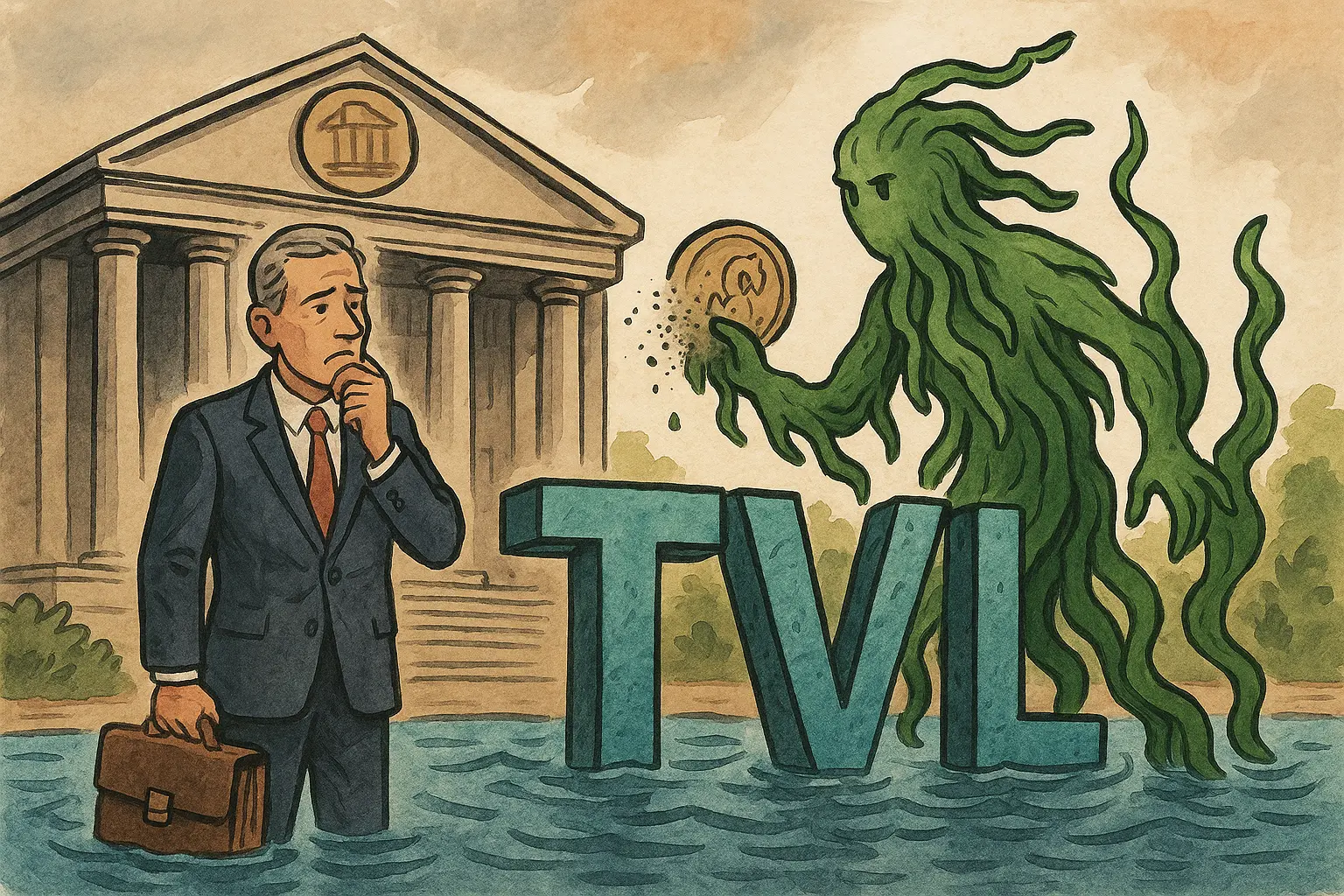
A JPMorgan research team led by analyst Nikolaos Panigirtzoglou said in a report published on April 23 that persistent security vulnerabilities and a stagnating total value locked (TVL) are eroding the appeal of decentralized finance (DeFi) to institutional investors. The report emphasized that the KelpDAO vulnerability wiped out roughly $20 billion in DeFi TVL within days, exposing structural risks.
Key Findings From JPMorgan’s Report
According to JPMorgan’s report published on April 23, the analysts’ team noted that in 2026, losses from hacker attacks in the crypto market are expected to be on par with the 2025 level. Despite progress in smart contract audits, bridge and infrastructure vulnerabilities remain the main sources of risk.
The report directly quoted the analysts’ team: “Just as traditional investors shift to holding cash during uncertain times, crypto participants are also coping with the recent attacks by seeking stablecoins.”
According to the report, although DeFi TVL denominated in U.S. dollars has partially recovered, DeFi TVL denominated in ether (ETH) has basically remained unchanged. JPMorgan analysts said this indicates that DeFi’s natural growth is limited, raising questions about whether DeFi has the scalability to meet the needs of institutional users.
Technical Analysis of the KelpDAO Vulnerability
According to JPMorgan’s report, the attack path of the KelpDAO vulnerability was: the attacker compromised the cross-chain bridge infrastructure, minted unsecured rsETH with a value of about $292 million, and deposited it as collateral into a lending protocol, ultimately resulting in roughly $200 million in bad debt.
JPMorgan’s report said the impact of this attack spread beyond the directly affected platforms, highlighting how interoperability in the DeFi ecosystem can amplify the reach of a single vulnerability. The report also noted that cross-chain bridges—due to their complex design and architecture, shared underlying infrastructure, and sometimes weak verification mechanisms—have historically led to cumulative losses of billions of dollars across the industry.
Institutional Capital Flows: TVL Outflows and USDT “Flight to Safety” Demand
According to JPMorgan’s report, after the KelpDAO vulnerability incident, capital flowed from DeFi lending protocols into Tether’s USDT. With stronger liquidity and faster withdrawal speeds, USDT further strengthened its position as a safe-haven asset in the crypto market.
JPMorgan analysts said in the report that repeated attack events weaken market trust in DeFi systems that rely on code rather than intermediaries. Smart contract vulnerabilities, network phishing, and cross-chain bridge shortcomings are the key technical risks that lead to large amounts of locked assets being exposed.
Frequently Asked Questions
When was this JPMorgan DeFi report published, and who led the writing?
According to JPMorgan’s publicly available information, this DeFi security analysis report was released on Wednesday, April 23, written by a research team led by analyst Nikolaos Panigirtzoglou.
How does JPMorgan describe the impact of the KelpDAO vulnerability on DeFi TVL?
According to JPMorgan’s report, the KelpDAO vulnerability erased about $20 billion in DeFi TVL within days. The attacker minted $292 million of unsecured rsETH as collateral and ultimately caused about $200 million in bad debt, with the impact spreading beyond the directly affected platform.
How does JPMorgan interpret the issue of DeFi TVL stagnating when denominated in ETH?
According to JPMorgan’s report, while DeFi TVL denominated in U.S. dollars has partially recovered, DeFi TVL denominated in ETH has basically remained unchanged. The analysts said this indicates that DeFi’s natural growth is limited, and they raised questions about whether DeFi can meet institutional users’ needs.
Disclaimer: The information on this page may come from third parties and does not represent the views or opinions of Gate. The content displayed on this page is for reference only and does not constitute any financial, investment, or legal advice. Gate does not guarantee the accuracy or completeness of the information and shall not be liable for any losses arising from the use of this information. Virtual asset investments carry high risks and are subject to significant price volatility. You may lose all of your invested principal. Please fully understand the relevant risks and make prudent decisions based on your own financial situation and risk tolerance. For details, please refer to
Disclaimer.
Related Articles
US Sanctions Iran-Linked Crypto Wallets; Tether Freezes $344M USDT in Coordination with OFAC
Gate News message, April 25 — The U.S. Treasury Department sanctioned multiple cryptocurrency wallets linked to Iran on April 24 as part of efforts to increase economic pressure on the country amid an ongoing ceasefire. Treasury Secretary Scott Bessent said the government will "follow the money
GateNews24m ago
Clarity Act Faces May 2026 Deadline Amid Banking Lobby Pushback on Stablecoin Yield Ban
Gate News message, April 25 — The Clarity Act, a key U.S. crypto regulatory bill, faces mounting pressure as Senator Thom Tillis recommended delaying the Senate Banking Committee markup to May 2026, citing intense lobbying from the North Carolina Bankers Association (NCBA). The NCBA is pushing for a
GateNews59m ago
Brazil fully bans 27 prediction market platforms such as Polymarket and Kalshi: the largest prediction market ban in emerging markets
The Brazilian government announced a comprehensive ban on 27 prediction market platforms (including Polymarket and Kalshi) on April 24, 2026, citing that they had not obtained licenses and did not comply with the current gambling laws, and that connections were blocked from that day onward. The new law only allows fixed-odds betting based on the results of in-person sporting events; event-based prediction contracts remain illegal. The central bank also added that the regulatory threshold for derivative transactions had not been met. This move has been seen as the first major negative case in the expansion of emerging markets worldwide, and in the future it may affect regulatory and cross-border compliance negotiations in places such as India, Indonesia, and Turkey.
ChainNewsAbmedia1h ago
Brazil Bans Polymarket, Kalshi Citing Investor Protections
Brazil has enacted a sweeping ban on prediction markets and betting platforms, according to local media and government filings. The two leading prediction markets, Polymarket and Kalshi, were inaccessible to researchers in the country. Finance Minister Dario Durigan stated that approximately 28 plat
CryptoFrontier3h ago
DeFi Education Fund Urges SEC to Formalize DeFi Broker Guidance into Rulemaking
Gate News message, April 25 — The DeFi Education Fund and 35 other crypto industry leaders are urging the Securities and Exchange Commission to formalize its recent decentralized finance interface guidance into formal rulemaking. In a letter sent to the SEC this week, the groups pressed the agency t
GateNews3h ago
Tennessee Bans Crypto ATMs Statewide, Becomes Second U.S. State After Indiana
Gate News message, April 25 — Tennessee became the second U.S. state to enact a statewide ban on cryptocurrency ATMs after Gov. Bill Lee signed House Bill 2505 into law on April 13. The law, which officially took effect on April 24, will become enforceable on July 1 and makes it a Class A
GateNews4h ago


