Artikel: DaiDai, Maitong MSX, Maidian
Kernübersicht
Am 3. Januar 2026 frühmorgens zerbrach die US-Militäraktion „Operation Southern Spear“ mit einer gewaltigen Wucht, die die globalen Märkte atemlos machte, die mehr als zwanzig Jahre lang von der anti-amerikanischen Festung Caracas gehalten wurde; es war nicht nur ein militärischer Schlag gegen das Maduro-Regime, sondern auch eine gewaltsame Neugestaltung der Energiekarte des westlichen Hemisphäre, die den „US-Union“ unter Führung von Wall Street-Kapital, Texas-Öl und Pentagon-Verteidigungstechnologie offiziell die Kontrolle über den „Bankrott-Riesen“ mit 3030 Milliarden Barrel Ölreserven übergab.
1. Der kritische Punkt der Geopolitik – vom „Monroe-Doktrin“ zum „Tangro-Doktrin“
1. Die tiefere Logik der Konflikteskalation: Vom Druck in die Ecke getriebene Hegemonie
Die militärische Aktion am 3. Januar 2026 war kein plötzlicher „Schwarzer Schwan“, sondern das unvermeidliche „Grauschwan“ nach dem Scheitern der geopolitischen Drucktests seit Mitte 2025. Während die offizielle Erzählung sie als Durchsetzungsmaßnahme gegen „Drogen-Terrorismus“ (Narco-Terrorism) darstellt, zeigt eine tiefgehende Analyse der Geheimdienstinformationen, dass die zugrunde liegende Logik die absolute Wiederholung der strategischen Kontrolle der USA über das westliche Hemisphäre ist, also die physische Umsetzung der „Monroe-Doktrin 2.0“.
Rückblickend auf die zweite Jahreshälfte 2025 zeigt sich eine klare spiralartige Eskalation in den Beziehungen zwischen den USA und Venezuela. Im August 2025 startete das US-Südkommando (USSOUTHCOM) unter dem Vorwand der Bekämpfung transnationaler krimineller Organisationen eine Marineansammlung vor der Nordküste Caracas, die seit Jahrzehnten nicht mehr gesehen wurde. Diese Aktion schien zunächst eine Reaktion auf Venezuelas langjährige Unterstützung krimineller Gruppen wie „Tren de Aragua“ zu sein, doch die Dimension überstieg schnell den Rahmen eines Sicherheitskriegs.
Der eigentliche Wendepunkt kam im September 2025, als die US-Armee bei einer Abfangaktion ein venezolanisches Schiff versenkte, was 11 Todesopfer forderte. Dieses „Kinetik“-Ereignis durchbrach die langjährige gegenseitige Stille und schob die Konfrontation an den Rand eines heißen Krieges. In den folgenden Monaten entschied Washington nicht für eine Deeskalation, sondern unter Leitung von Verteidigungsminister Pete Hegseth wurde im November offiziell die „Operation Southern Spear“ eröffnet, und es wurde beispiellos das modernste US-Flugzeugträgergeschwader „Gerald R. Ford“ in die Karibik verlegt.
2. Die Essequibo-Krise: Ein nicht zu ignorierender Zündstoff
Bei der Analyse der Rechtfertigung für die Invasion ist der Territorialstreit um Essequibo ein entscheidendes Puzzlestück. Seit 2023 verfolgt Venezuela eine zunehmend aggressive Territorialanspruchnahme auf dieses ölreiche Gebiet, sogar durch Gesetzgebung als Bundesstaat eingegliedert. Die Urteile des Internationalen Gerichtshofs (IGH) zwischen 2024 und 2025 konnten Venezuelas Ambitionen nicht wirksam eindämmen, sondern schürten vielmehr den nationalistischen Furor von Maduro, der Truppen an der Grenze zusammenzog.
Für die USA ist Essequibo nicht nur wegen der enormen Investitionen von ExxonMobil in die Region relevant, sondern auch wegen der Energieversorgungskorridore im Karibikraum. Venezuela hat Ende 2025 die Gasprojekte mit Trinidad und Tobago eingefroren, was die regionale Energiekooperation weiter einschränkt. Daher erscheint die militärische Lösung, Venezuelas Bedrohung für Nachbarländer dauerhaft zu beseitigen, als unvermeidlich, um die Interessen amerikanischer Energiekonzerne und die Stabilität der Region zu sichern.
3. „Öl-Rechnungs-Theorie“: Der Wiederaufbau-Ökonomik-Plan
Im Gegensatz zu früheren Interventionen, die auf „Demokratieförderung“ setzten, ist diese Aktion stark kommerziell geprägt. Präsident Trump erklärte nach dem Erfolg offen, dass US-Ölgesellschaften in Venezuela investieren werden, um durch die Förderung und den Verkauf von Öl die militärischen Ausgaben und Wiederaufbaukosten „abzuschreiben“. Diese „Öl-gegen-Wiederaufbau“-Strategie (Oil-for-Reconstruction) bietet nicht nur eine politische Rechtfertigung für den späteren Kapitalzugang, sondern definiert auch das Wirtschaftsmodell Venezuelas für die nächsten zehn Jahre: eine ressourcenbasierte Wirtschaft, die von US-Kapital dominiert wird, mit Schuldenrückzahlung und Export im Zentrum.
2. Die Profite der Kriegsmachine – Die praktische Präsentation der Verteidigungsindustrie
„Operation Southern Spear“ ist eine konzentrierte Demonstration der Ergebnisse der dritten Offset-Strategie der US-Armee. Für den Sekundärmarkt ist die Betrachtung der eingesetzten Ausrüstung und Technologien ein klarer Indikator für die Alpha-Erträge im Verteidigungssektor.
1. Absolute Kontrolle der Seemacht: Flugzeugträger und Schiffbau
Der Einsatz des USS Gerald R. Ford (CVN-78) ist das zentrale Highlight. Als erstes Schiff der Ford-Klasse zeigt es in der Karibik nicht nur Abschreckung, sondern auch die Belastbarkeit des elektromagnetischen Katapultsystems (EMALS) und der fortschrittlichen Abfangvorrichtungen (AAG) bei Hochfrequenz-Operationen.
Huntington Ingalls Industries (NYSE: HII): Als einziger Hersteller von nuklearbetriebenen Flugzeugträgern in den USA ist HII die einzige Quelle für diese strategischen Assets. Die Leistung des Ford in der Operation bestätigt die Kampffähigkeit dieser Klasse, was die kontinuierliche Finanzierung der Kennedy (CVN-79) und Enterprise (CVN-80) sichert. Für Investoren ist HII nicht nur ein Schiffbauer, sondern das Fundament für die globale maritime Hegemonie der USA, mit deutlich steigender Auftragsvolumina durch die geopolitische Eskalation.
General Dynamics (NYSE: GD): Neben der Beteiligung an der Konstruktion von Zerstörern im Rahmen der Bath Iron Works wird GD im Bereich Land- und Spezialoperationen eine Schlüsselrolle spielen, da die US-Armee die „vorübergehende Verwaltung“ Venezuelas angekündigt hat. Der Bedarf an gepanzerten Fahrzeugen und Logistikfahrzeugen wird in einem langjährigen Wartungs- und Modernisierungszyklus liegen.
2. Digitale Kill-Chain: Der Sieg der softwaredefinierten Kriegsführung
Wenn Flugzeugträger das Kriegsschiff sind, ist Software die Seele. Die Operationen gegen Venezuelas komplexe Luftabwehr und asymmetrische Drogennetzwerke basieren stark auf Datenfusion und KI-Entscheidungen.
Palantir Technologies (NYSE: PLTR): Bei „Operation Southern Spear“ dürfte Palantir mit seiner Gotham-Plattform die zentrale Rolle bei der Informationsverarbeitung gespielt haben. Durch die Integration von Satellitenbildern, Drohnendaten und Kommunikationsüberwachung konnten hochrangige Ziele (HVT) in urbanen und Dschungelumgebungen präzise lokalisiert werden.
Tiefere Einblicke: Kürzlich hat Palantir einen Vertrag über 4,48 Mrd. USD mit der US-Marine unterzeichnet, um mit seinem „Warp Speed“-System die Lieferketten im Schiffbau zu beschleunigen. Diese durchgängige Abdeckung vom Zielerkennungssystem auf dem Schlachtfeld bis zur Produktionsbeschleunigung in den Fabriken macht PLTR zum Kern der digitalen Transformation der Verteidigungsindustrie. Die Zusammenarbeit mit L3Harris, um KI in die Fertigung einzubringen, unterstreicht die zentrale Rolle von Software im modernen Krieg.
Anduril Industries (nicht börsennotiert / potenzieller Einhorn): Obwohl Anduril noch nicht an der Börse ist, ist die Anwendung seiner Technologien im Konflikt hochrelevant. Das „Lattice“-Betriebssystem wird von der Space Force zur Aufrüstung der Weltraumüberwachung genutzt, was für die Überwachung Venezuelas großer Grenzen und Meere entscheidend ist. Anduril steht für ein „kostengünstiges, autonomes, groß angelegtes“ Militärmodell, dessen Erfolg den traditionellen Rüstungsriesen Druck macht und die zukünftige Investitionsrichtung im Primärmarkt vorgibt.
3. Elektronische Kampfführung und unbemannte Systeme: Unsichtbarer Rauch
Venezuela besitzt russische S-300-Luftabwehrsysteme. Für die Etablierung der Luftüberlegenheit ist EW (Electronic Warfare) unerlässlich.
L3Harris Technologies (NYSE: LHX): Als führender Anbieter im Bereich EW liefert L3Harris entscheidende Flugzeuginterferenz- und SIGINT-Fähigkeiten. Zudem passt die Entwicklung unbemannter Wasserfahrzeuge (USV) perfekt zu den Anforderungen des Südkommandos bei der Bekämpfung von Drogen-U-Booten und Schnellbooten in der Karibik. Die Technologie ermöglicht es, feindliche Kommunikations- und Steuerungssysteme kontaktlos lahmzulegen – ein Kernbestandteil moderner „Soft-Kill“-Strategien.
Kratos Defense (NASDAQ: KTOS): Angesichts der möglichen Bedrohung durch portable Luftabwehrraketen in Venezuela ist der Einsatz hochleistungsfähiger unbemannter Ziel- und Aufklärungsdrohnen wie „Valkyrie“ die beste Strategie, um Pilotenrisiken zu minimieren. Diese „attritable“ Drohnen beschleunigen den Übergang der US-Streitkräfte von teuren bemannten Flugzeugen zu Drohnen-Teams.
AeroVironment (NASDAQ: AVAV): Bei urbanen Einsätzen und gezielten Angriffen auf Drogenverstecke bieten die Switchblade-„Springmesser“-Drohnen eine unvergleichliche Präzision. Mit zunehmender Tiefe der US-Spezialeinsätze in Venezuela steigt die Nachfrage nach solchen tragbaren Waffensystemen exponentiell.
4. Logistik und Basenbau: Fortsetzung des Krieges
KBR, Inc. (NYSE: KBR): Einer der klaren Profiteure dieser Operation. KBR besitzt den US-Armee-Vertrag LOGCAP V (Logistics Civil Augmentation Program), der die Basisinfrastruktur, Verpflegung und Wartung für US-Einsätze weltweit abdeckt.
Geschäftslogik: Mit der Ankündigung Trumps, die Kontrolle über das Land zu übernehmen und zu betreiben, werden Zehntausende US-Soldaten und Personal langfristig stationiert. Vom Wiederaufbau zerstörter Flughäfen bis zum Aufbau sicherer Militärlager und der Aufrechterhaltung der Versorgungsketten – KBR ist der einzige Anbieter mit derart großem und schnellem Reaktionsvermögen. Historisch brachte dieser Typ von Verträgen während des Irak- und Afghanistan-Kriegs Milliardenumsätze.
3. Das Erwachen des schwarzen Goldes – Der „große Neustart“ der Energieindustrie
Venezuela besitzt die größten Ölreserven der Welt. Mit dem Sturz des Maduro-Regimes wird dieses Land mit 3030 Milliarden Barrel nachgewiesener Reserven eine „Privatisierungs-Party“ unter US-Kapital erleben. Es geht nicht nur um die Wiederaufnahme der Produktion, sondern um eine strukturelle Umkehr im globalen Rohölhandel.
1. Reserven in Geld umwandeln: Vom „Untergrund-Asset“ zum „Bilanzposten“
Venezuelas Öl ist vor allem im Orinoco-Ölband konzentriert, das riesige Schwerölreserven birgt. Die Förderung und Verarbeitung sind jedoch technisch und kapitalintensiv. In den letzten zehn Jahren sank die Produktion durch Mangel an Verdünnungsmitteln und Upgradern auf etwa 1 Million Barrel pro Tag (hauptsächlich nach China).
Die US-Regierung plant klar: US-Ölkonzerne sollen die Infrastruktur reparieren, die Produktion wieder hochfahren und die Einnahmen zur Schulden- und Wiederaufbaufinanzierung nutzen.
2. Gewinnerliste: Wer kann das Stück vom Kuchen abbekommen
Chevron (NYSE: CVX):
- Kernlogik: Als einziger US-Ölkonzern, der während der Sanktionen noch begrenzt in Venezuela operieren durfte, hat Chevron einen unübertrefflichen First-Mover-Vorteil. Die Joint Ventures (z.B. Petropiar) sind vergleichsweise intakt, Fachkräfte vor Ort. In der Anfangsphase nach der Übernahme ist Chevron der einzige, der sofort reagieren und die Produktion ausbauen kann.
- Markterwartung: Es wird erwartet, dass Chevron die ersten „Super-Lizenzen“ erhält, die es erlauben, nicht nur die Förderung, sondern auch den Export direkt zu kontrollieren, was die Profitabilität der venezolanischen Assets erheblich steigert.
ExxonMobil (NYSE: XOM) und ConocoPhillips (NYSE: COP):
- Rache und Rückkehr: Beide wurden bei der Verstaatlichung 2007 enteignet, Conoco besitzt eine internationale Schiedsklage mit 8,7 Mrd. USD Entschädigung.
- Debt-to-Equity-Chance: Angesichts der finanziellen Erschöpfung Venezuelas ist es wahrscheinlich, dass die neue Regierung eine „Debt-for-Equity“-Umlagerung anbietet, um diese Konzerne wieder ins Spiel zu bringen. Conoco und Exxon könnten ihre Klagen nutzen, um zu günstigen Konditionen die besten Schwerölreserven zu übernehmen. Das ist nicht nur Bilanzsanierung, sondern auch eine 20-jährige Reserve-Lebensdauer-Garantie.
Ölservice-Giganten: Schlumberger (NYSE: SLB) und Halliburton (NYSE: HAL):
- Unverzichtbar: Nach langen Stillständen benötigen venezolanische Bohrungen umfangreiche Reparaturen (Workover) und Steigerungsmaßnahmen. Schwerölförderung ist auf Hochtemperatur- und elektrische Pumpentechnologie angewiesen. SLB und HAL dominieren diese High-End-Technologien.
- Infrastruktur-Reparatur: Neben den Bohrlöchern werden KBR und Fluor bei der Wiederherstellung der Raffinerie- und Petrochemieanlagen im Industriepark Jose die bevorzugten Auftragnehmer sein. Ohne diese Upgrades ist der Export von Schweröl aus dem Orinoco unbrauchbar.
Refinerie-Arbitrage: Valero Energy (NYSE: VLO):
- Die US-Gulf-Region (PADD 3) war ursprünglich auf venezolanisches Schweröl ausgelegt. Seit den Sanktionen mussten die Raffinerien teure Importe aus Kanada oder Nahost verarbeiten, was die Effizienz senkte.
- Arbitrage-Logik: Mit der Rückkehr venezolanischen Rohöls in den US-Markt, bei kurzen Transportwegen (nur wenige Tage von Venezuela nach Gulf Coast), und der typischen Preisabschlag (Discount) auf Brent, sinken die Rohstoffkosten für komplexe Raffinerien. Das erhöht die Crack-Spreads und die Margen.
3. Markteinfluss: Doppelbewegung bei den Ölpreisen
Kurzfristig könnte die Kriegsangst die Preise steigen lassen, doch langfristig ist die Rückkehr Venezuelas eine erhebliche Angebotssteigerung. Wenn die Produktion in einigen Jahren auf 3 Mio. Barrel/Tag steigt, wird das die OPEC±Kürzungen herausfordern und die Preise unter Druck setzen. Für die downstream- und chemische Industrie sowie die Luftfahrt (z.B. Delta DAL, United UAL) ist das eine positive Entwicklung.
4. Überreste und Wiederaufbau – Infrastruktur und Umweltsanierung
Neben Öl ist der Wiederaufbau Venezuelas ein riesiges Projekt in Energie, Verkehr und Umwelt. Jahre sozialistischer Experimente und die anschließende Wirtschaftskrise haben die Infrastruktur auf „Vor-Industrie“-Niveau gedrückt.
1. Beton und Stahl: Das Fundament des Wiederaufbaus
Cemex (NYSE: CX): Mexikanischer Baustoffriese mit starken Wurzeln in Lateinamerika. Cemex war lange in Venezuela aktiv, wurde verstaatlicht und entschädigt.
Investitionslogik: Der Bedarf an Zement ist im Nachkriegsaufbau unverzichtbar. Für den Wiederaufbau zerstörter Flughäfen, Häfen, Straßen und Wohnungen werden Zehntausende Tonnen Zement benötigt. Cemex kann durch seine Produktions- und Logistiknetzwerke in der Karibik eine führende Rolle spielen. Als ehemaliger „Geschädigter“ hat Cemex politische und rechtliche Legitimität, wieder in den Markt einzusteigen.
2. Umweltreparatur: Ein unterschätzter Markt im Milliardenbereich
Venezuela hat die Umweltstandards in der Ölindustrie vernachlässigt, was zu schweren Ölverschmutzungen und Ökosystemkatastrophen führte, besonders in den Morrocoy-Nationalpark.
Tetra Tech (NASDAQ: TTEK): Führend in Umwelttechnik und -sanierung, mit Top-Kompetenz in Wasseraufbereitung und Schadstoffbeseitigung.
Auftragslage: Tetra Tech erhielt kürzlich einen Auftrag der US-Umweltschutzbehörde (EPA) im Wert von 94 Mio. USD zur Bekämpfung von Ölverschmutzungen. Mit der US-Führung beim Wiederaufbau wird Umweltkonformität eine Voraussetzung für den Markteintritt der US-Ölindustrie. Tetra Tech dürfte große Umweltprüfungs- und Sanierungsaufträge von USAID oder Ölkonzernen erhalten.
3. Stromnetz: Von Dunkelheit zu Licht
Venezuela leidet unter einer katastrophalen Stromversorgung, häufige Blackouts lähmen Industrie und zerstören die Bitcoin-Mining-Industrie. Der Wiederaufbau des Stromnetzes ist essenziell für die Wiederaufnahme der Ölproduktion (benötigt viel Energie) und die gesellschaftliche Stabilität. Das kommt Unternehmen wie GE Vernova (NYSE: GEV) und Siemens Energy zugute.
5. Die Tiefen der Finanzmärkte – Schulden, Währungen und Krypto
Neben der Realwirtschaft löst der Machtwechsel in Venezuela auch auf den Finanzmärkten heftige und komplexe Schwankungen aus.
1. Staatsschulden: Das milliardenschwere Asset-Desaster
Venezuelas Staat und PDVSA haben Schulden von über 600 Mrd. USD, inklusive Zinsen könnten es bis zu 1500 Mrd. USD sein. Diese Anleihen wurden durch US-Sanktionen vom Handel ausgeschlossen und fielen auf Bruchteil ihres Nennwerts.
Handel: Mit der Anerkennung der neuen Regierung durch die USA ist die Aufhebung der Sanktionen nur noch eine Frage der Zeit. Das ermöglicht US-Investoren den Wiedereinstieg.
Reorganisationserwartung:
- Fonds wie Canaima Global Opportunities Fund und IlliquidX haben seit Jahren Positionen aufgebaut.
- CIO von Altana Wealth bezeichnete venezolanische Schulden als „die attraktivste asymmetrische Staatsanleihe-Chance der Welt“.
- Wenn die Anleihen von 5 Cent auf 30-40 Cent steigen (basierend auf Öl-Einnahmen und Reorganisationsaussichten), ergeben sich Verfünf- bis Zehnfachrenditen.
- Retail-Tools: Für Privatanleger ist der direkte Kauf von Anleihen schwierig. Indirekt kann man über ETFs wie VanEck Emerging Markets High Yield Bond ETF (HYEM) investieren, die Hochzinsanleihen aus Schwellenländern halten. Obwohl HYEM wahrscheinlich keine direkte Venezuelas-Exponierung hat (wegen Sanktionen), führt eine Indexaufnahme zu passivem Kaufdruck.
2. Kryptowährungen: Vom „Sanktion-Umgehung“ zum „Dollar-Proxy“
Venezuela ist weltweit bekannt für den Krypto-Einsatz, doch die treibenden Kräfte ändern sich grundlegend.
USDT (Tether): Früher wurde USDT von PDVSA genutzt, um den SWIFT-Umgehungskanal für Ölverkäufe zu verschleiern („Shadow Fleet“). Mit der US-Sanktionierung und Rückführung auf offizielle USD-Abwicklung bricht die Nachfrage nach USDT als Geldwäsche-Tool schlagartig weg. Tether hat zudem Wallet-Freeze-Aktionen im Rahmen der US-Sanktionen durchgeführt, was die Attraktivität im Graubereich mindert.
USDC und RSR profitieren:
- Circle (USDC): Circle arbeitete mit der US-Regierung zusammen, um mit Airtm Hilfsgelder an venezolanische Mediziner zu verteilen, um Maduro zu umgehen. In der Wiederaufbauphase wird USDC als regulierte, vertrauenswürdige „digitale Dollar“-Währung wahrscheinlich die offizielle Verteilungs- und Parallelwährung werden.
- Reserve Rights (RSR): Mit ca. 500.000 aktiven Nutzern in Venezuela ermöglicht die App, Bolivar in USD-Stablecoins zu tauschen, um Inflation zu bekämpfen. Im Gegensatz zum gescheiterten Petro ist RSR eine Bottom-up-Alternative. Mit der wirtschaftlichen Öffnung wird die Bedeutung von Reserve als Zahlungs-Gateway steigen, vor allem, wenn das traditionelle Bankensystem noch im Wiederaufbau ist.
- Bitcoin (BTC): Kurzfristig treibt der Konflikt den Bitcoin-Preis als sicheren Hafen. Für die lokale Mining-Industrie Venezuelas könnte der Wiederaufbau des Stromnetzes das Zeitalter billiger Stromdiebstähle beenden, was die Kosten erhöht, aber langfristig die Skalierung und Ökologisierung fördert.
6. Fazit und Risikoblick
1. Zusammenfassung
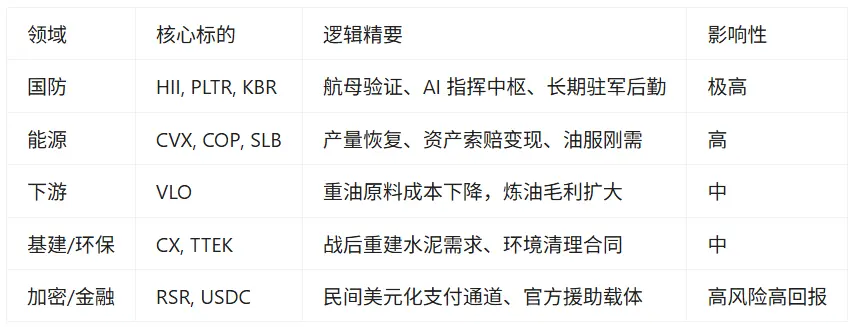
Die US-Militärübernahme Venezuelas ist im Kern eine globale Kapital-„Liquidation“ und Restrukturierung eines stark unterschätzten Kernassets. Es ist kein reiner geopolitischer Sieg, sondern ein kapitalistisches Fest. Vom Kampfflugzeug auf dem Flugzeugträgerdeck bis zu den Ölfeldern im Orinoco, vom Wall Street-Trading bis zu den Straßen in Caracas – eine klare Profitkette formt sich: Verteidigungsindustrie vor, Energieriesen an Bord, Infrastruktur und Umweltsanierung im Nachgang, Finanzkapital in der Arbitrage.
2. Wichtige Investitionsziele
Risikohinweis
- Sicherheitskrise: Wenn verbleibende Kräfte einen langwierigen Guerillakrieg führen, Pipelines und Stromnetze sabotieren, könnten Firmen wie KBR ihre Kosten nicht mehr kontrollieren, die Ölproduktion bleibt hinter den Erwartungen zurück.
- Großmacht-Duell: Russland und China sind Venezuelas Hauptgläubiger. Asset-Dispossession könnte neue diplomatische und rechtliche Konflikte auslösen und den Restrukturierungsprozess verzögern.
- Ölpreis-Volatilität: Übermäßiger Produktionsanstieg Venezuelas, zusammen mit einer globalen Wirtschaftsschwäche, könnte die Preise zum Absturz bringen und die US-Schieferölindustrie schädigen, was politische Kurswechsel erzwingt.
Haftungsausschluss: Dieser Bericht dient nur der Information und stellt keine Anlageberatung dar.


