Market Prediction: 45% Bet on BlackRock CIO Rick Rieder as Federal Reserve Chair
(Source: Polymarket)
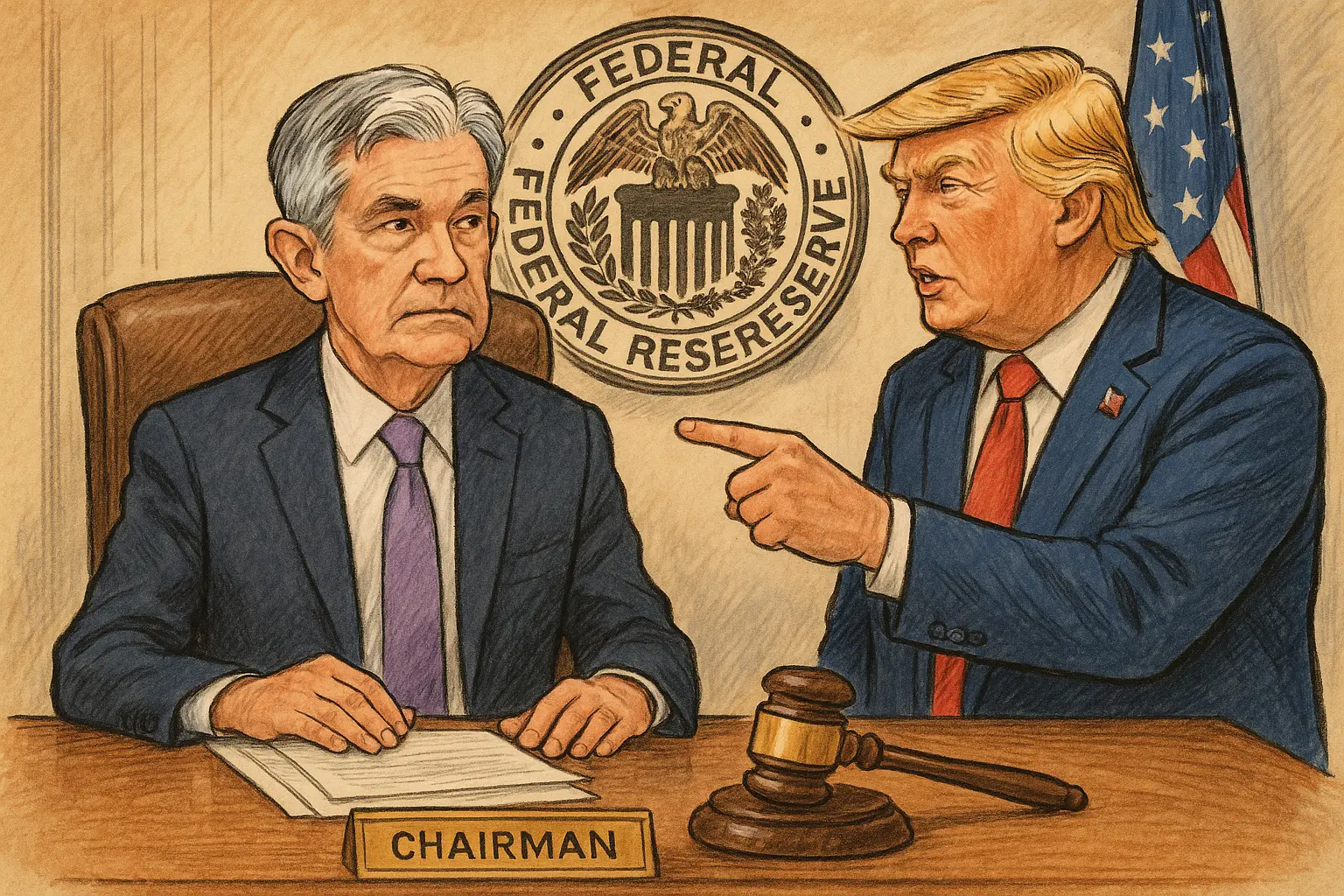
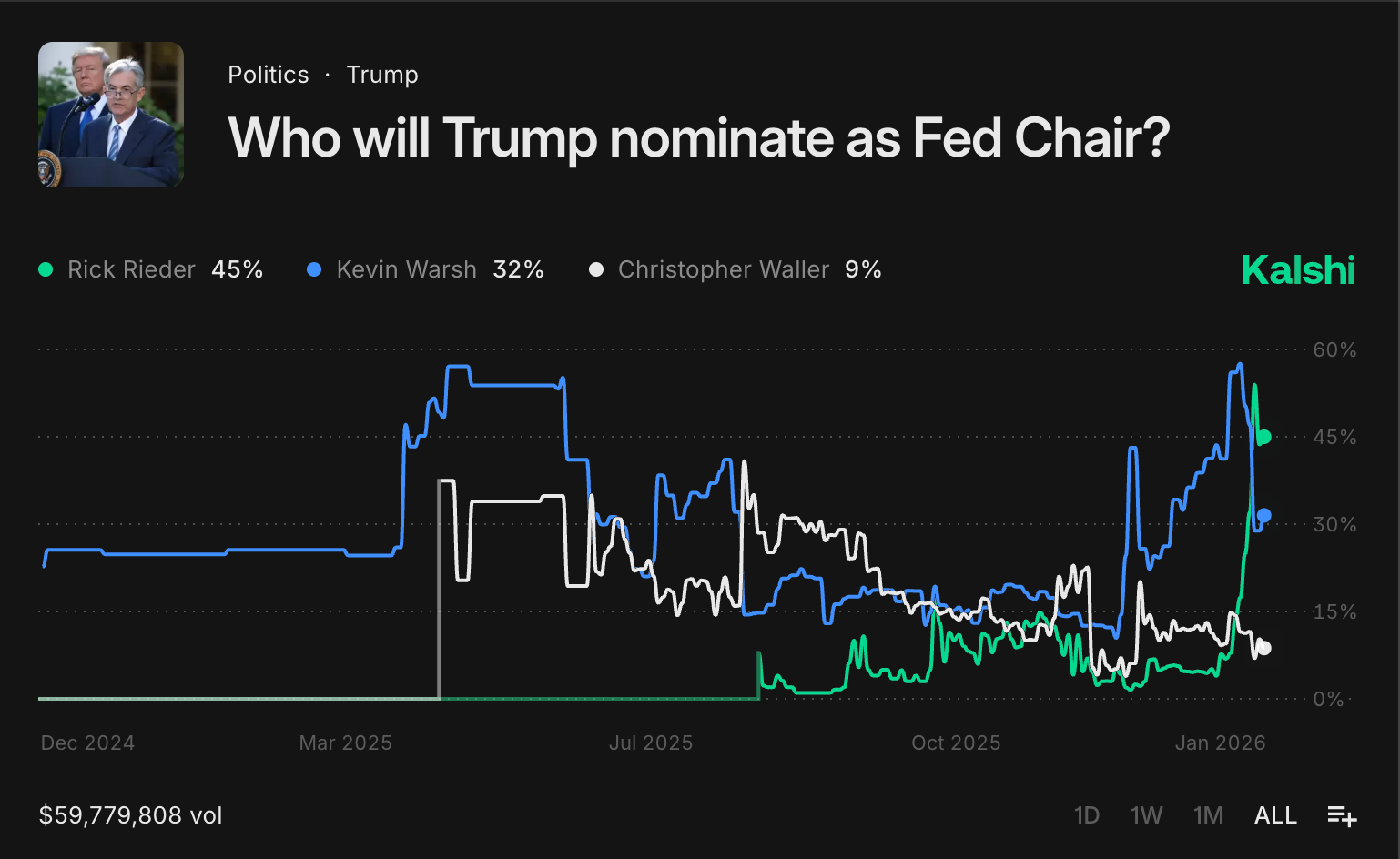
Federal Reserve Chair Powell’s term will end this May. However, market participants have already begun betting on who President Trump will choose to succeed him. Initially considered Kevin Hassett, but now the focus has shifted to BlackRock Chief Investment Officer Rick Rieder. Rieder currently has strong support on prediction platforms, with both Polymarket and Kalshi markets assigning him a 45% chance of being nominated, ranking higher than other candidates like Federal Reserve Board member Christopher Waller and former Fed officials Kevin Warsh.
At first glance, considering the long-standing tradition of the Trump administration hinting at potential Fed candidates, this seems like a typical investment. However, during a recent CNBC interview at the Davos World Economic Forum, Trump called this BlackRock executive “very outstanding,” saying, “I was going to say we only have three left, but actually two. And I might even tell you, in my view, we might only have one left,” Trump said. This near-explicit statement caused prediction markets to quickly adjust probabilities, further boosting Rieder’s lead.
According to Bloomberg, Rieder’s prominence among the candidates is due to several reasons. Unlike Waller or Warsh, he has never worked at the Fed, thus is perceived as having fewer ties to the institution. This “outsider” status is highly attractive to Trump, who has long criticized the Fed’s “establishment” thinking. Rieder has also expressed willingness to implement reforms at the Fed, aligning with Trump’s desire to reshape the central bank. However, this is not the first time Trump has publicly indicated support for a candidate; there may still be variables between his public statements and final decision.
Hassett Drops from Favorite to 8% in a Dramatic Turn
A month ago, Hassett was considered the leading candidate to replace Powell. As Director of the National Economic Council (NEC), he has consistently held dovish views on interest rates, aligning his economic outlook closely with Trump’s agenda. Given this stance, Trump initially strongly supported Hassett for Fed Chair. However, less than two weeks ago, he changed course, indicating a preference for Hassett to remain at the NEC. According to Polymarket, Hassett’s chances of being chosen have fallen to 8%.
This dramatic shift reflects the unpredictable decision-making style of Trump. Hassett, once a frontrunner, is now nearly out of the race, simply because Trump considers his role at the NEC more valuable. This casual approach to personnel adjustments increases market volatility and reminds investors that Trump’s final decision can change at any moment. Hassett’s background in economics and dovish stance should have made him an ideal candidate, but Trump evidently believes Rieder from BlackRock better fits his expectations for the Fed.
The shift from Hassett to Rieder also highlights subtle changes in candidate criteria. Hassett is a traditional economist and policymaker, while Rieder is a hands-on Wall Street asset manager. Rieder manages hundreds of billions of dollars at BlackRock and has firsthand knowledge of financial markets. Trump may believe that a leader from the asset management industry better understands market needs and is more willing to cooperate with his economic policies. This “practical over academic” logic is common in Trump’s personnel appointments.
Rate Cuts Favor Crypto but Concerns Over Independence Increase Volatility
Regardless of who ultimately succeeds Powell, Trump has made it clear he hopes to lower interest rates. If this occurs, the cryptocurrency market is likely to be the first to feel the impact of rate changes. Lower rates generally mean higher liquidity. For consumers, this translates to lower borrowing costs, often enabling higher risk tolerance. If the Fed continues to cut rates under new leadership, Bitcoin and Ethereum could benefit from renewed upward momentum.
However, the conditions for rate cuts are crucial. Over the past few months, Trump’s repeated questioning of the Fed’s independence has triggered negative reactions in the bond markets and spread volatility into the crypto space. If Trump continues to exert such pressure on the next Fed chair, the outlook for cryptocurrencies could worsen. The core value of Fed independence lies in its monetary policy decisions being based on economic data and long-term stability, not short-term political pressures.
If the new chair is perceived as a Trump puppet, market confidence in its policy independence will decline. This could lead to a weakened dollar, rising bond yields, and increased financial market volatility. In such an environment, even if the Fed cuts rates, cryptocurrencies might suffer due to overall market chaos. Historically, when Fed independence is questioned, financial markets tend to become unstable, and economic policy becomes chaotic.
From a crypto market perspective, the ideal scenario is: the new Fed chair independently decides to cut rates based on economic data, which markets interpret as a rational assessment of the economy. The worst case is: the new chair is seen as a political appointee, and rate cuts are viewed as yielding to political pressure, undermining confidence in the dollar and US economic policy. Current conditions lean more toward the latter, sowing seeds of uncertainty for crypto markets.
If Rieder is indeed appointed, he will face a difficult balancing act. On one hand, he needs to implement the rate cuts Trump expects to demonstrate loyalty. On the other hand, he must maintain the Fed’s independence to preserve market confidence. This delicate balance is hard to achieve, and any misstep could trigger market panic. For crypto investors, closely watching the new Fed chair’s initial policy statements and market reactions will be key to gauging future trends.
Disclaimer: The information on this page may come from third parties and does not represent the views or opinions of Gate. The content displayed on this page is for reference only and does not constitute any financial, investment, or legal advice. Gate does not guarantee the accuracy or completeness of the information and shall not be liable for any losses arising from the use of this information. Virtual asset investments carry high risks and are subject to significant price volatility. You may lose all of your invested principal. Please fully understand the relevant risks and make prudent decisions based on your own financial situation and risk tolerance. For details, please refer to
Disclaimer.
Related Articles
World Gold Council: Central Banks in each country net purchased 19 tons of gold in February; China has increased its holdings for the 16th consecutive month
A World Gold Council report shows that in February 2026, central banks net bought 19 tons of gold, up from January but below the 2025 average. Some central banks have continued to accumulate gold; China has increased its holdings for 16 months. Goldman Sachs and UBS predict that the gold price could rise to $5,400 and $5,900, respectively, in the future.
GateNews1h ago
Economists expect the U.S. March CPI month-over-month rate to jump by more than 1%, the largest one-month increase since 2022.
Gate News message, April 5, economists said that the sudden jump in gasoline prices that American consumers can feel firsthand will be fully reflected in the key inflation data to be released this week. The U.S. is expected to see March CPI rise 1% month over month, which would be the largest monthly increase since 2022; core CPI could rise 0.3% month over month. Earlier, the Iran war pushed gasoline prices at U.S. gas stations up by about $1 per gallon. As a result, the Federal Reserve may find it difficult to carry out interest rate cuts this year.
GateNews11h ago
U.S. March jobs smash expectations, with 178,000 added
In March, the U.S. added 178,000 jobs, recovering from February's losses and reducing the unemployment rate to 4.3%. The stronger-than-expected report may influence future interest rate decisions by the Fed amidst fluctuating oil prices.
CoinDesk23h ago
U.S. added 178k jobs in March, and Federal Reserve officials say low growth may become the new normal, but it is fragile amid wartime conditions
A Federal Reserve watcher said that the U.S. added 178k jobs in March, the unemployment rate fell to 4.3%, but wage growth slowed to the lowest level in five years. The average monthly number of new jobs was only 22.5k, the economic outlook is fragile, and inflation concerns may further limit the room for rate cuts.
GateNews23h ago
Bitcoin whales and sharks posted daily losses exceeding $300 million in Q1, with cumulative losses of $30.9 billion within the year
According to Glassnode data, in the first quarter of 2023, the average daily losses for “sharks” holding between 100 and 1,000 BTC and “giant whales” holding between 1,000 and 10,000 BTC were 188.5 million and $147.5 million, respectively, totaling approximately $337 million. Meanwhile, the year-to-date cumulative losses have already reached $30.9 billion, approaching the level of the 2022 bear market. Long-term holders’ average daily losses are still around $200 million, with the market affected by macro risks and weakening confidence.
GateNews04-04 08:55
The IMF urges the Bank of Japan to keep raising interest rates, saying that the Middle East war poses major new risks
The International Monetary Fund recommends that the Bank of Japan continue raising interest rates, despite new risks to Japan’s economy stemming from the Middle East war. Rising oil prices and yen depreciation have intensified inflation pressures. The IMF expects inflation to return to the 2% target in 2027 and emphasizes the importance of a flexible interest-rate policy.
GateNews04-04 07:46


