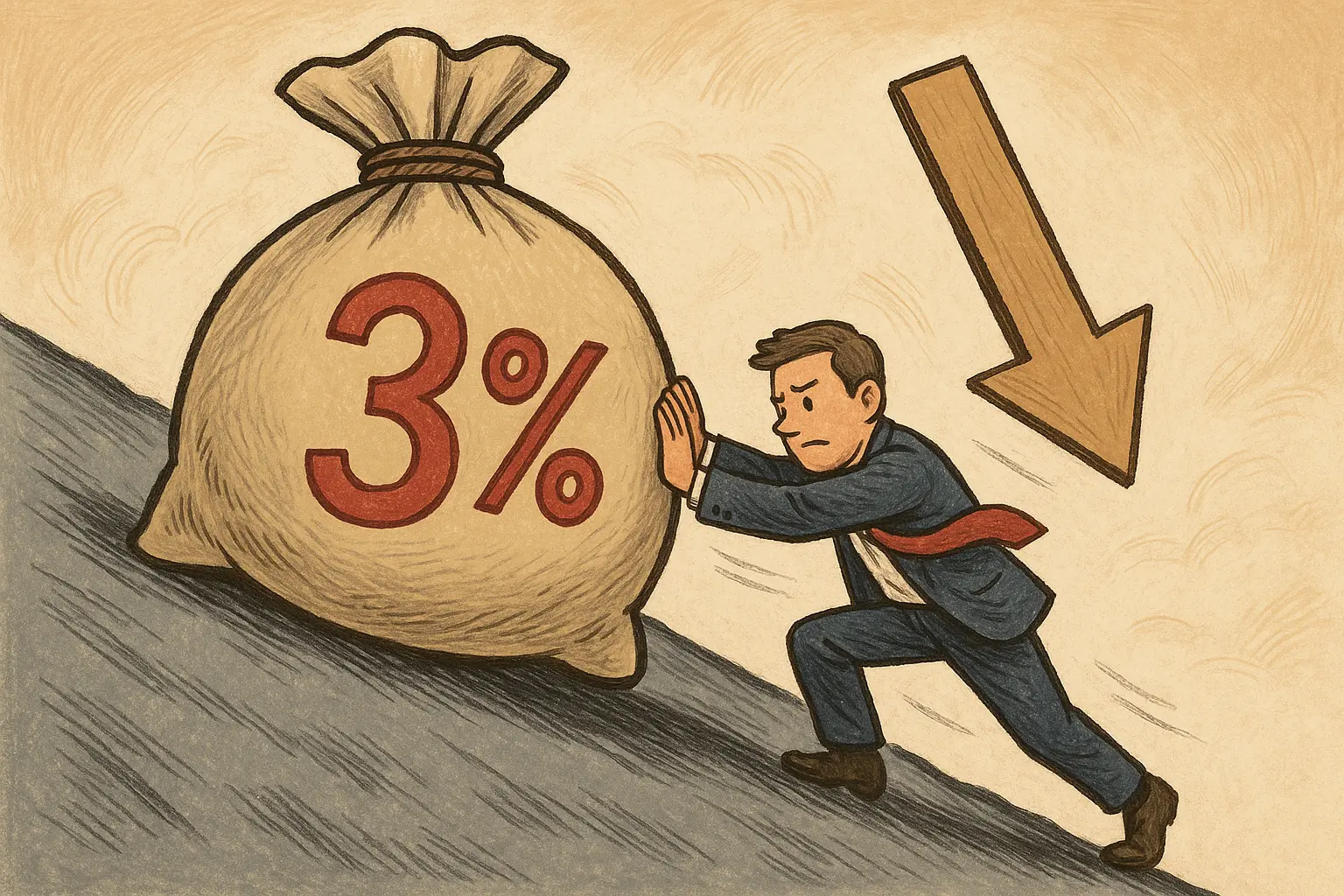
Cleveland Federal Reserve Chair Beth Hammack stated that the Federal Open Market Committee (FOMC) may pause further rate cuts as inflation remains too high. She warned that this year’s inflation rate could stay around 3%, and rates will not be adjusted again until it reaches the 2% target. Crypto traders have lowered their expectations for rate cuts, with Polymarket data showing expectations have shifted from three cuts to two.
Hammack’s Hawkish Stance: 3% Inflation as the Biggest Obstacle to Rate Cuts
During a speech at an event in Ohio, Federal Reserve Chair Beth Hammack said that, based on her forecast, rate cuts might be on hold for a period. She indicated that rather than trying to fine-tune the federal funds rate, she prefers to remain patient to assess the impact of recent rate cuts and closely monitor the economy. This “wait-and-see” approach is a typical hawkish stance, contrasting with market expectations for rapid rate reductions.
Hammack commented on the Fed’s dual mandate of employment and inflation, noting that the labor market currently appears roughly balanced. Meanwhile, inflation “still remains too high,” so the Fed should hold off on further rate cuts. The core of this judgment lies in inflation data. The current U.S. inflation rate is approximately 2.7-2.9%, significantly down from the peak of 9% in 2022, but still well above the Fed’s 2% target.
The Fed chair also warned that inflation could stay around 3% this year. This forecast is crucial because it suggests inflation has entered a “last mile” dilemma. Dropping from 9% to 3% is relatively easier, mainly through demand cooling and supply chain recovery. However, reducing from 3% to 2% is much more difficult and may require prolonged tightening or economic slowdown. If Hammack’s prediction is accurate and inflation remains at 3% throughout 2026, there will be very limited room for rate cuts.
She previously mentioned that before adjusting rates again, inflation must be brought down to the 2% target. This is a clear hawkish commitment, implying that unless inflation data unexpectedly drops rapidly, the likelihood of rate cuts in the first half of 2026 is very low. The Cleveland Fed president was among the members voting to keep rates unchanged at the January FOMC meeting.
She commented that they are currently in a favorable position to keep the federal funds rate at its current level and observe how things develop. Hammack estimates that the current federal funds rate is close to neutral, meaning it “does not exert substantial restraint on the economy.” The neutral rate is an important concept in economics, representing the interest rate level that neither stimulates nor restrains economic growth. If current rates are indeed near neutral, further rate cuts could risk overheating the economy and exacerbating inflation pressures.
Three Main Arguments for Hammack’s Hawkish Stance
- Persistent inflation: 3% inflation far above the 2% target, making rate cuts harder to achieve
- Balanced labor market: employment data shows no clear signs of weakness, no need for rate cuts to stimulate
- Rates near neutral: current rates are unlikely to overly suppress the economy, limiting room for cuts
This hawkish stance is highly unfavorable for the crypto market. Crypto assets are highly sensitive to liquidity; rate cuts lower borrowing costs and increase liquidity, typically pushing crypto prices higher. Conversely, maintaining high rates or delaying cuts suppresses liquidity, causing funds to flow from risk assets like cryptocurrencies into safe assets such as government bonds. When bond yields stay above 4%, why would investors risk highly volatile crypto investments?
Dallas Fed Chair Logan Joins the Hawkish Camp
Dallas Fed President Lori Logan also expressed similar views, stating she is not fully convinced that inflation will reach the 2% target. She believes the current policy stance is appropriate and that no further rate cuts are needed to achieve the dual mandate. Logan further noted that if the Fed sees inflation decline but the labor market cools further, then additional rate cuts would be appropriate. “But for now, I am more concerned about inflation remaining high,” she said.
It’s notable that Logan is also a voting member of the FOMC this year, giving her direct influence over rate decisions. The FOMC has 12 voting members, including 7 Fed governors and 5 regional Fed presidents (rotating votes). With two members (Hammack and Logan) explicitly hawkish, the chances of a rate cut at the March FOMC meeting are significantly reduced.
Logan’s comments reveal the internal policy priorities of the Fed. Among the dual mandates of inflation and employment, inflation currently poses a greater threat. Although recent data on unemployment claims and job openings (JOLTS) suggest the labor market may be softening, this slowdown has not yet reached a level requiring emergency rate cuts. Conversely, with inflation at 3%—well above the target—premature rate cuts could reignite inflation, undoing previous tightening efforts.
The shared hawkish stance of these two Fed leaders sends a clear message to the markets: don’t expect the Fed to adopt an easing stance before inflation is under control. This message has immediate effects on asset prices. Stocks declined after Hammack and Logan’s comments, and the crypto market also came under pressure. When investors realize “cheap money” won’t be coming soon, risk appetite naturally diminishes.
Polymarket Downgrades Expectations from 3 to 2 Rate Cuts: Market Repricing
As she made these remarks, crypto traders lowered their expectations for Fed rate cuts this year. Polymarket data shows that, despite Trump nominating former Fed governor Kevin Warsh as a candidate for Fed chair and hinting at rate cuts, traders now expect only two cuts instead of three. This downward revision reflects a reassessment of the Fed’s hawkish stance.
Polymarket, as a prediction market, reflects real capital bets on probability shifts. Moving from three to two cuts implies market participants believe at least one of the previously expected cuts will not happen. Assuming a standard 25 basis point (0.25%) cut per rate reduction, one fewer cut at year’s end means the federal funds rate will be roughly 0.25% higher than previously anticipated. Such a seemingly small difference can have a significant impact on rate-sensitive assets.
Trump’s nomination of Warsh and his hints at stimulating growth initially boosted expectations for rate cuts. However, Warsh cannot officially assume the chair until after Powell’s term ends in May 2026, and Senate confirmation is required. Until then, the Fed’s policy remains under Powell and current FOMC members’ control. Hammack and Logan’s hawkish signals strongly suggest that even if Trump favors rate cuts, the Fed will not cooperate before inflation is under control.
In terms of timing, if only two rate cuts occur in 2026, the most likely months are Q3 and Q4, each with one cut. This means rates will stay at the current high levels of 4.25-4.50% through the first half of the year. For crypto markets, this would mean a prolonged liquidity winter. Only when rate cuts actually begin and are confirmed by declining inflation data might crypto markets see a sustained rebound.
Wednesday’s Non-Farm Payrolls and Friday’s CPI: Key Data for the March FOMC
Therefore, the market’s focus will be on tomorrow’s January employment report. The forecast is 70,000 new jobs, with an unemployment rate of 4.4%. Additionally, the Consumer Price Index (CPI) inflation report will be released this Friday, which will influence the March FOMC decision.
The 70,000-job forecast is relatively weak. During normal economic growth, monthly job gains in the U.S. typically range from 150,000 to 250,000. A figure of 70,000 indicates the labor market is indeed cooling. If actual data falls below expectations—say, only 30,000 to 50,000 new jobs—it could trigger recession fears and force the Fed to reconsider the timing of rate cuts. Conversely, exceeding expectations with over 100,000 new jobs would support Hammack’s view of a balanced labor market, further reducing the need for rate cuts.
The 4.4% unemployment rate forecast is slightly above the current 4.2%. An increase in unemployment usually signals economic slowdown, but a rise from 4.2% to 4.4% is moderate and unlikely to trigger emergency rate cuts. Only if unemployment rapidly rises above 5% would the Fed see a severe deterioration in the labor market requiring rate easing.
The CPI data on Friday is even more critical. If January’s CPI year-over-year inflation rises from 2.9% to 3.1% or higher, it would confirm Hammack’s warning about persistent inflation, making a rate cut in March unlikely. Conversely, if inflation unexpectedly drops below 2.5%, it could give dovish policymakers room to maneuver, increasing expectations for rate cuts.
In trading terms, before and after the release of tomorrow’s non-farm payrolls and Friday’s CPI, crypto markets could experience significant volatility. Better-than-expected data (strong jobs, declining inflation) might temporarily boost crypto on rate cut hopes, but long-term pressures could remain if the Fed continues tightening. Conversely, worse-than-expected data could lead to short-term declines due to recession fears, but may also set the stage for future rate cuts.
Related Articles
Huatai Securities: The U.S. dollar and oil prices have outperformed expectations this year, and the degree of global liquidity easing has been lower than expected
A Haitong Securities research report says that the conflict in the Middle East has gone beyond short-term impacts, causing capital and supply disruptions. Even if the situation improves, the market’s allocation approach will be different from spring. It expects the U.S. dollar and oil prices to perform better than anticipated. It also calls for paying attention to shortages of goods and supply-chain risks, and maintaining a cautious attitude toward market volatility.
GateNews4h ago
Japan’s 10-year government bond yield rose to 2.400%, reaching a new high since February 1999
Gate News news, on April 6, local time April 6, the yield on 10-year newly issued Japanese government bonds, which is a benchmark for Japan’s long-term interest rates, briefly rose to 2.400%, the highest level since February 1999.
GateNews5h ago
Robert Kiyosaki warns of a “fake coin” crash, insisting Bitcoin is the safest asset for 2026
Robert Kiyosaki, in a recent post, said that Bitcoin and Ethereum could become the safest investments of 2026, because the United States continues to print money, debt is rising, and inflation is worsening. He criticized the safety of U.S. Treasuries as “the biggest lie,” and noted that real assets and cryptocurrencies can preserve wealth during inflation. His investment recommendations include holding Bitcoin, gold, silver, and commodities. Although some of his predictions weren’t accurate, some of his long-term predictions have come true.
MarketWhisper14h ago
OPEC+ expressed concern about attacks on energy facilities, emphasizing that repair costs are high and the process takes a long time
Gate News message: On April 5, OPEC+ held a committee meeting on Sunday, expressing concern about attacks on energy assets during the war between the U.S., Israel, and Iran. It said that the repair costs for the relevant facilities are high and will take a long time, which will affect overall supply capacity. The meeting statement emphasized that ensuring the safety of international sea lanes is crucial to keep energy flowing without interruption. The statement also noted that attacks on energy infrastructure are concerning and that restoring damaged energy assets back to full-load operation is both costly and time-consuming, thereby affecting overall supply capacity.
GateNews16h ago
World Gold Council: Central Banks in each country net purchased 19 tons of gold in February; China has increased its holdings for the 16th consecutive month
A World Gold Council report shows that in February 2026, central banks net bought 19 tons of gold, up from January but below the 2025 average. Some central banks have continued to accumulate gold; China has increased its holdings for 16 months. Goldman Sachs and UBS predict that the gold price could rise to $5,400 and $5,900, respectively, in the future.
GateNews19h ago
Economists expect the U.S. March CPI month-over-month rate to jump by more than 1%, the largest one-month increase since 2022.
Gate News message, April 5, economists said that the sudden jump in gasoline prices that American consumers can feel firsthand will be fully reflected in the key inflation data to be released this week. The U.S. is expected to see March CPI rise 1% month over month, which would be the largest monthly increase since 2022; core CPI could rise 0.3% month over month. Earlier, the Iran war pushed gasoline prices at U.S. gas stations up by about $1 per gallon. As a result, the Federal Reserve may find it difficult to carry out interest rate cuts this year.
GateNews04-05 01:16


