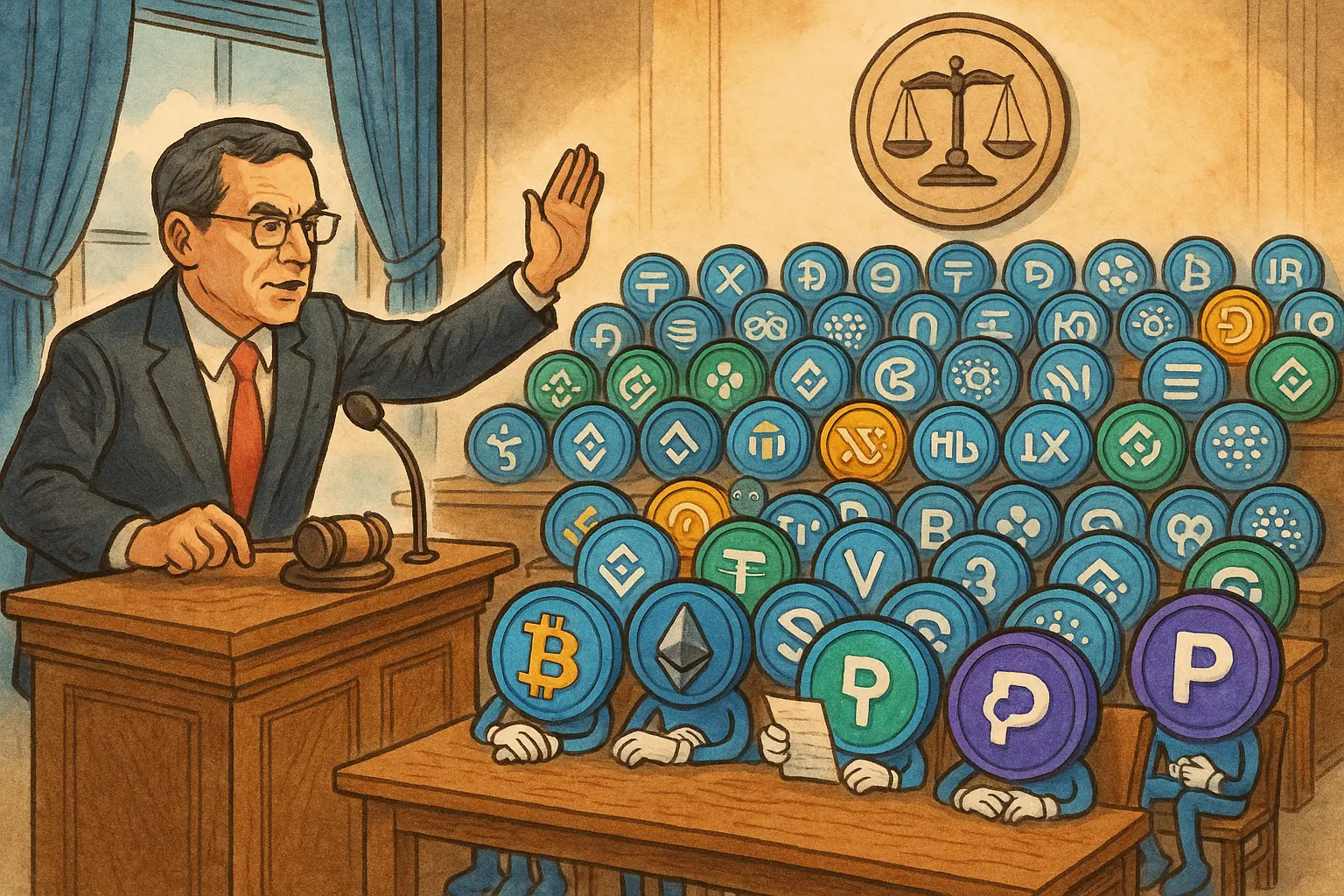
The CFTC Chair Michael Selig has appointed a 35-member advisory committee composed of senior executives from the cryptocurrency industry to provide guidance on the regulation of breakthrough technologies such as AI and blockchain. Market founder Polymarket’s Shayne Coplan is predicted to be among the appointees. Traditional financial giants including CME, DTCC, and Nasdaq representatives are also part of the committee.
The 35-Person Dream Team: An Unprecedented Gathering of the Crypto Industry
The U.S. Commodity Futures Trading Commission has appointed several senior executives from the cryptocurrency sector to a new Innovation Advisory Committee, which will offer opinions on how the commodity regulator should oversee disruptive technologies like artificial intelligence and blockchain in the markets. “Today marks the official establishment of the CFTC Innovation Advisory Committee, an important and exciting milestone,” said CFTC Chairman Michael Selig. “The work of the advisory committee will help ensure that CFTC’s decisions reflect market realities, enabling the agency to future-proof its markets and establish clear rules for America’s financial markets’ golden era.”
Among the 35 advisors, nearly all have direct ties to the crypto industry. This overwhelming representation of crypto indicates Selig’s emphasis on digital assets. During the Gensler era at the SEC, crypto representatives held very few seats on advisory committees, with most positions allocated to traditional finance and investor protection organizations. In contrast, Selig’s IAC is predominantly composed of native crypto professionals.
The committee includes representatives from major blockchain projects such as Vivek Raman of Etherealize, Anatoly Yakovenko of Solana Labs, Brad Garlinghouse of Ripple, Sergey Nazarov, CEO of Chainlink Labs, and Hayden Adams, CEO of Uniswap Labs. This “big collection of public chains” is extremely rare; Ethereum, Solana, and Ripple are among the top five market cap public chains, Chainlink is the largest oracle network, and Uniswap is the biggest decentralized exchange. These projects differ greatly in technical approach and business model, even competing directly, yet all are included in the same advisory committee.
Executives from centralized crypto exchanges like Bullish, as well as leaders from other trading platforms such as Bitnomial and Robinhood, are also listed. These five major exchanges account for a significant share of crypto trading in the U.S. and globally. Coinbase is the only U.S.-listed crypto exchange, with Bullish having a traditional finance background. Their participation ensures that the IAC’s recommendations are practically actionable.
Core Members of the 35-Person IAC
Public Chain Representatives: Ethereum, Solana, Ripple, Chainlink, and other infrastructure projects
Exchanges: Bullish and other market participants
DeFi Protocols: Uniswap and other decentralized finance applications
Prediction Markets: Polymarket, Kalshi, and other innovative financial products
Venture Capital: a16z, Paradigm, Framework, and other capital firms
Traditional Finance: CME, DTCC, Nasdaq, and other legacy giants
This cross-sector combination is highly strategic. It includes technical developers (public chains and protocols), business operators (exchanges and platforms), capital providers (VCs), and traditional finance voices. This diversity helps ensure that the IAC’s advice balances innovation with prudence, efficiency with security, crypto-native interests with traditional finance needs.
Founders of leading prediction markets, such as Polymarket’s Shayne Coplan and Kalshi’s Tarek Mansour, are also members. This appointment is highly symbolic because, as previously mentioned, SEC Chair Gensler recently characterized prediction markets as a “major problem.” Selig’s inclusion of these founders signals that the CFTC is adopting an “embrace and regulate” approach rather than suppression. This difference also reflects the fundamental divergence in regulatory philosophy between the CFTC and SEC.
Crypto venture investors like Chris Dixon of a16z crypto, Vance Spencer of Framework Ventures, and Alana Palmedo of Paradigm are also on the list, along with executives from traditional financial giants such as Cboe, CME, DTCC, Nasdaq, and options clearinghouses. The participation of VCs brings a capital perspective, while involvement from traditional finance ensures new rules remain aligned with existing systems.
Project Crypto and the Accelerated Modernization of Regulation
This move aligns with signals from the Selig-led CFTC, indicating that the government aims to establish a more relaxed regulatory environment for digital assets and promote financial innovations like prediction markets. The CFTC and SEC jointly launched “Project Crypto,” aiming to modernize cryptocurrency regulation. Such cross-agency cooperation was nearly impossible during Gensler and Behnam’s tenures, reflecting a unified regulatory front under the Trump administration.
“By bringing together participants from various market sectors, the IAC will be a valuable asset for the committee, helping us improve regulations to accommodate current and future innovations,” Selig said. This statement shows that the CFTC recognizes that regulation cannot be made behind closed doors and must incorporate industry voices. However, this “regulatory capture” also carries risks: when regulated entities become the rulemakers, rules may become overly lenient, potentially failing to adequately protect investors.
In terms of timing, the establishment of the IAC coincides with the March 1 deadline for the CLARITY Act, indicating that the CFTC is preparing to take over most crypto regulation. If the CLARITY Act passes, the CFTC will oversee the majority of cryptocurrencies (with the SEC retaining only securities tokens), and the advice from the IAC will directly influence future regulatory frameworks. This makes the perspectives and interests of IAC members critically important.
Regarding operational mechanisms, the IAC typically meets quarterly to discuss specific issues and submit recommendations to the CFTC. The CFTC is not obligated to adopt the IAC’s advice, but in practice, regulators tend to highly value advisory committee input. Becoming an IAC member effectively provides a direct channel to influence regulatory policy, offering a significant strategic advantage for participating companies and individuals.
Politically, Democrats might criticize the composition of the IAC as too industry-biased, lacking voices from investor protection groups and consumer advocates. If, after the 2026 midterm elections, Democrats regain control of Congress, they could push to reorganize or weaken the IAC. Therefore, the “golden window” for the IAC may only last a few months to a year, requiring rapid action to push key rules forward.
For the crypto industry, the establishment of the IAC is a major positive. It signifies that crypto is no longer merely a regulated target but a participant in rulemaking. This elevated status could clear many obstacles for industry growth. However, this influence also comes with responsibility: if the rules promoted by the IAC are too lax, leading to investor losses or market chaos, the crypto industry could face political and reputational repercussions.
From an investment perspective, companies and projects represented by IAC members may gain advantages under future regulatory frameworks. Their involvement in rulemaking and early insight into upcoming regulations can allow them to adjust business models and compliance strategies proactively. While this “information asymmetry” is legally compliant, it provides a competitive edge over others. Investors should pay close attention to developments involving IAC member companies.
Related Articles
Morgan Stanley: S&P 500 correction nearing its end, oil prices and the dollar's movement will determine the duration of volatility
Morgan Stanley Chief Investment Officer Michael Wilson stated that the S&P 500 correction is nearing its end, and profit growth and market breadth are expected to improve over the next 6-12 months. He believes that oil prices and the dollar's movement will influence market volatility, and short-term weakness could present buying opportunities, especially in the financial, industrial, and small-cap sectors.
GateNews54m ago
Oil prices rise to $119, reaching a new high since 2022, Bitcoin remains at $67,000, and the Federal Reserve has a 99% probability of maintaining interest rates in March.
On March 9th, WTI crude oil prices rose to $119 per barrel, reaching a new high since 2022. Due to threats from Iran, global crude oil supply losses approached 20 million barrels. Bitcoin remained at $67,000, with no signs of panic selling. The probability that the Federal Reserve will keep interest rates unchanged is approximately 99%.
GateNews1h ago
Wall Street Expert Warns of 35% Stock Crash Amid US-Iran War
Ed Yardeni predicts a 35% crash in U.S. and crypto stocks amid escalating tensions in the U.S.-Iran war, with rising oil prices and changing investor sentiment. Crypto firms are adjusting strategies as the economic outlook becomes more uncertain.
TheNewsCrypto2h ago
U.S. financial industry job openings drop to 13-year lows, with 92,000 jobs lost nationwide in February
According to data from the Federal Reserve Bank of St. Louis, by the end of 2025, job vacancies in the U.S. finance and insurance industry will drop to 134,000, a 13-year low, down 75% from 2022. Analysts warn that more layoffs may occur, while the U.S. Bureau of Labor Statistics reports that employment unexpectedly decreased in February, but financial activities defied the trend by adding 10,000 net jobs, which could influence the Federal Reserve's interest rate cut policy.
GateNews5h ago
Emphasize technological neutrality! The Federal Reserve: The capital recognition method for "tokenized securities" should follow that of traditional securities
The Federal Reserve and other agencies have issued new guidelines for the banking industry, requiring tokenized securities to follow the same regulatory capital standards as traditional securities, emphasizing that technological form does not affect the method of capital calculation. This reflects regulatory authorities' focus on the legal nature and risk assessment of financial assets, demonstrating the gradual integration of banks and blockchain finance, which helps banks evaluate the risks and costs of tokenization businesses.
区块客5h ago
Trump says oil prices will quickly fall back, but Bitcoin and the stock market have already been hit
On March 9th, as the "Epic Rage Action" escalated, the global energy markets experienced intense volatility, with oil prices soaring to $116 at one point, raising concerns about supply disruptions through the Strait of Hormuz. Trump predicted that oil prices would fall back, but gasoline prices have already risen to $3.45. The stock and cryptocurrency markets declined sharply, and investors should pay attention to the impact of geopolitical events on the markets and future monetary policies.
GateNews6h ago


