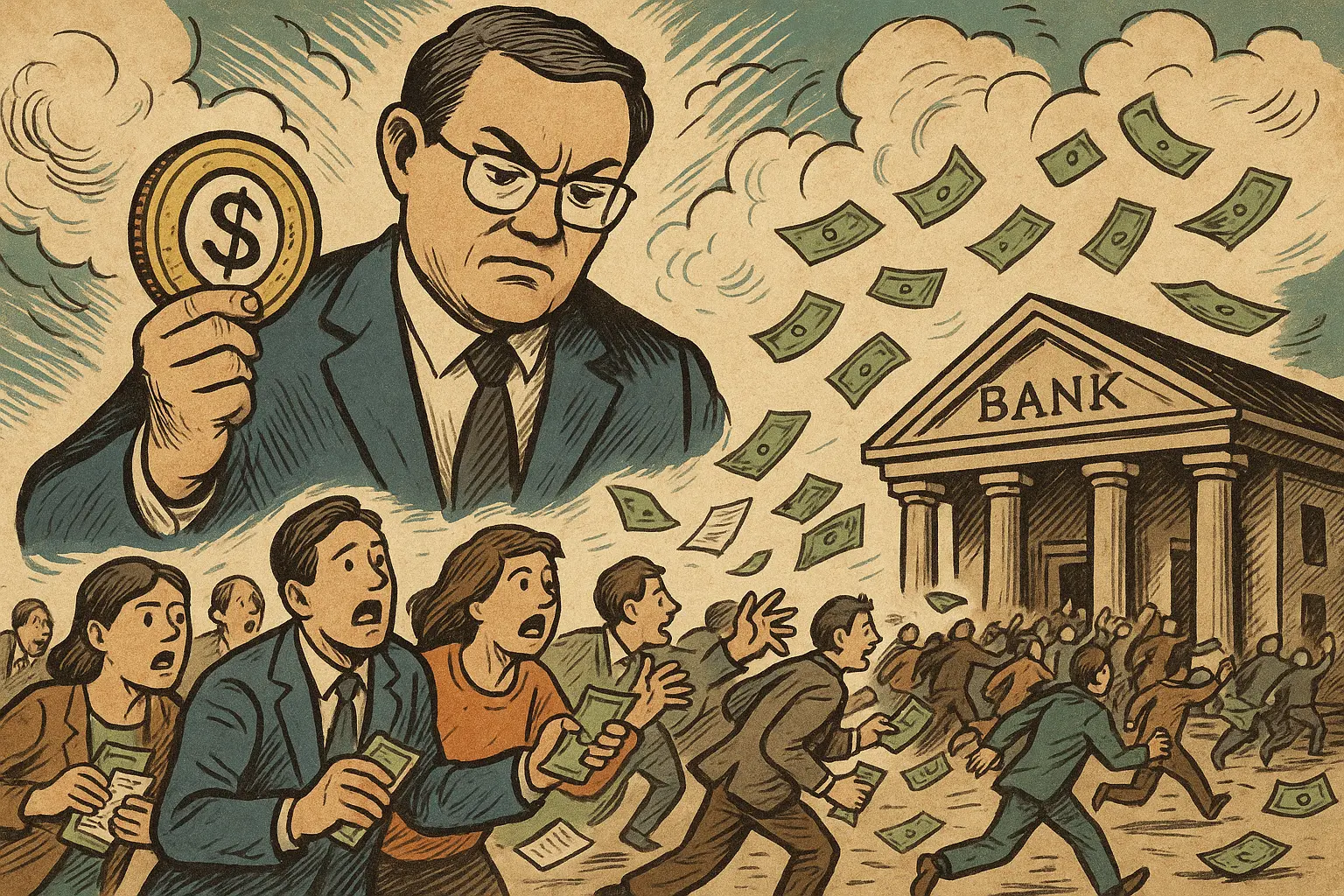
BIS (Bank for International Settlements) Director General Pablo Hernández de Cos warned on Monday at a conference in Japan hosted by the Bank of Japan that the global stablecoin market has surpassed $315.9 billion, but its operating mechanism is closer to investment products such as ETFs rather than genuine money. BIS said that once large-scale redemptions occur, it will trigger a chain-run effect similar to the one seen in 2023 at Silicon Valley Bank.
Highly concentrated market: USDT and USDC control 85% of the share
The stablecoin market structure is highly concentrated, with Tether (USDT) and Circle (USDC) together accounting for about 85% of circulating market share. USDT has a market value of about $186.0 billion, while USDC is about $78.8 billion. Pablo Hernández de Cos believes that this level of concentration reflects systemic importance and also highlights structural flaws in the way existing stablecoin arrangements function as payment instruments. While stablecoins offer advantages such as fast cross-border transfers and the ability to integrate with smart contracts, without an effective international regulatory framework, they will have a major impact on financial stability and monetary policy.
Redemption flaws and financial contagion risk: a run mechanism like SVB
The “redemption frictions” of stablecoins are the core risk point that BIS is most concerned about. In the primary market, issuers often set redemption fees or impose limiting conditions, and secondary-market prices frequently deviate from the $1 peg. As a result, during periods of stress, stablecoins cannot remain as stable as traditional fiat currencies. Once the market sees large-scale withdrawals, issuers are forced to sell reserve assets in an already pressured market. This not only transmits funding pressure into the banking system, but may also depress the prices of related assets, triggering chain effects on banks holding similar assets. To mitigate such risks, some policymakers are considering limiting interest paid on stablecoin holdings, or allowing regulated issuers to access central bank lending facilities or mechanisms similar to deposit insurance.
Fragmented regulation and loopholes for illegal financing
Regulatory progress worldwide is uneven. FSB Chair and Bank of England Governor Andrew Bailey said that the international rulemaking process has stalled. The U.S. “CLARITY Act” is currently under consideration in the Senate. While the issue of stablecoin yields has partially reached compromise, there are still disagreements over DeFi regulation and professional ethics standards. BIS specifically noted that stablecoin usage relies on non-custodial wallets and public blockchains, with a large share of activity lying outside traditional AML and CTF monitoring. Unless specialized safeguards are implemented in on-off ramps, it is easy for stablecoins to become tools for the flow of illicit funds.
European countries step up countermeasures against dollar stablecoins, fueling a battle over the fiat map
Against a backdrop of tightening regulation, European countries are actively adjusting their strategies. French Finance Minister Roland Lescure urged Europe’s banking sector to expand the issuance of euro-denominated stablecoins, and Denis Beau, Deputy Governor of the Banque de France, suggested revising MiCA rules to restrict the use of non-euro stablecoins in everyday payments. UBS launched a Swiss franc stablecoin pilot in early April 2026. Demand is also continuing to grow—according to a BVNK survey, among 15 countries, 54% of respondents held stablecoins in the past year, and 56% plan to increase their holdings. For some freelancers and e-commerce sellers, stablecoin payments have accounted for 35% of their annual revenue.
Frequently Asked Questions
Why does BIS say stablecoins are more like securities than money?
BIS pointed out that stablecoin issuers set redemption fees and impose limiting conditions in the primary market, and that secondary-market prices frequently deviate from the $1 peg. These features align more with the behavior of ETFs or investment products than with the unconditional convertibility that genuine money should have. Therefore, BIS believes they are more akin to securities in terms of regulatory classification.
Why can stablecoin redemption mechanisms create systemic risks similar to bank runs?
Stablecoin issuers typically hold short-term government bonds and bank deposits as reserves. Once large-scale redemption demand arises, issuers are forced to sell reserves in markets that are already under pressure. This not only pushes down the prices of related assets, but may also have ripple effects on banks holding similar assets—similar to the runs triggered in 2023 at Silicon Valley Bank, when bond asset losses forced it to sell.
What are the latest developments in global stablecoin regulation right now?
Regulatory progress is uneven: the U.S. “CLARITY Act” is still pending in the Senate, and there are disagreements over DeFi provisions; Europe’s MiCA framework faces pressure for revisions to limit non-euro stablecoins; the Bank of England’s governor said that international rulemaking has fallen into a stalemate; Swiss UBS has launched a fiat stablecoin pilot; China continues its ban on offshore yuan stablecoins, but Circle CEO predicts China may launch related products within 3 to 5 years.
Disclaimer: The information on this page may come from third parties and does not represent the views or opinions of Gate. The content displayed on this page is for reference only and does not constitute any financial, investment, or legal advice. Gate does not guarantee the accuracy or completeness of the information and shall not be liable for any losses arising from the use of this information. Virtual asset investments carry high risks and are subject to significant price volatility. You may lose all of your invested principal. Please fully understand the relevant risks and make prudent decisions based on your own financial situation and risk tolerance. For details, please refer to
Disclaimer.
Related Articles
White House Economic Adviser Hassett Envisions Rate Cuts Alongside Balance Sheet Reduction
Hassett says the Fed could cut rates while shrinking its balance sheet.
Gate News, April 22, quotes Hassett, director of the White House National Economic Council, who envisions the Federal Reserve cutting interest rates while reducing its balance sheet.
GateNews2h ago
USD Index Retreats 2.3% as Risk-Off Sentiment Fades and Rate-Cut Bets Intensify
Gate News message, April 22 — The U.S. dollar index has fallen approximately 2.3% from its March peak, marking its worst monthly performance since August 2025, as easing Middle East tensions reduce safe-haven demand and expectations for Federal Reserve rate cuts intensify.
Major financial
GateNews8h ago
Turkey's Central Bank Maintains Policy Rate at 37%
Gate News message, April 22 — Turkey's Central Bank held its policy rate, the one-week repo rate, steady at 37% on April 22. The overnight lending rate remained unchanged at 40%.
GateNews8h ago
71 of 103 Economists Expect Fed to Cut Rates at Least Once in 2026
Reuters survey finds 71 of 103 economists expect the Fed to cut rates at least once this year, signaling market bets on easing amid ongoing economic conditions.
Abstract: A Reuters poll of economists shows widespread expectation of at least one Federal Reserve rate cut this year, reflecting market pricing of potential monetary loosening amid persistent economic conditions.
GateNews10h ago
Trump Signals Openness: Consider a Currency Swap With the UAE, Extending “Wartime Dollar Diplomacy” Further
CNBC reported that Trump publicly said he would help if needed, considering establishing a currency swap channel with the UAE, marking the White House’s first public response on the issue. The UAE central bank governor visited the U.S. last week to raise the possibility, but the actual decision still rests with the U.S. Federal Reserve. Fighting in the Strait of Hormuz disrupts dollar liquidity; if it goes ahead, it would broaden the impact of dollar diplomacy and on crypto, stablecoins, and global inflation/exchange rates.
ChainNewsAbmedia13h ago
Bank of Korea Prioritizes CBDCs Under New Governor Shin, Maintains 2.5% Rate Amid Regional Uncertainty
Gate News message, April 22 — South Korea's central bank has entered a new monetary phase with newly appointed governor Shin Hyun-song placing central bank digital currencies (CBDCs) at the forefront of the country's financial system. In his inaugural address, Shin positioned CBDCs and bank-issued d
GateNews14h ago


