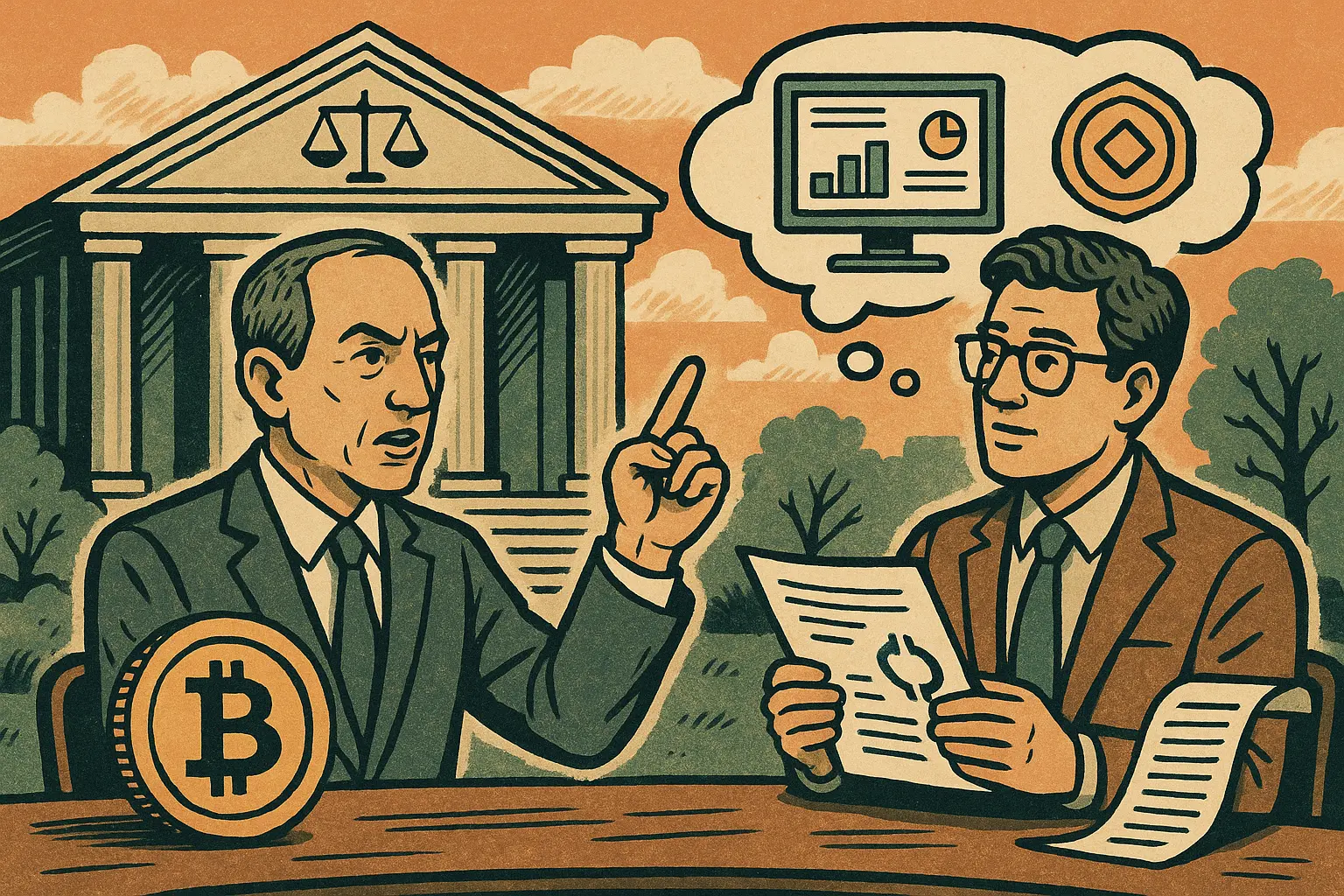
Fidelity Investments sent a letter to the U.S. Securities and Exchange Commission (SEC) on March 22, urging the agency to continue refining the regulatory framework for broker-dealers that offer, custody, and trade crypto assets on Alternative Trading Systems (ATS). The letter outlines three core demands: establishing comprehensive trading rules for tokenized securities, reforming reporting standards for decentralized finance (DeFi) platforms, and providing guidance on the application of distributed ledger technology.
Key Recommendations from Fidelity to the SEC: Three Core Demands
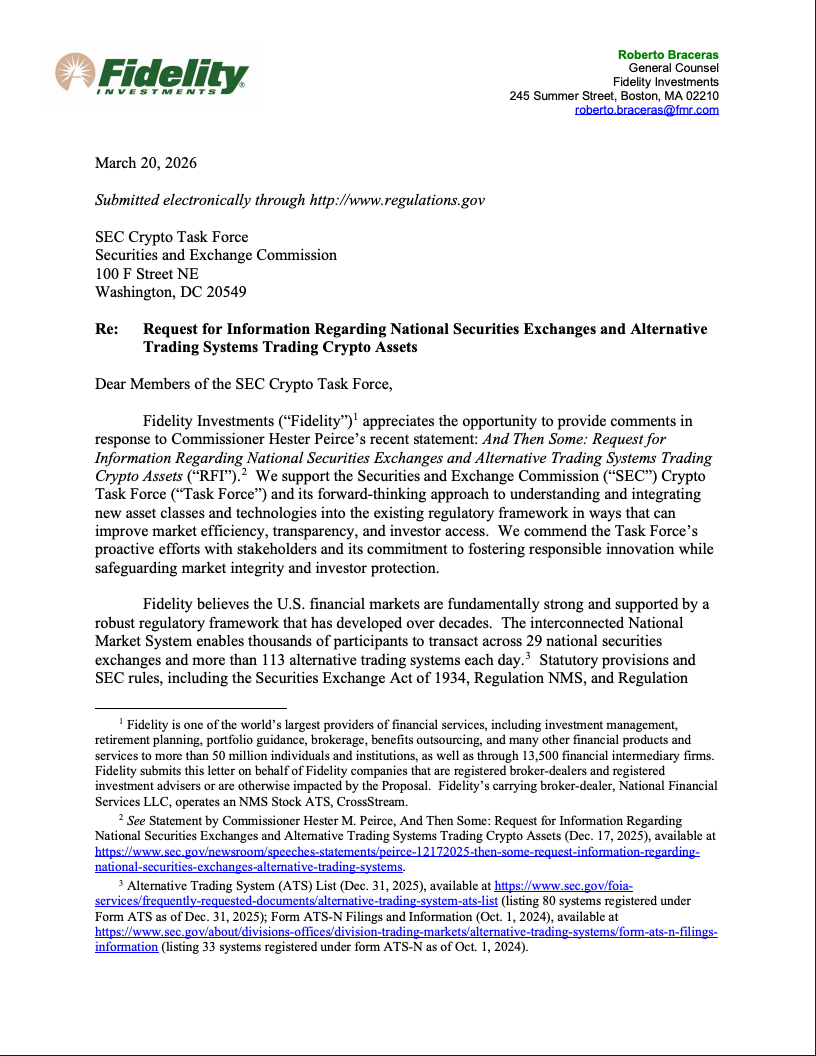 (Source: Fidelity)
Comprehensive Trading Rules for Tokenized Securities: Fidelity emphasizes the importance of establishing detailed trading regulations for tokenized securities, including those issued by third parties. The letter notes that tokenized tools differ significantly in issuance structure, legal validity, and valuation models—tokenized real-world assets (RWA) include stocks, real estate, bonds, and private credit, which are entirely different asset classes and cannot be regulated under a single set of rules.
Bridging the Regulatory Gap Between Centralized and Decentralized Systems: Fidelity urges the SEC to “consider how intermediary trading venues and non-intermediary trading venues develop and coexist,” and calls for a comprehensive overhaul of existing reporting rules to reflect the reality that DeFi trading platforms lack central authorities and are objectively unable to generate detailed financial reports as required by the SEC, thereby preventing the imposition of “undue burdens” on decentralized systems.
Guidelines for Distributed Ledger Technology (DLT) Applications: Fidelity recommends that the SEC issue clear guidance permitting broker-dealers to utilize DLT for ATS operations and recordkeeping, establishing a compliant pathway for institutional-grade blockchain applications.
Regulatory Challenges of Tokenization Tools: Legal Classification and Stakeholder Rights
Fidelity elaborates on the legal complexities surrounding tokenization tools. The letter distinguishes two main models: one, where crypto assets represent indirect ownership of underlying securities through security interests; and two, where crypto assets constitute securities swaps, which are typically only accessible to qualified contract participants.
This distinction directly impacts investors’ rights, trading feasibility, and regulatory classification. Fidelity points out that tokenization models “differ significantly” in structure and the rights granted to holders. If current regulations cannot effectively differentiate between these models, systemic gaps may arise in compliance obligations, capital requirements, and investor protections.
Current Policy Context: Recent Regulatory Positions
Fidelity’s letter echoes broader recent trends among regulators. SEC Chair Paul Atkins has repeatedly expressed support for 24/7 capital markets, approved several tokenized trading experiments by financial firms, and stated that the SEC’s interpretation of cryptocurrency laws “is just the beginning, not the end.”
Meanwhile, the Federal Reserve, FDIC, and OCC jointly issued a statement in March confirming that tokenized securities and their underlying assets should be subject to the same banking capital requirements, emphasizing that “the technology used for issuing and trading securities generally does not affect their capital treatment.” This statement establishes basic capital regulation standards for tokenized assets, but specific trading rules under the ATS framework remain undefined.
Frequently Asked Questions
Q: What specific actions does Fidelity’s letter call for from the SEC?
Fidelity urges the SEC to take action on three levels: establish comprehensive trading rules for tokenized securities (including RWAs); reform existing reporting requirements to reflect the realities of DeFi platforms; and issue guidance allowing broker-dealers to use DLT for ATS operations and recordkeeping.
Q: What is an Alternative Trading System (ATS), and why does crypto regulation require special rules?
An ATS is a trading venue that matches buyers and sellers but is not registered as a national securities exchange. As crypto assets and tokenized securities begin trading on such platforms, existing regulations are not clearly defined regarding their scope, leading to regulatory gaps in custody requirements, reporting obligations, and capital treatment.
Q: Why are DeFi platforms difficult to comply with SEC reporting requirements?
Traditional SEC reporting presumes a central managing entity. DeFi platforms, with their decentralized architecture, lack a single legal entity responsible for operations, making it objectively impossible to generate detailed financial reports as required by the SEC. Fidelity calls on the SEC to recognize this technological reality and develop differentiated compliance pathways for decentralized systems.
Disclaimer: The information on this page may come from third parties and does not represent the views or opinions of Gate. The content displayed on this page is for reference only and does not constitute any financial, investment, or legal advice. Gate does not guarantee the accuracy or completeness of the information and shall not be liable for any losses arising from the use of this information. Virtual asset investments carry high risks and are subject to significant price volatility. You may lose all of your invested principal. Please fully understand the relevant risks and make prudent decisions based on your own financial situation and risk tolerance. For details, please refer to
Disclaimer.
Related Articles
BTC 15-minute rise of 0.86%: A rebound driven by a convergence of short liquidations and inflows into ETFs
2026-04-13 13:45 to 2026-04-13 14:00 (UTC), the BTC price fluctuated within the 70945.9 to 71699.9 USDT range. Within 15 minutes, it recorded a notable gain of +0.86%, with a swing of 1.06%. Market attention has surged, short-term volatility has clearly intensified, and on-chain large transfers, spot, and derivatives trading volumes have expanded in sync, indicating that the activity level of funds by major players is at one of the highest points of the year.
The main driving force behind this anomaly is that BTC has been probing the 72000–73500 USDT range with a large amount of leverage shorts
GateNews1h ago
Korea’s central bank: Cryptocurrency trading should introduce a “circuit breaker” mechanism; CBDC should be the digital core
The Bank of Korea recommends introducing a circuit breaker mechanism in the crypto-asset industry to prevent abnormal trading, and points out that the Bithumb mistaken payment incident reveals a structural vulnerability. The governor nominee, Hyun-sung Shin, emphasizes that CBDCs and deposit tokens should be the core of digital currencies, and proposes a phased opening strategy for stablecoins. The Bank of Korea also plans to launch an offshore KRW system with real-time gross settlement in 2027 to reduce credit risk.
MarketWhisper9h ago
CryptoQuant Analyst: In March, the U.S. CPI month-over-month increase hit a record high; if the U.S.-Iran conflict continues or forces the Federal Reserve to raise interest rates
CryptoQuant analyst Darkfost noted that although March CPI recorded the largest month-over-month increase, core CPI remained stable, indicating that U.S. inflation has not fully spread yet. Attention should be paid to upcoming PCE data. If the Iran-Iraq conflict continues, inflation could evolve into a systemic risk and affect economic growth, and the Federal Reserve may need to continue raising rates to respond.
GateNews04-12 10:00
Hassett: The Strait of Hormuz could be opened within two months, and the Federal Reserve still has room to cut rates
Gate News message: On April 10, U.S. National Economic Council Director of the White House, Hassett, said the Strait of Hormuz could be reopened within two months. In addition, Hassett said the Federal Reserve still has room to cut interest rates, and this outlook will be very solid.
GateNews04-10 13:25
Reuters: The market is pricing in expectations that the U.S. Federal Reserve will keep interest rates unchanged throughout 2026
Gate News, April 10, according to Reuters, the market continues to price in expectations that the Federal Reserve will keep interest rates unchanged throughout 2026.
GateNews04-10 13:06
CME Data: The probability that the Federal Reserve will keep interest rates unchanged in April is 98.4%
Gate News message: On April 10, according to CME "FedWatch" data, before the CPI data is released, the probability that the Federal Reserve will raise rates by 25 basis points in April is 1.6%, while the probability of keeping rates unchanged is 98.4%. Looking ahead to June, the probability of cumulative rate cuts of 25 basis points is 1.5%, the probability of keeping rates unchanged is 96.8%, and the probability of cumulative rate hikes of 25 basis points is 1.7%.
GateNews04-10 12:31


