Even when the DGFIP, France’s tax watchdog, has no way to verify the data submitted, the French National Assembly passed an article establishing that contributors should disclose funds over 5,000 € held in self-custody, affecting wallets like Metamask, Phantom, and even Ledger.
Key Takeaways:
- The French National Assembly passed a bill forcing users to report self-hosted wallets holding over €5,000.
- The DGFIP warns that tracking data for these wallets makes users prime targets for hackers.
- Gregory Raymond predicts that this rule will probably fail, as the government is hostile towards it.
France Surprises With Self-Custody Wallet Disclosure Article In Anti-Fraud Law
European countries, including France, are moving to exert more control over the cryptocurrency funds held in self-custody.
According to Gregory Raymond, co-founder of The Big Whale, the French National Assembly passed an article establishing that funds held in self-hosted wallets, meaning that they are not connected to any public institution, should be disclosed to the DGFIP, France’s national tax watchdog, when they account for over 5,000 € ($5,847 at the time of writing).
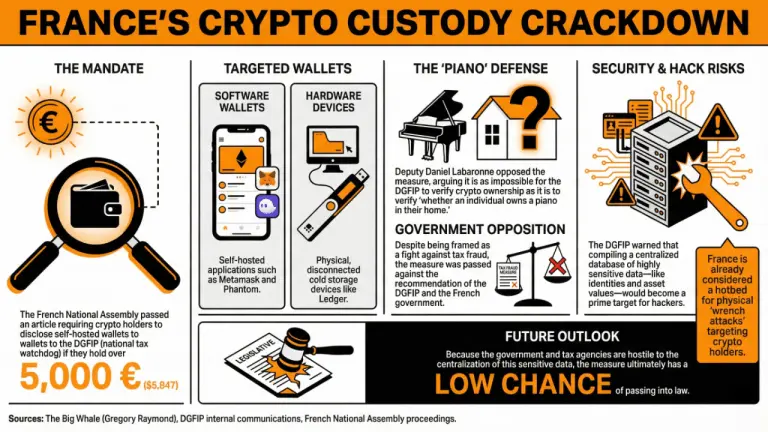
Deputy Daniel Labaronne opposed the inclusion of this article in the law, arguing it would be impossible for the DGFIP to ascertain the ownership of these assets. “Likewise, how could it verify whether an individual owns a piano in their home?” he asked. Nonetheless, the motion to suppress the article was defeated.
The measure, framed as another move to fight tax fraud, was taken against the DGFIP and the French government recommendation, as the agency acknowledged that it had no tools to verify the data provided by contributors.
The DGFIP warned about the effects of such a measure on the security of French citizens, as the country is a hotbed for wrench attacks targeting crypto holders. In an email, the agency stated:
“It should be noted that a generalized declaration of these portfolios would lead to the centralization of highly sensitive data, such as the identities of the holders and the value of their assets.”
In this regard, it was ratified that “in a context of frequent cyberattacks against large databases, this information would become a prime target for hackers, entailing heightened risks of fraud.”
If finally passed, all funds held in wallets like Metamask, Phantom, and even in hardware devices like Ledger wallets will have to be disclosed by crypto holders. Nonetheless, Raymond stressed that the measure has a low chance of passing as is, as the government is hostile to it.
Disclaimer: The information on this page may come from third parties and does not represent the views or opinions of Gate. The content displayed on this page is for reference only and does not constitute any financial, investment, or legal advice. Gate does not guarantee the accuracy or completeness of the information and shall not be liable for any losses arising from the use of this information. Virtual asset investments carry high risks and are subject to significant price volatility. You may lose all of your invested principal. Please fully understand the relevant risks and make prudent decisions based on your own financial situation and risk tolerance. For details, please refer to
Disclaimer.
Related Articles
Bitcoin Core Developers Propose BIP-361 to Freeze 1.7M Early BTC Against Quantum Computing Threats
BIP-361, proposed by co-authors including Jameson Lopp, aims to secure early Bitcoin by migrating 1.7 million coins from weak P2PK addresses to stronger formats, allowing 3-5 years for users before freezing untransferred coins. Community responses vary significantly.
GateNews53m ago
U.S. Tax Day: Bitcoin Daily Payments Involve Hundreds of Pages of Filing Documents
A report from the Cato Institute states that the United States requires reporting capital gains tax for every Bitcoin transaction, which would increase the reporting burden. The report recommends either eliminating the capital gains tax or raising the exemption threshold in the “Virtual Currency Tax Fairness Act” to about $80k to ease the tax burden on small transactions.
MarketWhisper3h ago
Gate Daily Report (April 16): Tether may have purchased 951 BTC; Virginia enacts crypto property law
Bitcoin continues to rise, reaching $74,630. Tether uses its profits to buy 951 bitcoins. Virginia passes an unclaimed property law, requiring idle cryptocurrency to be transferred to the state government. U.S. stocks are driven by tech stocks, and the S&P 500 index hits a new high. Crypto market dynamics show that investors are paying attention to geopolitical conditions and U.S. monetary policy.
MarketWhisper4h ago
Kalshi Launches Parental Portal and AI Verification to Combat Underage Misuse of Prediction Market
Kalshi is introducing a parental portal for identity verification and selfie authentication to prevent minors from bypassing age restrictions. This follows scrutiny over its compliance with prediction market regulations amid ongoing lawsuits.
GateNews4h ago
Pakistan Lifts an Eight-Year Ban: Central Bank Allows Banks to Serve Crypto Businesses, and the Virtual Assets Law Takes Effect
On April 14, 2026, the State Bank of Pakistan lifted its crypto-assets banking ban that has been in place since 2018, officially kicking off the Virtual Assets Act 2026. Banks may open accounts for licensed virtual asset service providers, but must establish a segregation-of-funds mechanism to ensure that customers’ funds are not affected. This policy change responds to domestic demand and demonstrates Pakistan’s growing role on the international stage.
ChainNewsAbmedia14h ago
The central bank issues a digital currency report—does it directly refute Qu Bo? If Taiwan issues a CBDC, merchants generally cannot refuse to accept it
The central bank released a report stating that Taiwan’s CBDC development will follow a phased promotion strategy. In the short term, it is not urgent to issue retail CBDC; the focus is on wholesale CBDC and the infrastructure for asset tokenization. The central bank emphasized that CBDC will not increase the money supply and will have legal standing. As a rule, merchants may not refuse to accept it, in order to prevent the payment market from becoming overly dependent on the private sector.
ChainNewsAbmedia16h ago


