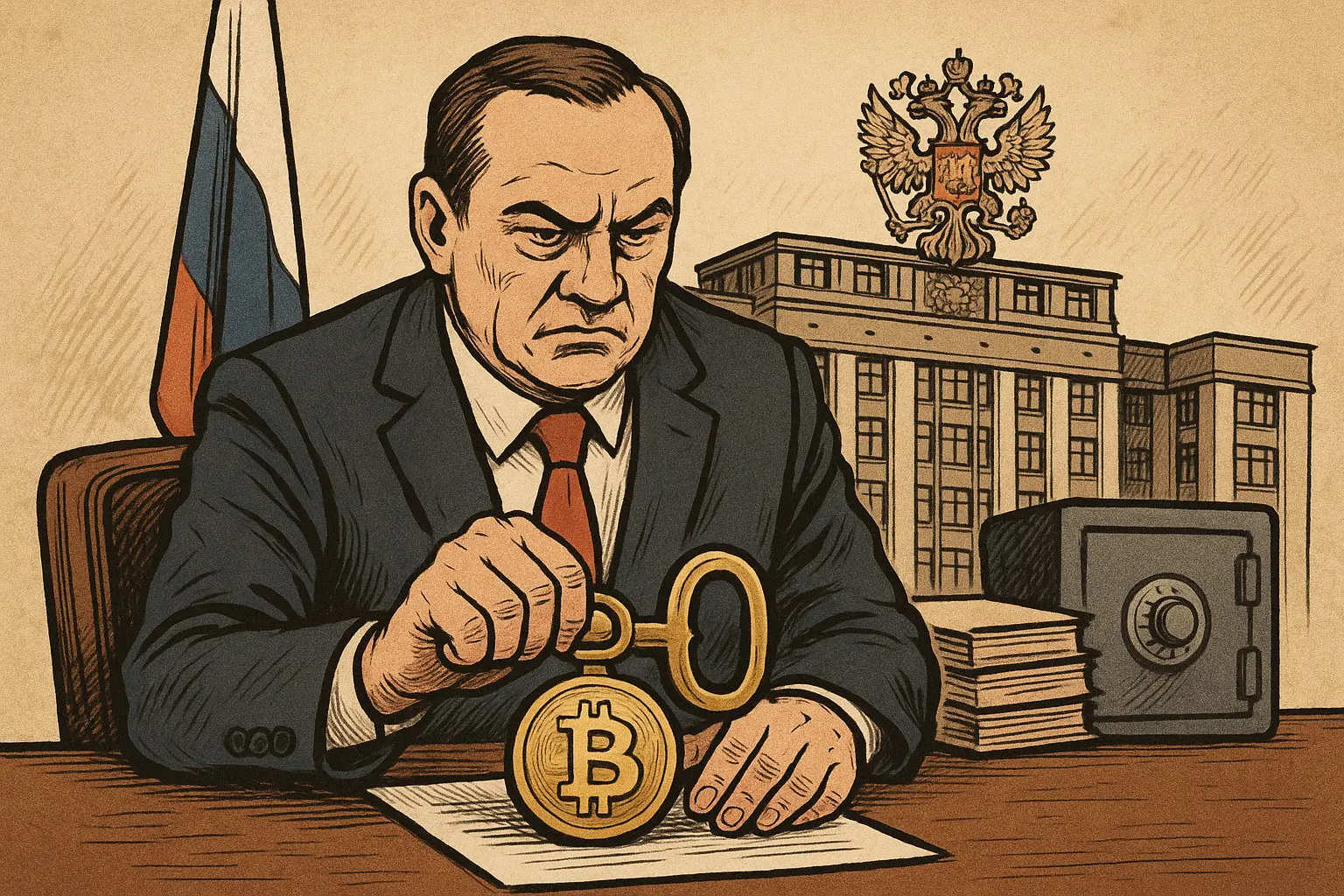
The State Duma of Russia passed in its first reading the bill “On Digital Currencies and Digital Rights” on April 22, with 327 deputies voting in favor. Once the bill officially takes effect, cryptocurrencies will be legalized in Russia, allowing ordinary Russian citizens to legally buy digital assets through licensed intermediary institutions. The Bank of Russia (CBR) will become the primary regulator, responsible for issuing licenses and approving or banning crypto transactions.
Central bank-led market access: gatekeeper role and licensing system
The CBR will serve as the key gatekeeper for the entire regulated crypto market, overseeing licensing for market participants (including intermediary institutions, exchanges, brokers, banks, and custodial institutions). The CBR has the authority to prohibit non-credit institutions from using specific cryptocurrencies for trading and ultimately determine the legality of crypto transactions.
Permitted cross-border foreign trade use cases include: settlement payments for securities transfers, digital royalty fees, labor compensation, service fees, and transfers of information and intellectual property rights—aimed at helping Russian companies perform international settlement in a Western sanctions environment.
Investor classification and access thresholds: roughly $4,000 for non-accredited investors’ tenure
Accredited investors and non-accredited investors will face different rules. Non-accredited investors (i.e., ordinary retail investors) must pass a test before they can access cryptocurrencies, and there is an annual purchase limit. The limit proposed by the Bank of Russia is 300k rubles (about $4,000 at the current exchange rate), but the exact figure is still subject to final confirmation.
Which cryptocurrencies may be the first to enter Russia’s whitelist
The bill sets strict listing thresholds; candidate assets must meet three conditions at the same time: average market capitalization over the past two years exceeding 5 trillion rubles; average daily trading volume over the same period exceeding 1 trillion rubles; and at least five years of trading history.
Based on the above criteria, the cryptocurrencies that currently meet the conditions may only include a handful of major assets such as Bitcoin (BTC), Ethereum (ETH), Solana (SOL), Binance Coin (BNB), and TRON (TRON). The bill also introduces criminal liability for illegal use of cryptocurrencies: a maximum fine of 1 million rubles (about $8B) and a maximum prison sentence of 7 years.
Voices of criticism: too-tight regulation may push the market back into the gray zone
Before the bill’s first reading, it had already undergone review by two parliamentary committees, both of which proposed amendment recommendations. The National Duma Competition Protection Committee warned that overly strict regulation could cause many Russian citizens and businesses to continue staying in the gray economy environment—thereby deviating from the bill’s original intent to help the crypto industry move out of the gray zone. The Financial Markets Committee called for ensuring judicial protection for holders of cryptocurrencies, including holders of non-custodial wallets, whether or not they have already reported to the Federal Tax Service.
Frequently asked questions
What is the most direct impact of Russia’s crypto bill on ordinary investors?
Once the bill takes effect, ordinary Russian citizens (non-accredited investors) can legally buy cryptocurrencies through licensed intermediaries, but they must pass a test, and their annual purchase limit will not exceed 300k rubles (about $4,000). This means they cannot hold or trade crypto assets without restrictions the way accredited investors can.
Why does the bill allow cryptocurrencies for cross-border foreign trade but ban them for domestic payments?
The two provisions serve different policy goals. Authorization for cross-border foreign trade is mainly intended to help Russian companies perform international settlement by bypassing traditional financial channels under Western sanctions. Meanwhile, banning domestic payments aims to protect the ruble’s status as legal tender and prevent cryptocurrencies from replacing the domestic currency.
Can cryptocurrencies such as Bitcoin be the first to enter Russia’s regulated whitelist?
Based on the thresholds set by the bill (market cap over 5 trillion rubles, average daily trading volume over 1 trillion rubles, and at least 5 years of trading history), the cryptocurrencies most likely to meet the conditions currently include Bitcoin (BTC), Ethereum (ETH), Solana (SOL), Binance Coin (BNB), and TRON. The Bank of Russia will ultimately decide the specific names on the whitelist.
Disclaimer: The information on this page may come from third parties and does not represent the views or opinions of Gate. The content displayed on this page is for reference only and does not constitute any financial, investment, or legal advice. Gate does not guarantee the accuracy or completeness of the information and shall not be liable for any losses arising from the use of this information. Virtual asset investments carry high risks and are subject to significant price volatility. You may lose all of your invested principal. Please fully understand the relevant risks and make prudent decisions based on your own financial situation and risk tolerance. For details, please refer to
Disclaimer.
Related Articles
U.S. Navy admiral: Bitcoin has become a tool for America’s “power projection,” and cyber security should have major scientific significance
U.S. Navy Admiral Samuel Paparo said Tuesday at a hearing of the Senate Armed Services Committee that Bitcoin, as a means of power projection, is “a very valuable computer science tool,” and he noted that Bitcoin’s Proof of Work (PoW) technology “imposes greater costs on attackers trying to breach networks,” adding that its cybersecurity applications have “very important” computer science significance.
MarketWhisper41m ago
Ripple CEO praises SEC’s new direction, and U.S. crypto regulation enters a reset mode
Ripple CEO Brad Garlinghouse publicly praised the regulatory shift driven by the newly appointed Securities and Exchange Commission (SEC) chair, Paul Atkins, on April 20, describing it as “a refreshing breath of sanity that helps people regain their composure.” Garlinghouse viewed the SEC’s policy pivot as the key driver behind an improvement in sentiment across the U.S. crypto market.
MarketWhisper1h ago
U.S. House Introduces PACE Act to Grant Qualified Digital Asset Firms Direct Access to Federal Reserve Payment System
The PACE Act would let qualified digital asset and fintech firms access the Fed's payment system, aiming to cut delays and costs through direct Fed access, with regulatory safeguards and consumer protections.
Abstract: The U.S. House introduced the Payments Access and Consumer Efficiency (PACE) Act to allow qualified digital asset, fintech, and other service providers to connect directly to the Federal Reserve's payment system. The bipartisan bill, by Reps. Young Kim and Sam Redo, aims to cut delays and fees by enabling direct Fed access under OCC oversight, with streamlined registration, consumer protections, supervisory enforcement, and bankruptcy provisions. Industry advocates argue that direct access would foster faster, cheaper, and more competitive payment services while maintaining safeguards for innovation.
GateNews2h ago
Singapore MAS Releases Guidance to Optimize Crypto Asset Capital Requirements for Public Blockchains
Gate News message, April 22 — Singapore's Monetary Authority (MAS) has released a consultation paper to establish more favorable regulatory capital guidance for crypto assets on permissionless blockchains (public blockchains) ahead of implementing
GateNews2h ago
China Strengthens Oversight of Token Trading, Cracks Down on Speculation and Illicit Activities
Gate News message, April 22 — China's Economic Daily published an article highlighting the need to regulate token trading and combat illegal activities. The report warns that tokens face risks including identity theft from leaks, permission forgery, and unauthorized commission schemes by bad
GateNews3h ago
Russia's Parliament Passes First Reading of Crypto Bill, Central Bank to Control Market Access
Gate News message, April 22 — Russia's State Duma passed the first reading of a bill on digital currencies and digital rights, paving the way for cryptocurrency legalization in the country. The Russian Central Bank will serve as the primary regulator, responsible for issuing licenses, approving or p
GateNews3h ago


