
FDIC Chair States Stablecoins Not Covered by Deposit Insurance, “GENIUS Act” Clarifies Banking Deposit Boundaries, and Discusses Banning Pass-Through Insurance, Sparking Interest and Regulatory Debates.
FDIC Chair Clarifies Regulatory Stance: Stablecoins Not Included in Deposit Insurance System
The Chairman of the U.S. Federal Deposit Insurance Corporation (FDIC), Travis Hill, recently stated that under the current implementation of the “GENIUS Act,” funds held by stablecoin holders will not be protected by government deposit insurance. This statement has reignited market discussions on stablecoin regulation and revenue models. Hill noted at the American Bankers Association (ABA) Summit in Washington that payment-type stablecoins are legally distinguished from bank deposits, and therefore do not fall under FDIC deposit insurance. Currently, U.S. bank deposits are insured up to $250,000, but stablecoins are not covered by this system.
He also revealed that FDIC is planning to propose new regulations to explicitly prohibit the use of “pass-through insurance” mechanisms for stablecoin arrangements. This mechanism originally allowed financial institutions to obtain deposit insurance on behalf of clients, but it will not apply under stablecoin frameworks.
Hill stated that while the “GENIUS Act” does not explicitly ban stablecoins outright, its legislative intent indicates that stablecoins should not be regarded as extensions of bank deposits, and regulators are inclined toward a restrictive interpretation.
Separating Stablecoins from Bank Deposits to Prevent Market Confusion
The “GENIUS Act” is the first comprehensive regulatory framework for payment-type stablecoins in the U.S. It requires stablecoin issuers to maintain 100% reserves to ensure tokens can be exchanged 1:1 for USD. Despite the full reserve requirement, regulators emphasize that stablecoins and bank deposits have different legal statuses. Hill pointed out that stablecoin reserves are usually held in bank accounts, but deposit insurance only covers the issuing company’s accounts, not the stablecoin holders’ assets.
Allowing pass-through insurance would mean that if a bank fails, FDIC would provide coverage based on each stablecoin holder’s proportion of assets, rather than the insurance limit applied to corporate accounts. Hill explained that such a mechanism would be difficult to implement in large stablecoin networks because regulations require clear identification of all ultimate customers and their holdings. Most current stablecoin structures lack this level of transparency. Therefore, regulators prefer to maintain clear boundaries between stablecoins and bank deposits to prevent market misconceptions that stablecoins are government-insured.
Stablecoin Yields and Competition with Banks Spark Fierce Financial Industry Debate
Another key issue in stablecoin regulation is whether stablecoins should be allowed to offer interest or yields. Banking industry representatives worry that if stablecoins can provide interest, large amounts of capital might shift from bank deposits to stablecoin markets, potentially impacting banks’ lending capacity and deposit base. Some analyses suggest that if the stablecoin market continues to grow, it could lead to a 3% to 5% decline in core bank deposits over the next five years.
Earlier this year, the American Bankers Association proposed regulatory measures to prohibit payment-type stablecoins from offering interest or yields, aiming to prevent them from becoming substitutes for bank deposits. However, some policymakers believe that overly restricting stablecoins could hinder financial innovation.
White House crypto advisor Patrick Witt recently stated on social platforms that relevant regulations should promote innovation and not turn into tools that hinder technological development due to industry competition.
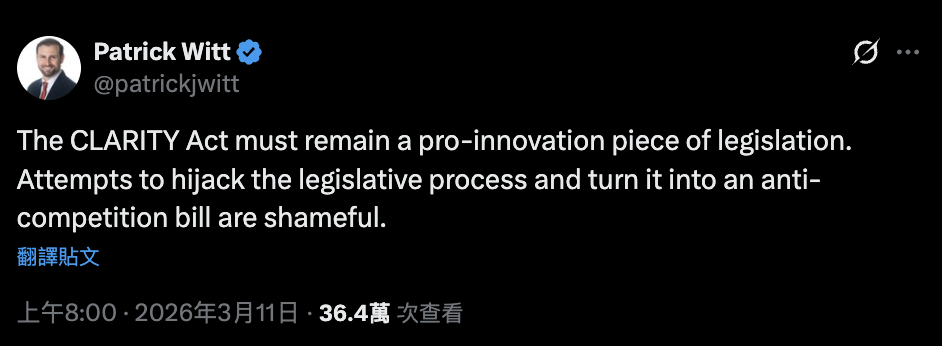
Image source: X/@patrickjwitt White House crypto advisor Patrick Witt states that relevant regulations should promote innovation and not turn into tools that hinder technological development due to industry competition.
Tokenized Deposits as Another Regulatory Topic, Banks May Receive Different Treatment
In addition to stablecoins, regulators are also discussing the legal classification of “tokenized deposits.”
Hill indicated that if banks convert traditional deposits into programmable tokens on the blockchain, they are still fundamentally bank deposits and should be subject to the same regulation and insurance systems. This means that tokenized deposits issued by banks could still be eligible for FDIC deposit insurance, whereas stablecoins are viewed as a different type of digital asset.
The “GENIUS Act” has established a basic regulatory framework for payment-type stablecoins, but detailed rules are still to be developed by FDIC, the Treasury Department, and other agencies. The law is expected to be fully implemented within approximately 18 months after signing. As regulatory policies become clearer, the distinctions between stablecoins, bank deposits, and tokenized assets are becoming key issues in the ongoing transformation of the global financial system.
This content is summarized by Crypto Agent from various sources, reviewed and edited by “Crypto City.” It is still in training and may contain logical biases or inaccuracies. The information is for reference only and should not be considered investment advice.
Disclaimer: The information on this page may come from third parties and does not represent the views or opinions of Gate. The content displayed on this page is for reference only and does not constitute any financial, investment, or legal advice. Gate does not guarantee the accuracy or completeness of the information and shall not be liable for any losses arising from the use of this information. Virtual asset investments carry high risks and are subject to significant price volatility. You may lose all of your invested principal. Please fully understand the relevant risks and make prudent decisions based on your own financial situation and risk tolerance. For details, please refer to
Disclaimer.
Related Articles
Hong Kong SFC issues two tokenized offering circulars on the same day (26EC22 / 26EC23): Full breakdown of VATP secondary trading and primary subscription and redemption rules
The Hong Kong Securities and Futures Commission will issue two guidance circulars for tokenized products in 2026, covering primary-market subscription and redemption and secondary-market trading requirements, respectively. The circulars will clearly define the responsibilities of product providers, liquidity requirements, and fair pricing mechanisms. The new regulatory framework will affect how the industry operates and will create new business opportunities for compliance lawyers, forming a template for tokenized finance regulation in the Asia-Pacific region.
ChainNewsAbmedia17m ago
Hong Kong SFC prepares the world’s first tokenized assets trading framework for VATP: money market funds to lead the way, gradually expanding to all authorized products
The Hong Kong Securities and Futures Commission will publish a framework in April 2026 that will allow licensed virtual asset trading platforms to conduct secondary-market transactions of tokenized assets, with the first batch including money market funds and future expansion to stocks, bonds, and more. This will make Hong Kong the first market to use Web3 infrastructure, and it will advance in step with the regulatory technology “CrypTech” to establish a regulatory template for tokenized finance. The move is intended to secure Hong Kong’s position as an Asia-Pacific digital-asset hub and to create competitive pressure on Taiwan-based industry players.
ChainNewsAbmedia46m ago
BIS calls for globally coordinated stablecoin regulation: warns that Tether and Circle account for 85% of those showing “security-like characteristics”
The Bank for International Settlements (BIS) once again emphasized the importance of global stablecoin regulatory coordination, pointing out three major risks that stablecoins face at this stage, including regulatory challenges related to cross-border flows and issues with market concentration. BIS proposed a unified ledger framework and argued that central banks need to lead the development of digital currencies, which would pose challenges to existing stablecoin issuers such as Tether and Circle. Overall, in the future, stablecoins may face a more stringent regulatory framework.
ChainNewsAbmedia2h ago
Hong Kong SFC Approves New Framework for Trading Tokenized Investment Products
Hong Kong's SFC introduced a regulatory framework for trading tokenized investment products, enabling secondary market trading on licensed virtual asset platforms and enhancing access for retail investors.
GateNews3h ago
Central Bankers Warn Stablecoins Risk Accelerating Dollarization in Emerging Markets
Central bankers warn that stablecoins may accelerate dollarization in emerging markets and pose financial crime risks due to weak regulatory oversight. They urge for international coordination on stablecoin standards to balance innovation with financial stability.
GateNews3h ago
Charles Schwab Explores Prediction Markets Tied to Financial Events Amid Regulatory Scrutiny
Charles Schwab is considering introducing prediction markets for financial events amid growing Wall Street interest, while maintaining a focus on wealth management. Regulatory scrutiny is increasing, especially regarding sports and entertainment wagers, highlighted by recent legislation and concerns over insider trading and market manipulation.
GateNews6h ago


