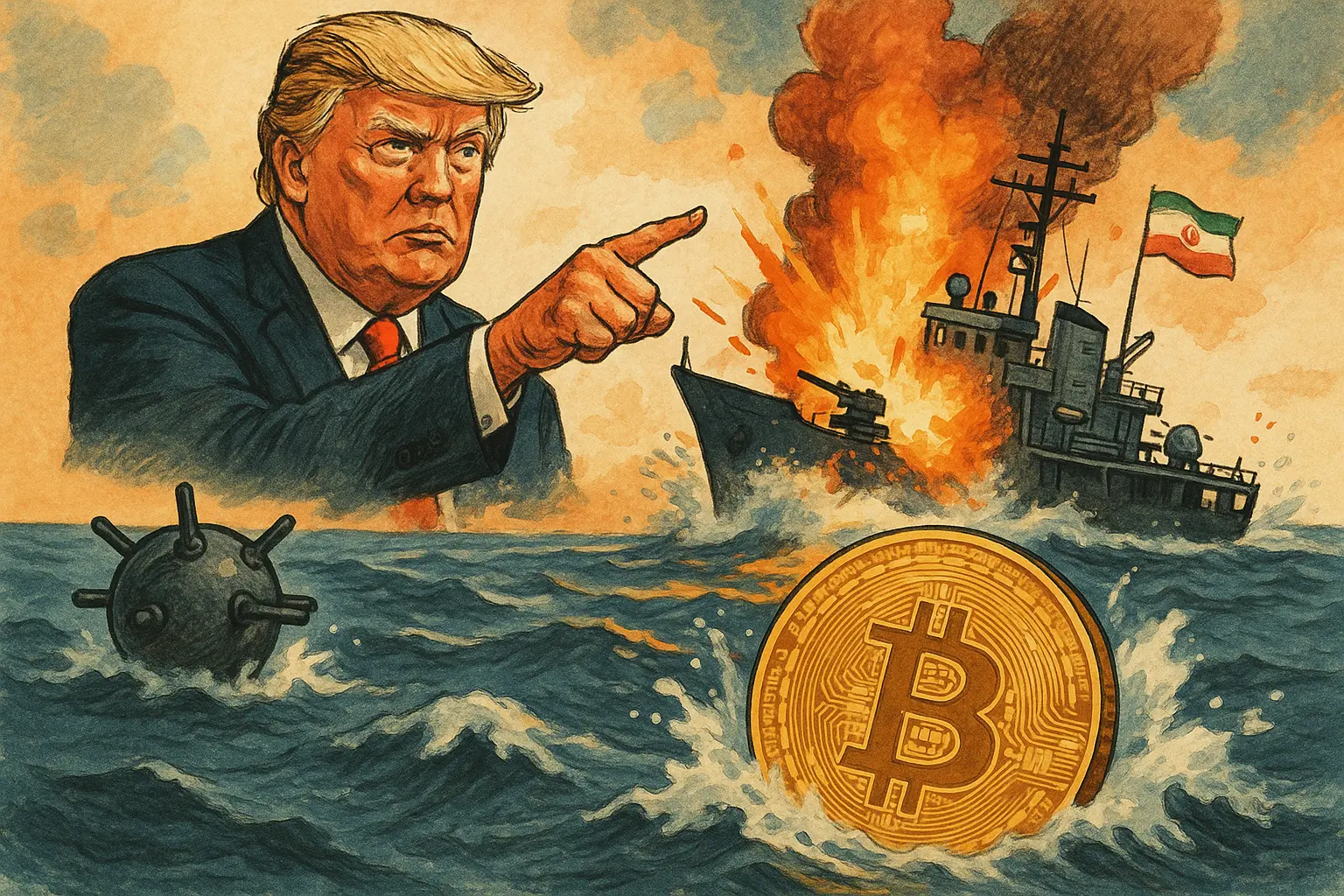
On April 24, U.S. President Donald Trump announced in a post on Truth Social that the ceasefire agreement between Israel and Lebanon will be extended by three weeks. On the same day, he also ordered the U.S. Navy to “sink any ships that are laying mines in the Strait of Hormuz,” and instructed the military to carry out mine-clearing operations with “three times the force.” Brent crude spot prices have returned above $100, while Bitcoin is trading under pressure and consolidating around $78,000.
Key Middle East Situation Statement Record
According to a post published by Trump on Truth Social on April 24, the representatives of the three parties in the U.S.-Israel-Lebanon discussions held a high-level meeting at the White House that “went very smoothly.” The ceasefire agreement will be extended by three weeks. Trump said he is looking forward to hosting Israeli Prime Minister Benjamin Netanyahu and Lebanese President Joseph Aoun.
According to an official Israeli statement, Israel’s Defense Minister Israel Katz said on April 23, after the conclusion of a situation assessment, that Israel is prepared to restart a war with Iran, “only waiting for the United States’ green light.”
Citing a report by Iran’s Mehr News Agency, Reuters said Tehran heard voices that air-defense systems are “intercepting hostile targets,” and the capital’s air-defense system was activated at one point. Separately, according to a report from Iran’s Fars News on April 23, news about Iran charging encrypted cryptocurrency for tolls through the Strait of Hormuz is “inaccurate.”
Reports about whether Iran’s parliamentary speaker Mohammad Baqer Ghalibaf might withdraw from the negotiating team had not been fully confirmed as of the time of publication.
According to a report from Fox News on April 23, Trump said he would not set a separate deadline for the negotiations. Both sides claim they are willing to negotiate, but there are disagreements about resolving the issue of the naval blockade.
Oil Market and Bitcoin Spot Status Data
According to market trading data, Brent crude spot prices have returned above $100 per barrel, and shipping in the Strait of Hormuz is close to stalling.
According to data from Farside Investors, last week U.S.-listed spot Bitcoin ETFs recorded net inflows of $996.5 million, and since then fund flows have continued to remain positive. As of the time of publication, Bitcoin was trading at about $77,900, with a 24-hour trading range of $77,456 to $79,468.
According to Glassnode data, among recent buyers, more than half have taken profits, with profit-reversal amounts exceeding $4.4 million per hour—higher than the $1.5 million level of the previous local market high. This makes it the second-largest short-term investor profit-taking scale since January of this year. Glassnode also noted that the average cost of short-term holders is about $80,100, which is a key resistance zone Bitcoin is currently facing.
CME FedWatch Interest Rate Expectation Data
According to CME FedWatch data, the market assigns a 99.5% probability to the Federal Open Market Committee (FOMC) keeping rates unchanged in April. The probabilities for keeping rates unchanged in June and July are 95.8% and 91.7%, respectively. The probability of no rate cuts before the end of the year is 74.8%.
According to congressional hearing records, Fed chair candidate Kevin Warsh emphasized in recent hearings the central bank’s independence, while Trump has continued to publicly call for rate cuts.
Institutional Assessment: Bitfinex Weekly Report and QCP Capital Market Judgment
According to a weekly report released by Bitfinex on April 22, mid-term market positions are relatively stable. As exchange fund flows decrease and large investors continue to add positions, structural demand continues to absorb supply; ETF fund flows have shifted to net positive. Bitfinex also said that in the near term, geopolitical risks and positioning in the derivatives market could exacerbate downside volatility.
According to QCP Capital’s public statement, the firm believes Bitcoin’s recent rebound is “more like a release of risk-hedging sentiment rather than being driven by market confidence.” Open interest has begun to rise again, but the funding rate remains negative, indicating that the market still favors short positions. QCP Capital said that as long as oil prices stay high and uncertainty in monetary policy persists, the upside room for risk assets may remain limited.
Frequently Asked Questions
What specific statements did Trump make about the tense situation in the Strait of Hormuz?
According to Trump’s public statement on April 24, he ordered the U.S. Navy to “sink any ships that are laying mines in the Strait of Hormuz,” and instructed the military to continue mine-clearing operations with “three times the force.” On the same day, Trump announced on Truth Social that the ceasefire agreement between Israel and Lebanon has been extended by three weeks.
How did fund flows into spot Bitcoin ETFs change over the past week?
According to Farside Investors data, last week U.S.-listed spot Bitcoin ETFs recorded net inflows of $996.5 million. Since then, fund flows have continued to stay positive, indicating a rebound in institutional demand.
What do CME FedWatch data show about market expectations for the FOMC’s rate decision in the near term?
According to CME FedWatch data, the market expects a 99.5% probability that the FOMC will keep rates unchanged in April. The probabilities for keeping rates unchanged in June and July are 95.8% and 91.7%, respectively. The probability of no rate cuts before the end of the year is 74.8%.
Disclaimer: The information on this page may come from third parties and does not represent the views or opinions of Gate. The content displayed on this page is for reference only and does not constitute any financial, investment, or legal advice. Gate does not guarantee the accuracy or completeness of the information and shall not be liable for any losses arising from the use of this information. Virtual asset investments carry high risks and are subject to significant price volatility. You may lose all of your invested principal. Please fully understand the relevant risks and make prudent decisions based on your own financial situation and risk tolerance. For details, please refer to
Disclaimer.
Related Articles
Glassnode: Whales on Hyperliquid Maintain Long Positions, Expect Bitcoin Breakout
Gate News message, April 24 — According to Glassnode data, large traders on Hyperliquid have maintained sustained long positions in Bitcoin, anticipating a breakout from the current trading range.
Over the past two months, these whales have steadily increased their confidence and long positions, re
GateNews4m ago
SHIB Holder Base Surges by 10,000 Wallets to 1.573M as Shibarium Hits 1B Transactions
Gate News message, April 24 — Shiba Inu's holder base expanded sharply between April 19 and April 22, 2026, with more than 10,000 new Ethereum wallets joining the network and pushing the total above 1.573 million. Etherscan data recorded the move as one of the fastest short-term expansions this
GateNews10m ago
Willy Woo: Bitcoin Price Action Mirrors Nasdaq, May Need Decade to Gain Recognition as Safe Haven
Gate News message, April 24 — Crypto analyst Willy Woo stated that while most Bitcoin holders view BTC as a safe-haven asset, the reality is more nuanced. Bitcoin does possess safe-haven characteristics—for instance, it enables cross-border asset transfers via seed phrases during wartime and
GateNews12m ago
Bitcoin Technical Signals Show Multi-Dimensional Convergence, $73K Becomes Key Reversal Confirmation Level
Gate News message, April 24 — According to BIT on Target's weekly report, Bitcoin's bear market phase may be nearing its end as multiple technical signals across different timeframes are forming a convergence pattern. The weekly stochastic oscillator has retreated to levels not seen since
GateNews1h ago
Bitcoin Short-Term Holders Discount Narrows to -5.7%, SOPR Signals Recovery
Gate News message, April 24 — Bitcoin short-term holders (STH) are showing signs of recovery as their discount narrowed from -21.6% to -5.7%, according to on-chain analyst Axel Adler Jr. The STH-SOPR (Spent Output Profit Ratio) 7-day moving average has climbed back above 1.0, indicating that short-t
GateNews2h ago
ARK Invest Report: Bitcoin confident buyers increased their holdings by 69%, and the bottom range hasn’t been tested yet
According to the Q1 2026 Bitcoin Quarterly Report released by ARK Invest on April 24, the holdings of Bitcoin “confidence buyers” increased from 2.13 million BTC to 3.60 million BTC, up 69% quarter-over-quarter. ARK Invest said that the key support range for the cyclical bottom as defined by the firm ($54,000 to $50,000) was not tested by the end of the first quarter.
MarketWhisper3h ago


